|
Government to act on A&E failures |
Related newsCharting Scotland’s future health and hospital demand We “cannot be complacent” on breast cancer rise How data insights will help deliver NHS reform Shocking levels of violence towards NHS staff AI to help take pressure off A&E Scotland’s frailty services to help address NHS waits Glasgow district nurses ready to strike Glasgow LEZ success sparks call for expansion Watchdog criticises homelessness health service cuts Community support ‘vital’ to asylum-seeking families 
|
|
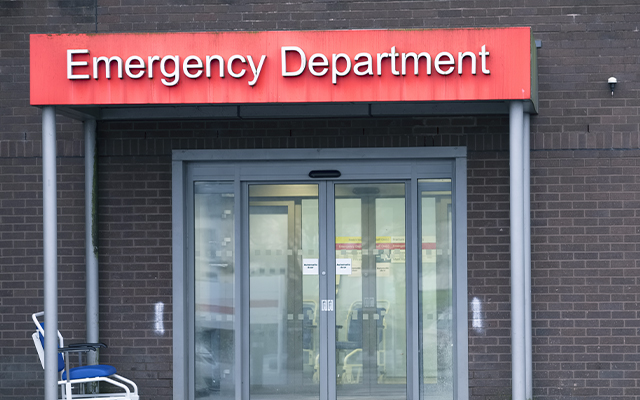
Image Credit: © Richard Johnson
|
||
|
||
|
The Scottish government has committed to address service gaps and improve national reporting in urgent care services, after a review found relationship breakdowns between senior staff in Glasgow had risked patient safety.
Healthcare Improvement Scotland launched a review of safety and quality of care at NHS Greater Glasgow and Clyde’s three A&E departments, following concerns raised by staff.
The watchdog found the board had failed to address their long-held concerns, and made a series of recommendations to managers and government, to tackle long waits, improve patient safety and care, and strengthen leadership.
NHS Greater Glasgow and Clyde leaders soon after apologised to emergency department staff for failing to act on their warnings, committing to take forward a ‘bold system-wide improvement programme’.
Now, the Scottish government has accepted nine of the 11 national recommendations and partially accepted the remaining two.
Health Secretary Neil Gray said the government will work collaboratively to deliver improvements:
‘I am acutely aware of the pressures faced by boards, and the specific, protracted challenges faced within emergency departments and, in working to implement the report’s recommendations, I will promote progress at pace.’
Leadership, staffing and patient safety
The Scottish government will now look to evaluate and improve how it appoints and onboards non-executive NHS board members, to support them to govern effectively.
The government ‘partially accepted’ the recommendation for it to work with NHS Education for Scotland (NES) to improve medical training and recruitment and help reduce service gaps.
The health watchdog said this would help NHS Scotland build more sustainable, effective medical workforce for the future.
While the minister acknowledged the government’s responsibility, he said NES will play a distinct role in the achieving these changes.
He said the government is undertaking a detailed review of doctor training through future medical workforce planning.
Gaps in the current approach to safety and quality of care in Scotland’s urgent and unscheduled pathways were also acknowledged, with the government committing to work with partners to deliver services ‘fit for the future’.
The government also partially accepted responsibility for enhancing transparency and safety reporting in NHS boards, with Mr Gray writing ‘we will consider a refresh/reminder of guidance’ to boards to provide and monitor routes for raising concerns.
He said decisions around this will be made by the end of June 2025 and healthandcare.scot have requested an update from the government.
The minister also committed to work with the Centre for Sustainable Delivery, to see if it needs to strengthen the way it supports boards to drive improvements and reduce unwarranted variation in service delivery.
He confirmed work is underway to review national guidance for health and care demand and capacity to support Scotland’s emergency departments – with the framework to be in place this winter.
The government recognised the need for clear staff guidance on whistleblowing and said all boards should improve awareness of how to raise issues.
Ministers will also work to better gather patient feedback and insights to inform policy decisions and shape services.
Meanwhile, the government will work with Public Health Scotland to make sure the right data is available to health boards to support improvements.
This comes after NHS Scotland’s chief executive told MSPs earlier this year that urgent care activity is not fully captured in NHS Scotland data and improved monitoring is needed.
Read more: NHS waits pushing more patients private; Shocking levels of violence towards NHS staff; Watchdog criticises homelessness health service cuts; Spotlight on NHS burnout and discrimination; NHS governance must be strengthened; Racism in NHS Scotland still rampant; Government to merge two national NHS boards
Sign up to our bulletin for key health & social care updates straight to your inbox. |