|
Government failing to meet GP promises, says watchdog |
Related newsDoctors say GP funding boost “just the start” Less than full-time – behind the NHS trend Doctors invited to shape medical workforce reforms Chief Medical Officer: ‘Critical connections’ priority Health and charity leaders join forces for NHS reform 
|
|

Image Credit: © Monkey Business
|
||
|
||
|
The Scottish government has failed to deliver for both the primary care workforce and patients looking to access GPs, a new report from the public sector watchdog has revealed.
Doctors’ organisations say the findings lay bare the government’s “systematic neglect” and underinvestment in general practice.
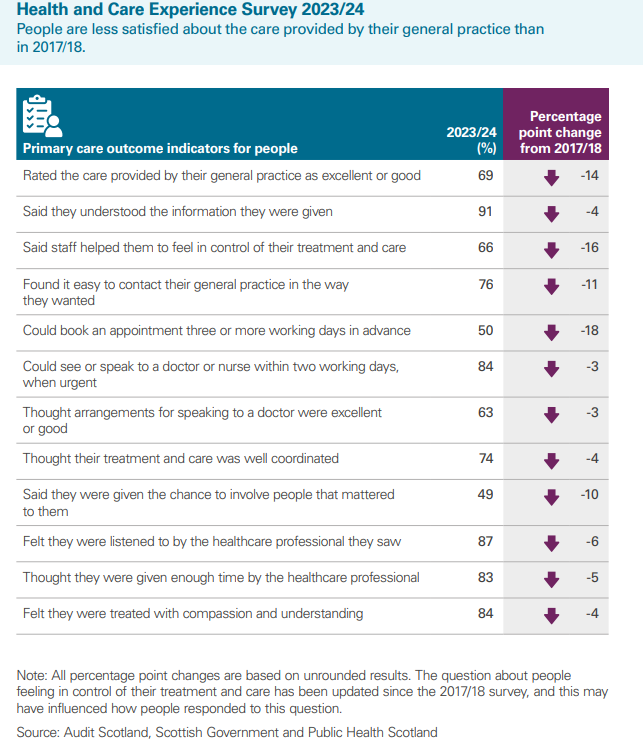
Audit Scotland says several commitments made in the 2018 General Medical Services (GMS) contract to address the financial and workload burdens facing GPs remain outstanding seven years on.
A commitment to increase the number of GPs by at least 800 by 2027 is unlikely to be met, according to the watchdog which has found the number of whole-time equivalent GPs has fallen since 2017.
Scotland’s Health and Social Care Secretary Neil Gray has today recommitted to the 800 additional GP target.
The expansion of primary care teams to support general practice, including more nurses, pharmacists, physiotherapists and other specialists, has also been slower than planned and ‘significant gaps’ remain, according to the report.
With both real-term spending on GPs and patient satisfaction declining, doctors are urging the Scottish government to deliver on its promises to increase GP numbers and boost primary care investment.
Dr Iain Morrison, chair of the British Medical Association (BMA)’s Scottish General Practitioners Committee, said:
“This report demonstrates in forensic detail exactly why so many practices across Scotland are struggling to meet demand and the enormous pressures so many GPs are having to work under which has left them angry and demoralised.
“The failure to invest in general practice and plan effectively to recruit GPs is taking its inevitable toll.
“After seven years, the 2018 GP contract has failed to create anywhere near the services and capacity promised to the profession by the Scottish government.”
He added that amid rising demand from a growing and ageing population, with more complex health conditions, the failure to expand the workforce has left GPs “simply unable” to provide the services patients need.
The report also highlights a lack of clarity around how much additional investment will be needed to deliver on the government’s commitment to expand multi-disciplinary teams.
Dr Morrison said Scotland “desperately” needs more GPs, and the government has failed to effectively plan for this, despite BMA Scotland’s earlier warnings about a lack of progress.
Another longstanding issue Audit Scotland highlights is the 'lack of robust information' collected on GP demand, workforce and quality of care, which has limited the government's ability to track progress in its commitment.
Over the next year the government must assess the state of general practice, publish its total spending on priority health services in primary care and plan for the future, according to Audit Scotland.
The health secretary welcomed the report, telling healthandcare.scot that many of its recommendations are underway:
“We are committed to working with the BMA to support general practice and to meet our commitment to deliver 800 additional GPs by 2027.
“The First Minster and I have been clear that we know too many people have had issues seeing their GP and we have set out a plan to improve access, with a greater proportion of new NHS funding going to primary and community care so GPs and services in the community have the resources to play a greater role in our health system.”
Mr Gray said an extra £73.2m has been invested in general practice and the 2025-26 budget will deliver over £2.2bn in primary care which will “make it easier” for people to see their GP.
However, the NHS renewal plans revealed by the First Minister fail to detail how the increased NHS spending will reach GPs.
While the government has committed to increase investment in primary care by 25% by the end of 2026, it has not set out how much of this increase will be for general practice.
In 2023/24, 6.5% of NHS Scotland spending was on general practice – a lower proportion than in 2022.
BMA Scotland’s Dr Morrison said increasing this to 15% could deliver an extra 1,800 GPs across Scotland, bringing “huge benefits across the NHS” by improving patient access to primary care.
He said more funding is needed to not only recruit more GPs but also retain the existing, overstretched workforce and urgently address the “shocking situation” facing general practice:
“A properly-resourced general practice can offer so much to the health and wellbeing of Scotland, but the dire predicament we are in means we need immediate action to safeguard the bedrock of the NHS.”
“Not a surprise” to GPs
Royal College of General Practice Scotland’s Dr Chris Provan said underinvestment and “systematic neglect” has led to a “state of perpetual crisis”.
After years of asking the government to take action to uplift primary care, he said both patients and staff have been let down by the government’s failure to fulfil its commitments:
“Regrettably, the stark findings of this report will not come as a surprise to any GP working in Scotland today.
“The report lays bare the increased pressure that GPs and their teams have worked tirelessly to absorb, often at the expense of their job satisfaction and personal wellbeing.
“With proper support, recognition and investment, general practice is the solution to preserving the NHS for future generations.”
Read more: Scheme for GPs to help lost patients extended; NHS will “struggle to see out” 2025, say doctors; Labour: We'll fix the NHS, starting with GPs; Current metrics fail to capture full NHS activity; Researchers: policy needed for patient ‘missingness’; Film series showcases power of link workers
|