|
“Get ready now” for advances in dementia care |
Related newsAction needed to deliver dementia ambitions Dementia rise estimate should be “wake up call” Edinburgh welcomes outdoor brain health centre Call for ‘new way’ to assess dementia drugs Action needed on women’s brain health Challenging assumptions around dementia Scientists to help cut NHS medical device waste Edinburgh IJB faces judicial review over cuts Scotland’s new Chief Nurse appointed Urgent plea to safeguard advocacy amid local cuts New gene study offers arthritis treatment insights New Edinburgh hub set to transform global healthcare 
|
|
|
||
|
||
|
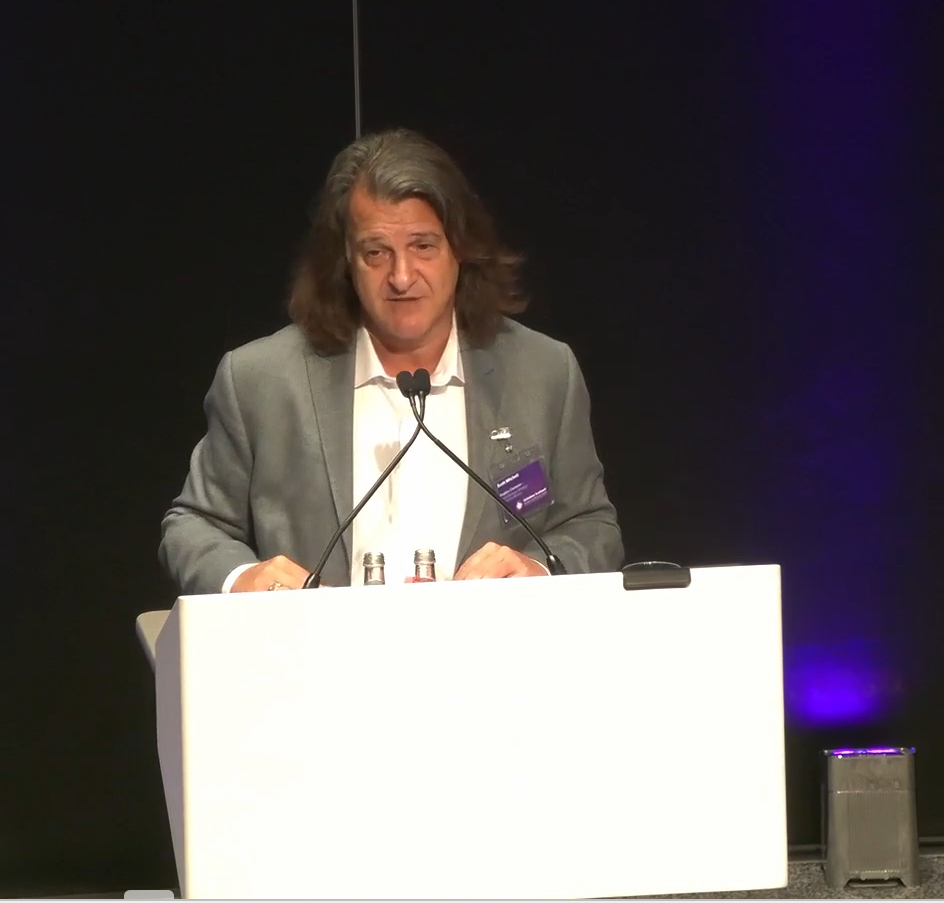
With years of lived experience as a carer and advocate for dementia, Scott Mitchell has this year been appointed the People’s Champion for the UK-wide Dame Barbara Windsor Dementia Mission which seeks to advance research and access to new treatments for people with dementia.
During the Alzheimer’s Scotland conference on dementia care and treatment, he spoke with healthandcare.scot about the importance of centring the people living with dementia and their loved ones in all work towards early diagnosis and access to care – emphasising the need to get health systems ready now to deliver better care and new treatments.
Scott Mitchell was married to the late Dame Barbara Windsor who was an advocate for dementia research and treatment after her own diagnosis, and explained he initially knew next to nothing about dementia, finding himself “learning on the job” as a carer.
The UK’s Dementia Mission was launched in honour of Barbara Windsor in 2022 with a commitment to double research funding for dementia to £160m a year by 2024/25.
This funding commitment is now at £120m a year and the Dementia Mission works across sectors with the NHS, industry, academia and global partners to speed up access new treatments.
Appointed as the People’s Champion for the Dementia Mission earlier this year, Mr Mitchell said he works to bring that personal perspective to the table:
“The Dementia Mission brings together industry, researchers, the NHS and charities all into one pot.”
Scott explained that he spoke with the chief executive of the Dementia Mission to share that the voices of carers and people with lived experience cannot be lost in this work – and so his position as People’s Champion was created.
In his role, Scott holds talks with groups of carers, organisations and individuals to hear where there are gaps.
He emphasises the importance of not duplicating what’s already being done, but instead hearing about specific problems facing people on the ground.
Scott says he has already spoken with different organisations and people with lived experience as patients or carers.
He told healthandcare.scot that in his role, he is always asking: “What about the people living with it, their families and how are they going to be heard?”
Research and reform
Mr Mitchell said work like the recently launched ‘rethink' dementia campaign to shift the narrative around dementia is a good start – but more is needed:
“A lot of people are saying that most support is directed at a white, middle class person that comes forward. We really need to reach different communities and let people know that you can talk about it.
“There has always been a real stigma around dementia – we do have a better awareness now, but we need to do more.
“Personally, I think the earlier we start, the better. We need to start having this conversation in schools so children can understand.”
He explained this must extend across different areas of life, including having staff in shops trained to recognise potential signs of dementia, but that it has be supported by the government.
Mr Mitchell said that the structure of diagnosis and treatment must be “desperately looked at” to better support people and their carers:
“I think policies and politics are above my remit but personally, I think we need continued investment in social care as well as our NHS and research.
“We talk about a social care problem – a lot of that is a dementia care problem.
Mr Mitchell said that structural change is needed to prepare for future dementia treatments as well as care.
With both the UK and Scottish government committed to conversations around NHS reform this year, Mr Mitchell this could be an opportunity for positive change:
“If we’re talking about the NHS, a major part of that reform must include dementia. As this research expands, we’re going to have the most incredible, hopeful future ahead of us.
“Future generations who won’t maybe have to go through many of the struggles and hardships that people have and are still going through now.
“So I appeal to all the governments across the UK – please, look at the NHS and get ready. Start planning now and preparing our systems.”
“So many feel alone”
Mr Mitchell told healthandcare.scot that he hopes that people living with dementia and their families do not feel like the “poor relatives” in the NHS and that support from diagnosis is improved:
“From that government level, more support is needed in the NHS so that people don’t feel alone. So many people and their loved ones getting a diagnosis feel alone. I felt very overwhelmed, my head went to the darkest place on the day Barbara was diagnosed”, Scott shared.
“We need to educate people more that there is still going to be life going forward – it’ll be challenging at times but it’s different for everyone and we need a better structure for support.”
He added that work to better support people affected by dementia needs to improve now – and has to be accessible to everyone, not just those with money:
“People work all their lives, they pay into the system – it shouldn’t be the case that this really large number now affected by dementia are just left to ‘get on with it.’ It has such a knock-on effect – people are selling their parents homes to pay for their care.
“I don’t want to live in a country where only a privileged few can spare their relatives from the effects of dementia.”
Read more: Action needed on women's brain health; Dementia care services need urgent reform; Physical inactivity increasing threat to adult health; Broken hearts can be as deadly as heart attacks; Voices of experience key to dementia care; Music's potential to help with dementia
|