|
Challenging assumptions around dementia |
Related newsExercise key to combatting frailty epidemic Call for ‘new way’ to assess dementia drugs Scotland commits to change the dementia story Dementia: a treatable condition of midlife Confident conversations on dementia research 
|
|
|
||
|
||
|
A new book written about dementia by those affected by it is seeking to challenge preconceived ideas that dementia is for old people, that it’s all about memory and that a dementia diagnosis represents the end of someone’s active life.
Twelve people affected by different forms of dementia and members of the Patient and Public Involvement Group of NHS Scotland’s Neuroprogressive and Dementia Network spent a year as co-authors sharing their insights.
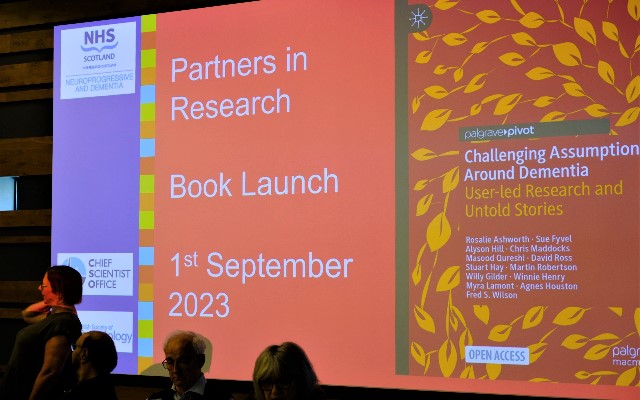
Last week healthandcare.scot went to the launch of their book, Challenges the Assumptions Around Dementia, at a meeting in Dundee.
The co-authors are six people living with dementia and six who support or have supported someone with the condition.
Their work was brought together by research psychologist Dr Rosalie Ashworth who leads the Partners in Research initiative, focusing on getting those with lived experience to become more involved in informing research – and moving the focus of research from the illness to the people affected by it:
“A huge part of what the co-authors are saying that that your life will be different - but that doesn't mean it's over. They want to encourage people to find what is meaningful to them and to create a new life with the diagnosis of dementia.
“The plan had been to focus on the different types of dementia and the different experiences people had. But when we all came together, that became just one chapter and so many other things needed to be included.”
The co-authors
Co-author Chris Maddocks told the meeting about some of the misconceptions – that dementia is contagious or that you are automatically at an end stage. He said people should “see the person beyond the dementia”:
“Don’t just listen to us – hear us.”
Agnes Houston said she hopes that every NHS professional will read the book. Her dementia affects her senses and, even after her diagnosis, professionals were telling her she couldn’t possibly have dementia, forcing her to go through the process to have her diagnosis confirmed a second time:
“I’ve never looked back. I decided – what do they know? It’s my diagnosis. It’s my life. I will live it the way I want to.”
Alyson Hill is the daughter of parents who were both diagnosed with dementia which affected them each differently. After her mother moved in with her during the pandemic, she began writing a journal which is included in the book. She said one of her greatest frustrations was when people tried to decide what her mother’s actions or mood meant without knowing her:
“People would make comments about her behaviour. What about her behaviour? She's behaving like an 83 year old with dementia.
“We have to tilt our axis, not expect her to conform to what we expect. And the value that we place on our elderly needs to be a bit more obvious.”
Looking for answers
David Ross cared for his late wife and says much of the time since she died has been spent looking for answers about what might have led to her illness, whether there were signs many years earlier – and why it was so difficult to be taken seriously:
“For someone with little or no knowledge of dementia, it is a dark and uncharted experience, when your suspicions are waved aside by the GP after two years of trying. It's a bit dispiriting when you ask the psychiatrist what caused this to happen, and they don't know and say everyone is different. And to me, that just wasn't an answer.”
Masoud Qureshi, or Maq, had what he calls “an accidental diagnosis” of dementia after a routine brain scan following heart surgery – though he felt well and wondered for some time if there had been a mistake.
He spends time trying to raise awareness and understanding of dementia in South Asian communities where, in none of the 14 languages and dialects he speaks, is there a word for dementia. He also believes too often society adopts a single view of people with dementia:
“People say that if you've met one person with dementia, you have met all people with dementia. We are all unique. We don't look like we've got dementia, and we don't dress like we've got dementia.
“I wish that [professionals] would actually practice that. Because they treat everybody the same. It’s the same test that they do for everybody.”
Memory isn’t the only thing
Another co-author is Martin Robertson, a charity trustee, advocate and patient advisor for NHS guidelines. His dementia means he has what he calls a sort of ‘brain blindness’ where he struggles to process large amounts of external stimuli and information.
Like other co-authors, he questions the focus always being on memory loss as a symptom of dementia:
“My cognitive function and memory are probably what you'd call early stage. Everything else is middle and probably even late middle.
“My main purpose in life is to show people with dementia don't have to curl up in a ball, they can get out into the wider community.”
Myra Lamont was a carer for her late husband who had Semantic dementia. She has campaigned for better information and services for people affected by dementia – and increasingly has focused on support for carers. She says that when she was training as to be midwife, she was told to always listen to her patients:
“Because we really know what we need, and how we need to be treated, and what's best for us.”
Winnie Henry was a carer for her late husband Wullie who had vascular dementia:
“When he was first diagnosed, he was quite keen to tell everyone that he had dementia. It wasn’t a big secret, He’d say ‘I have an illness. I am not stupid. I'm still me.’
“What I would like to see happening from the book is that people listen to folk with lived experience. We are the ones who have been through it. We are the experts here… You haven't been in my shoes.”
Dr Rosalie Ashworth says it’s important that the voices of experience continue to inform research into dementia:
“I feel so humbled and privileged that this incredible group of people have trusted me with their story and have been willing to be really vulnerable and really open to sharing really, really difficult parts of their life in order to make sure that other people have a better experience.”
The book Challenging Assumptions Around Dementia: User-Led Research and Untold Stories is available online free of charge following a grant from the Chief Scientist Office
Read more: Partnership seeks early Alzheimer’s blood test; Chief Scientist calls for more research volunteers; Opinion: Dementia strategy sows seeds of change
Sign up to our bulletin for key health & social care updates straight to your inbox and you can follow healthandcare.scot on Google News. |