|
Addiction and recovery employment scheme grows |
Related newsChief Medical Officer: ‘Critical connections’ priority Health and charity leaders join forces for NHS reform First Minster pledges people will see GP sooner Highland to end unique health and care model Health and care in the Scottish budget Scheme for GPs to help lost patients extended Medical trainee abuse reports ‘shut down and silenced’ Politicians must take ‘bold’ action on child poverty Glasgow district nurses ready to strike NHS and Glasgow rethink routes into healthcare ‘Major’ update to One Health AMR register Glasgow LEZ success sparks call for expansion 
|
|
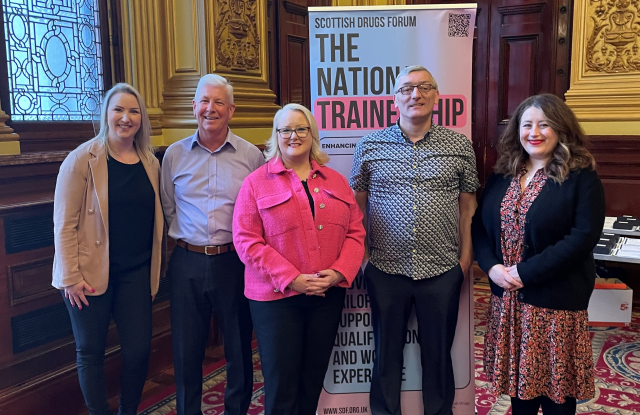
Image Credit: © Scottish Drugs Forum (SDF)
Kirsten Horsburgh, SDF CEO (Left), Christine McKelvie MSP (Centre), with other stakeholders.
|
||
|
||
|
The Scottish Drugs Forum (SDF) last week celebrated the new cohort of 30 graduates from its National Traineeship programme, marking two decades of supporting and training people with experience of drug and alcohol problems to work in social care.
The trainees undertook field placements in local partner agencies across Scotland over the course of a nine-month salaried traineeship.
The SDF says, for the first time this year, funding from Scottish government has allowed it to increase the scale and scope of the programme, providing more spaces to people experiencing employment barriers across Scotland.
This SDF programme provides a ‘resource of skilled and motivated workers’ for the social care sector, with 2024 seeing the initiative delivered in 11 local authorities across Scotland.
Recruited from and working in local communities, all trainees have experience and insight into the particular barriers and challenges faced in their community.
Scottish Drugs Forum CEO Kirsten Horsburgh said she was delighted to witness what this means to the graduates and their families, adding:
“We are proud of this project which emerged from identifying the support required for people with lived experience to find work, the staff shortages within services and most importantly the potential for people with lived experience to contribute to changing services for the better.
“For twenty years, this programme has provided qualified, informed and skilled staff to services working with marginalised people. They are now colleagues working in and managing services across Scotland.
“This inspires the whole staff team, partner organisations and funders to maintain what is now a national programme.”
Formerly known as the Addiction Worker Training Programme, the National Traineeship was initially established in Glasgow in 2004, in response to the barriers to employment faced by people with experience of drug and alcohol problems.
Alongside this, the programme recognises the difficulties in recruiting and retaining staff within treatment agencies in Scotland.
The 20-year milestone was marked by an award ceremony held in Glasgow City Chambers last week, with certificates and awards presented by Scotland’s Minister for Drug and Alcohol Policy.
Trainees bring a ‘collective drive, enthusiasm and unique perspective’ to the placements they serve, says SDF – adding that their own life experiences help foster trust and rapport with the people accessing services.
Trainees are employed by SDF and complete an intensive nine-month programme of specialist training and vocational learning, and are supported to achieve an SVQ Level 2 award in Social Services and Healthcare.
In addition to achieving qualifications, developing skills and confidence, SDF trainees receive a salary and a package of personalised support to move into long-term, meaningful employment at the end of the programme.
Since its first cohort, 399 addiction worker trainee programme places have been created, with 85% of graduates securing a job – the majority within the social care sector.
This year’s trainees were recruited from Argyll & Bute, Borders, East Ayrshire, Edinburgh, Fife, Glasgow, Highland, Inverclyde, North Lanarkshire, Renfrewshire and South Lanarkshire.
Most graduates have already moved into employment because of the project, with peers continuing to ‘develop and forge their career paths’ in social care, says SDF.
Drug and Alcohol Policy Minister, Christina McKelvie MSP, said the government will continue to fund additional places for the next two years:
“As it celebrates its 20th anniversary, I’m delighted to see that Scottish government investment and support has allowed SDF to widen access to its supported employment programme so even more people can benefit.
“It’s a great example of how our £250m National Mission on Drugs is delivering change and making a real difference at on the ground.
“Making sure those with lived and living experience is at the heart of our National Mission – that’s why we’ve provided an extra £480,000 a year until 2026 to support up to 20 additional trainees annually.”
Applications for the 2025-26 programme will open in autumn 2024.
Read more: Decriminalisation call to support drug deaths mission; Employment rights extended to unpaid carers; Analysis: drugs and alcohol in Scottish health survey; Safe consumption rooms key for drug harms; Experts: Drugs deaths need emergency response now; The health benefits of being able to work
Sign up to our bulletin for key health & social care updates straight to your inbox and you can follow healthandcare.scot on Google News. |
