|
Analysis: drugs and alcohol in Scottish health survey |
Related newsPlea to hear the voices of drug death families RADAR system to spot drug death risks Charting Scotland’s future health and hospital demand How data insights will help deliver NHS reform Charter update for health data researchers Analysis: Why people are left behind NHS staff say data vital to improving care Insight: The health benefits of being able to work Pre-eclampsia test approved for NHS Scotland Phage therapy approved for resistant infections Auditor General: Difficult choices for Scotland’s NHS 
|
|
Image Credit: © Contains public sector information licensed under the Open Government Licence v3.0
Scottish Health Survey 2021.
|
||
|
||
|
This week the Scottish government’s Chief Statistician published the Scottish Health Survey for 2021, reporting on the health and wellbeing of Scotland’s adults and children. The report makes a series of findings around drug and alcohol harm – by age, gender and the communities people live in.
Victoria Wilson, research director Scottish Centre for Social Research (ScotCen) has said the annual survey makes a “major contribution” to understanding and monitoring the health of people in Scotland.
Speaking in parliament today, Maree Todd, Minister for Public Health, Women's Health and Sport, said:
“Excess alcohol consumption is an important public health challenge in Scotland, it contributes to an increasing risk of developing a number of risks including cancer, heart disease and stroke.
“In 2020-21, there were 35,124 alcohol-related hospital admissions in Scotland – this has decreased from previous years, although the covid-19 lockdown measures are likely to have contributed.”
Surveying 4,557 adults in Scotland in 2021, the report found that three percent of adults reported ever having a drug problem and nine percent reported ever having a problem with alcohol.
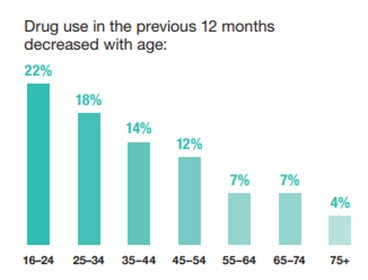
While an average 12% reported using drugs in the past 12 months, a decreasing trend was observed with age – with the highest level of drug use in the past year reported for 16-24 year olds.
This overall pattern of decreasing drug use as people get older was evident for both class A and class B drugs, while class C drug use remained low for all age groups.
The survey also found that men were more likely than women to report having experienced problems with drugs and alcohol in 2021, with 4% of men responding that they had a problem with drugs in 2021 compared to 2% of women.
For alcohol consumption in 2021, 10% of Scottish men responding self-reported having had a problem with alcohol compared to 8% of women.
Similarly, harmful or hazardous weekly alcohol consumption was almost twice as high for men at 31% in 2021 compared to the 16% of women responding.
Unlike drug consumption, the highest rates of harmful alcohol consumption were reported from the wealthiest areas. Moreover, the highest proportion of Scotland’s non-drinkers in 2021 were living in the most deprived areas, representing twice as many non-drinkers as those living in the least deprived areas.
In response to the survey, Alison Douglas, chief executive of Alcohol Focus Scotland, said:
“It is encouraging to see a small decrease in the overall number of people who report drinking at harmful and hazardous levels in Scotland, but still nearly a quarter of us are putting our health at risk from alcohol. For men aged 35 to 75, this rises to nearly a third.
“Concerningly, we have seen a substantial rise in deaths from alcohol over the last two years so reducing how much we drink must remain a priority. The Scottish government has rightly recognised alcohol harm as a public health emergency alongside drugs, but we have not yet seen an emergency response on the same scale; they must act now.”
At the start of 2021, Scottish government launched its new national mission to reduce drug deaths and harm, supported by an additional £250m budget on top of the existing drugs policy funding. Earlier this year, Drugs Policy Minister Angela Constance appointed a chair to the oversight group tasked with improving and scrutinising policy and practice on the mission.
Since 2003, the units of alcohol consumed by men in Scotland have been around twice that by women.
Ms Douglas added that one of the tools to help reduce consumption, minimum unit pricing must be monitored by the government to avoid alcohol becoming more affordable. Alongside this, she calls for more investment in support and treatment services and implementing restrictions to “aggressive marketing” of alcohol.
With a 5% increase from 2020 was reported as 1,245 people died from alcohol-specific deaths in 2021, the highest number since 2008.
Despite the Scottish Health Survey reporting that 9% more respondents from the wealthiest areas reported hazardous and harmful alcohol consumption in 2021, National Records Scotland (NRS) found that deaths attributed to alcohol were 5.6 times more likely in the most deprived areas. Additionally, two thirds of those who died from alcohol-specific causes in 2021 were male.
Although a rise in alcohol-related deaths was recorded, 2021 appeared to have the lowest level of alcohol sales in more than two decades. At 9.4 litres of pure alcohol sold per adult in Scotland, this record low sales still represents 18.1 units per adult per week, which stands around 30% higher than national guidelines.
Scottish Families Affected by Alcohol & Drugs (SFAD) has called for alcohol support to match that dedicated to Scotland’s drug crisis.
Following the announcement that 1,330 drug-related deaths occurred in Scotland during 2021, Julie Ramsay, Vital Events Statistician at NRS explained that despite the minor decrease of 1%, health inequalities widened:
“In 2021, after adjusting for age, people in the most deprived areas were more than 15 times as likely to have a drug-related death as those in the least deprived areas. This ratio has widened over the past two decades.”
In 2021, the survey also found adult respondents – both men and women – who reported using drugs in the last 12 months, had “significantly lower mental wellbeing” than those who had not used drugs.
In general, the survey found that mental wellbeing has declined since before the pandemic, with clear health inequalities in areas of mental health such as anxiety, depression and self-harm.
For class A and B drugs, drug use was most common in the most deprived areas, with the 19% of respondents using ‘Any Drug’ in 2021 from the most deprived areas compared to just 9% in the least deprived areas.
As this was the first time the survey included questions on drug use, comparison cannot be made with previous years for Scottish adults.
However, a year into the ‘national mission on drugs’, drug-related deaths remain high.
SFAD have also called for a zero drugs deaths target to be included in government action plans going forward.
Read more: Oversight group for government drug action; RADAR system to spot drug death risks; Charity calls for zero drug deaths target; Drugs oversight group chair appointed
Sign up to our bulletin for key health & social care updates straight to your inbox and you can follow healthandcare.scot on Google News. |