|
Health board in ‘tattooless’ radiotherapy first |
Related newsAncestry clues to lottery of who gets cancer Discarded bowel tests offer ‘unparalleled’ insights Conference to build on cancer research partnerships Link to research for breast cancer patients Matching breast cancer patients to newest trials Dundee celebrates part in ‘phenomenal’ cancer study Boards hail Golden Jubilee waiting time support Shocking levels of violence towards NHS staff Agency staff paid as high as 400% to fill NHS gaps Highland GPs to reclaim vaccine services Highland to end unique health and care model Tourist lets make rural NHS recruitment harder 
|
|
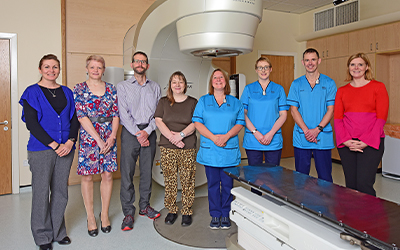
Mo Beange (fourth left) & the rest of the
clinical oncology team behind the innovation |
||
|
||
|
People being treated for breast cancer in the Highlands are to be among the first in Scotland to benefit from new techology that removes the need for patients to be tattooed with small target dots ahead of treatment.
NHS Highland will be the first NHS centre to take forward ‘tattooless’ radiotherapy for breast cancer patients.
Before radiotherapy treatment can begin, breast cancer patients have a CT scan that allows treatment to be planned and are then tattooed with small dots to allow accurate positioning.
But for some patients the marking can be a lasting and unwanted reminder of treatment.
Now a new optical monitoring system (AlignRT) provides a different method of positioning the patient that does not rely on tattooing.
“We have wanted to do this for a while and now that we have our two AlignRT systems, which track a patient’s position before and during radiation therapy, we are now able to offer tattooless radiotherapy to suitable patients,” explains therapeutic radiography head Mo Beange.
“Patients will be scanned as usual but we will use a surface guided radiotherapy system to ensure patients are positioned accurately.”
Surface guided radiation therapy avoids the need for skin marks while maintaining accuracy in positioning patients.
Ms Beange added: “We know from our own patient feedback that the tattoos have been an issue in the past so this new method will be good for our patients’ psychological wellbeing.
“The whole clinical oncology team has really embraced this new way of working. It’s taken a lot of planning and we are still taking it slowly in the first instance by introducing one patient a week but it’s a very exciting development for the unit and one that we hope to roll out to other oncology patients in the future.” Tags: Cancer; Research & Innovation. |
