|
Discarded bowel tests offer ‘unparalleled’ insights |
Related newsScotland must prioritise new bladder cancer test Ancestry clues to lottery of who gets cancer Conference to build on cancer research partnerships Matching breast cancer patients to newest trials Treatment-resistant cancer focus of new study Scots patient first to join leukaemia study 
|
|
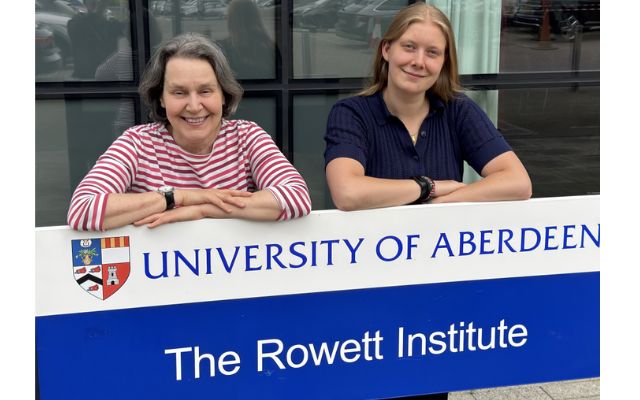
Image: © University of Aberdeen
Professor Anne Kiltie (left) and PhD candidate Merel van den Haak
|
||
|
||
|
Researchers at the University of Aberdeen’s Rowett Institute say the discarded remains of half a million poo samples collected annually as part of Scotland’s bowel cancer screening programme should be used to open new lines of research. The team behind the study say the faecal material has “unparalleled statistical power” to assess links between the gut microorganisms and some of the most prevalent causes of poor health, including cardiovascular disease, chronic inflammatory disease and diabetes.
Only a small amount of the poo collected as part of Scotland’s bowel screening programme of people aged over 50 is needed to test for traces of blood, and the rest is discarded.
The researchers found each sample remains useful for at least a fortnight making it possible for the discarded part to be used for research.
In a paper published in the Microbial Genomics journal, the Rowett team says the samples offer ‘vital insights into the gut microbiota during cancer development and treatment response’.
In the longer term, they say, studying the samples, including DNA testing, could deepen understanding of how interventions aimed at altering the gut microbiota – the mix of microorganisms that includes bacteria, fungi and viruses – might improve clinical outcomes in a number of diseases.
The team states in the paper: ‘an ability to reliably measure gut microbiota composition in surplus qFIT [quantitative faecal immunochemical test] samples…could lead to large-scale, low-cost, population-based studies.
‘Given the challenges of collecting, storing, processing and comprehensively assessing the gut microbiota using larger volume/whole stool samples…the utility of such an acceptable, easy to use, reliable and reproducible method of sampling which already has widespread clinical use cannot be understated.’
2 milligrams
Friends of ANCHOR Clinical Chair in Oncology at the Rowett Institute, Professor Anne Kiltie says there is huge potential from a small amount of faecal material:
“We are thrilled that the tiny amounts of poo, 2 mg, in the qFIT cassettes can give us so much reliable information about the bacteria in the gut.
“We now want to conduct much larger studies in common diseases with big impacts on people’s lives. We need to engage with patient and public partners and relevant agencies to design the studies and then obtain substantial grant funding to undertake this work.”
The study, which was funded by NHS Grampian Charity, brought together the Rowett with the NHS Grampian Biorepository, the Universities of Glasgow and Edinburgh and Biomathematics & Statistics Scotland.
Professor Chris Halsey, Head of the School of Cancer Sciences at the University of Glasgow added:
“This innovative research means that we can maximise the value of bowel screening tests to not only detect cancer but also understand better the link between gut bacteria and a wide range of health challenges facing the Scottish population.”
NHS Grampian Charity Lead, Lisa Duthie says the findings are encouraging for people living with chronic health conditions:
"Innovative thinking, like expanding the use of bowel cancer screening samples, is essential to develop new diagnostic tools and treatment options for patients in the future, and we are grateful to our generous supporters who help us fund exciting new research like this."
The qFIT test is used in Ireland and Wales and some areas of England.
The study is thought to be the first detailed examination of the potential of using samples from the tests.
You can watch a video by Merel van den Haak explaining the study.
Read more: Aberdeen ‘lifeline’ for young people with IBD; Charity: follow up more positive bowel cancer tests; A third of positive bowel tests not followed up
Sign up to receive our bulletin for key health & social care updates straight to your inbox. Tags: Cancer; Life Sciences; Research & Innovation. |