|
Scots to benefit from new NHS heart treatment |
Related newsScottish health research collaboration extended Eye provides a window to kidney health AI for lung cancer care to help tackle “hidden killer” Collaboration on NHS procurement key to healthy future Government boosts health innovation funding First phase of obesity meds to prioritise highest BMIs "Landmark" newborn test rollout begins in Glasgow Queen Elizabeth and the Golden Jubilee NHS Scotland forms landmark partnership Scotland reaches heart valve treatment milestone Piecemeal approach to serious NHS errors handling NHS problems ‘still need fixed’ despite pandemic focus 
|
|
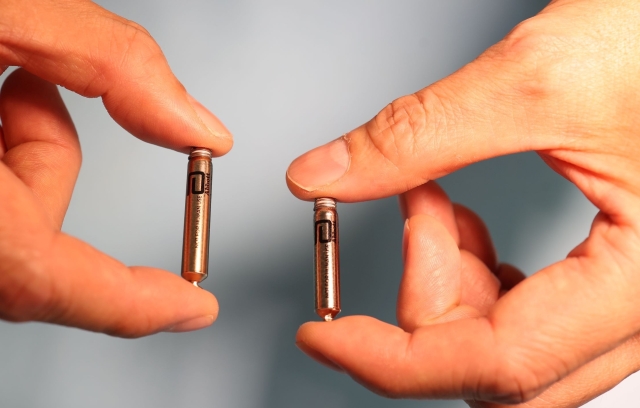
Image Credit: © NHS Golden Jubilee & Abbott Aveir™
|
||
|
||
|
Patients at the NHS Golden Jubilee are being fitted with a ‘pioneering’ heart pacemaker that lasts longer and is ten times smaller than traditional implants, which cardiologists say will reduce the risk of complications for more heart patients across Scotland.
Traditional pacemakers are comprised of a ‘generator’ typically inserted under the collarbone with connecting leads that are fed down through a patient’s veins and implanted into the heart wall.
Conventional pacemakers are inserted during surgery, which is usually done under local anaesthetic and involves cutting a pocket under the skin to insert the generator.
The ‘AVEIR VR’ leadless pacemaker system involves a small device that is placed within the heart chamber through a catheter passed through a vein in the groin.
Cardiologists at the Golden Jubilee University Hospital in Clydebank have already begun implanting a new innovative pacemaker into the hearts of patients who suffer from a slower than normal heart rate.
Consultant Cardiologist, Dr Gareth Padfield, said the innovative new system brings a range of benefits to patients:
“The leadless pacemaker is a much smaller device and is implanted directly within the heart’s right ventricle, so there wouldn't be a scar or generator under the clavicle.
“One of the main advantages of a leadless pacemaker is that no leads that are liable to get infected or broken.
“With conventional pacemakers, infections are most frequently where the generator is situated, under the clavicle, and leads under the clavicle can also become crushed and fractured. Damaged or infected leads may need to be extracted which can be dangerous, or additional leads need to be inserted into the heart.
“Another main advantage is its battery longevity. The traditional pacemaker battery would last around 10 years. However, the single chamber leadless pacemaker has a projected battery longevity of around 18 years, with some having projected longevity in excess of 25 years.”
Dr Padfield added that the new leadless pacemaker could also be paired with another leadless device implanted in the atrium to accommodate for any emerging needs, marking a “significant development” in cardiology.
One of the first Scottish patients to benefit from the new leadless pacemaker, 42-year-old Alistair McGowan has experienced heart rhythm issues and a heart blockage for years.
He had his first pacemaker implanted when he was 24, followed by a second pacemaker three years ago to help his heart maintain a consistent rhythm.
However, after this second pacemaker became infected and had to be removed, specialists at NHS Golden Jubilee decided to implement the new leadless pacemaker.
Mr McGowan said this felt “night and day compared to previous pacemakers I’ve had”:
“The procedure itself was plain sailing and the fact that you don't have a box protruding or have leads reduces the risk of infection or fear that the box might catch on something.
“Post-implantation I have felt absolutely fine with no fainting or dizzy episodes that I experienced in the past, it's like I've returned to normal.
“I like to go to the gym and exercise and keep fit, but I spent the last year in hospital and was then housebound as I couldn't drive. My plans now are to get a bit more active, to be running again and playing golf.
“This is another benefit of the leadless pacemaker as there are no restrictions in movement, and you can move freely.”
Patients with traditional pacemakers are advised to avoid strenuous activity and limit arm motions after surgery for four to six weeks and avoid contact sports thereafter.
In contrast, patients with leadless pacemakers are advised that they can return to strenuous activity after just a few days.
NHS Golden Jubilee’s Medical Director, Mark MacGregor, added:
“At the heart of everything we do is the patient, and this new leadless pacemaker is a fantastic example of how innovation can make a real difference to people’s lives.
“As a regional and national heart and lung centre, NHS Golden Jubilee is proud to be leading the way in adopting technologies that improve outcomes and support people to return to full and active lives.
“It’s about helping people get back to doing the things they love – whether that’s returning to work, exercising, or simply enjoying time with family – with confidence and peace of mind.”
Read more: New ‘clue’ to treating arthritis and severe COVID; Growing patient safety and career concerns for doctors; Scots from poorer areas less likely to survive stroke; Doctors invited to shape medical workforce reforms; Call for government to prioritise heart health; Chief Medic: ‘Critical connections’ priority; Action needed to deliver dementia ambitions |