|
Queen Elizabeth and the Golden Jubilee |
Related newsDoctors: ‘Shocking’ A&E figures require action Less than full-time – behind the NHS trend Government to merge two national NHS boards Longest NHS waits a funding priority, says government ‘Systemic change’ needed for inclusive communication NHS doctors unemployment crisis despite understaffing "Landmark" newborn test rollout begins in Glasgow Scots to benefit from new NHS heart treatment NHS Scotland forms landmark partnership Scotland reaches heart valve treatment milestone Piecemeal approach to serious NHS errors handling NHS problems ‘still need fixed’ despite pandemic focus 
|
|
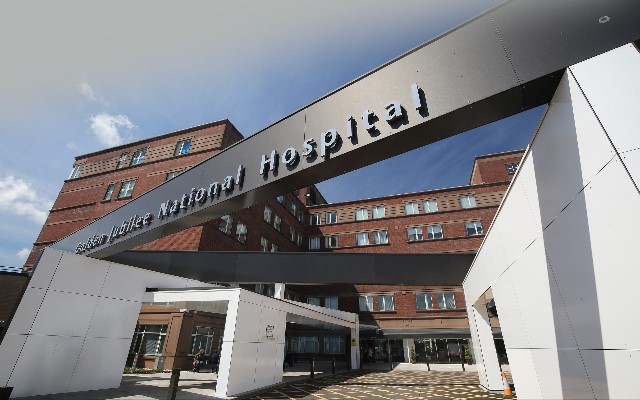
Image: © NHS Golden Jubilee
|
||
|
||
|
The royal family has always had close connections with hospitals and healthcare in Scotland. In the second of two articles exploring legacies of royal golden jubilees, Chris Holme looks at the NHS Golden Jubilee, the Clydebank hospital built on the site of heavy industry that was never meant to be part of the NHS.
The late Queen Elizabeth left a bricks and mortar legacy which plays a pivotal role in NHS Scotland.
The Golden Jubilee hospital in Clydebank is unique in the history of the National Health Service: a huge state-of-the-art private hospital taken over and run by the NHS.
But its verdant and peaceful setting overlooking the Clyde belies a turbulent and chequered past.
William Beardmore bought the site at Dalmuir and by 1914 had established it as the most advanced shipbuilding yard in the world, employing more than 13,000 workers.
Beardmore also owned Parkhead Forge where a young metallurgist, Ian Macgregor, started his career as a manager, earning plaudits from his bosses for driving cranes during a strike.
The Beardmore empire collapsed with the Great Depression of the 1930s. The government took over Dalmuir and it was one of the targets for the Luftwaffe raids which virtually annihilated Clydebank in March 1941.
Forty years later it became the focus of a bitter conflict over Prime Minister Margaret Thatcher’s privatisation of state industries.
She brought Ian Macgregor, then knighted after a successful career in the USA, to act as her battering ram to break trade unions, firstly in British Steel and then the National Coal Board.
Her policies also created bitter divides in the NHS. Compulsory competitive tendering meant cleaning and other services were taken over by private companies. The internal market split commissioning and provision of clinical services largely through NHS trusts. This was an alien concept in Scotland’s NHS and did not last – trusts were abolished by the Scottish parliament in 2004.
It was against this febrile background, that a plan was hatched for a huge private hospital in Clydebank to serve people who would travel to Scotland for treatment.
It was the brainchild of two amiable but maybe naïve Boston doctors, Raphael Levy and Angelo Eraklis, who won backing from investors to set up Health Care International (HCI).
Scottish ministers and the Scottish Development Agency were desperate to attract overseas investment in the derelict site. It would create much-needed jobs in a deprived area. Thus, it became Scotland’s largest inward investment project.
What irritated many was that it was subsidised by £30 million of taxpayers’ money.
As the private hospital building, designed by Massachusetts architects, took shape, more public money was poured in to remove an asbestos dump on the site.
After many protests, the HCI hospital finally opened its doors in 1994. But within a year it had gone bankrupt – the global demand for medical tourism never materialised.
It was taken over by an Abu Dhabi investment group who announced plans to double the number of beds to five hundred. Some contracts came in, including a few from the NHS, but it went bust for a second time in 2002.
At this stage civil servants, not previously known for sharp-eyed deal making, negotiated a buyout by the NHS for £37.5 million
Specifications for the hospital were the best in the world. Single rooms minimised the risk of hospital acquired infections, and there was colour TV in every one with several Arabic channels.
Surprisingly perhaps, there was a precedent for this.
At the start of the 1950s, public concern contrasted Scotland’s increasing waiting lists for tuberculosis treatment with empty beds available at reduced rates in Switzerland.
The first flights to Zurich began in June 1951 in a UK scheme for four hundred patients to be treated at Davos and Leysin. It was publicised as the first triumph for an egalitarian NHS – ordinary folk enjoying the best TB facilities in Europe, hitherto only available to the very rich.
By the time it ended in 1956, more than one thousand Scots had been treated – at a considerable cost of £525,000.
In retrospect, purchasing the Clydebank hospital has proved a bargain. Had it been built from scratch as an NHS hospital, the cost would have been around £180m. This was also at a time when the major hospital rebuilding programmes in Edinburgh and Glasgow were at a very early stage.
The original choice of a name was less inspired – the National Waiting Times Centre did not really set the heather alight.
So the Queen’s Golden Jubilee in 2022 provided a fortuitous opportunity.
What is remarkable is how it has developed over twenty years. A potentially toxic liability has turned into a flourishing national asset.
It is also unique in the NHS in having a 170-bed four-star hotel as part of the hospital complex.
Thousands of patients across Scotland waiting for hip, knee or cataract operations have chosen to go to Clydebank for shorter waits. The hospital offers to coordinate transport and allow family members to stay in the hotel.
In 2008 the Queen and Prince Philip opened the new Heart and Lung Centre, and the Golden Jubilee’s expertise now extends across a range of specialities.
It also continues the Scottish tradition of close links with academic medicine and innovative research projects. This was formalised with an agreement with Strathclyde University in June this year and a new name – Golden Jubilee University National Hospital.
Its history has been chequered and there will be more hiccups ahead, but the future looks bright for the Golden Jubilee.
Read the first of Chris Holme’s Jubilee articles
Chris Holme is the founder of The History Company
Read More by Chris: Diabetes and Aberdeen; The Glasgow mother of the C-section; TB and the Edinburgh physician; Scottish midwives on the frontier; Long read: The CMO who spoke the unspeakable
|
