|
Ready to fail - or already failed? |
Related newsPlaying politics while social care support burns A timeline of Scotland’s National Care Service Review: More social care staff should be regulated Social care wage settlement branded ‘derisory’ National Care Service cannot be ’mini-NHS’ Sceptical response to government’s care proposals 
|
|
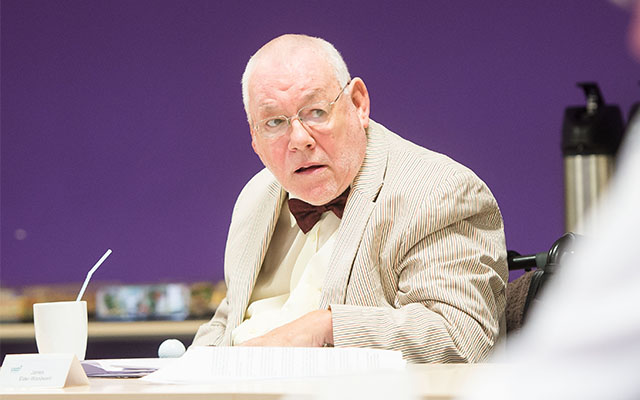
Dr Jim Elder-Woodward, OBE
|
||
|
||
|
Co-design of Scotland’s National Care Service continues apace while the Bill remains paused, with more than 140 participants turning up to share their views at the first two public forums of the summer.
However, the Scottish government’s co-design process has not been without its critics: think-tank Common Weal recently made the case in a new policy paper that meaningful engagement with the public remains sparse and that there is little evidence that the input of workers, carers and those who use services are making it into the final plans.
Dr Jim Elder-Woodward OBE, a disabled activist, says decades of local councils not listening to the wishes of service users is one reason why the system is struggling. The news that local authorities are set to continue their role in social care service delivery could pose a barrier to the universal delivery of services.
Dr Elder-Woodward calls for National Care Service discontents, including Common Weal, to engage properly with those who have the most to lose – and gain – from the reform of services.
I reply to healthandcare.scot’s article: “Designing social care with all of us” which appeared on 7th July, 2023. This article referred to Common Weal’s report, which criticised the Scottish government’s attempt to set up a National Care Service. This report is entitled “Ready to fail”, indicating that such a policy was doomed to failure. One such reason for failure was the lack of input from local authority personnel in the ‘co-design’ of the service.
I retort, the system which Common Weal, and its fellow discontents to the National Care Service, wish to defend has already failed millions of people over decades of (non)provision and recorded harm. Such harm has resulted, in the main, by those people for whom Common Weal advocates.
I am a member of a group of disabled people with whom the Scottish government say they are ‘co-designing’ the National Care Service. I, like the Common Weal, am critical of the use of this term, but possibly for different reasons. I think we would both agree that ‘co-design’ isn’t ‘coproduction’.
From our point of view, we welcome the idea of a new National Care Service for the following reasons, but like our opposite discontents, we are unsure of its final structure, philosophies, strategies and policies, as its discontents keep rubbing away its outlook and purpose in order to retain power and prestige over disabled people and their carers. We can only be hopeful that the following will be retained:
I could go on, and I acknowledge that there is no guarantee that the provisions of the National Care Service will deliver that which the Scottish government is presently promising; especially now that local authorities will retain the power over the personnel delivering the services. Will this put another barrier to the universal delivery of service?
The Common Weal has taken none of our concerns over the present system into consideration. They have taken a very ableist, dominant, neo-colonial position towards social care, ignoring the perception and thinking of the major stakeholder in the system – that is that of the service user.
As said before, but worth repeating, if the present dysfunctional disjointed system had made the effort to treat us respectfully as the subjects of our support systems, then many of the issues experienced within the current system would have, at least, been minimised.
I am particularly concerned about the patronising statement which indicates that able-bodied care workers’ opinions are more valid than disabled people’s. To quote from the report:
‘The research and evidential basis for the Scottish government’s proposals are threadbare. Policy is being ‘designed by anecdote’ rather than through rigorous, consistent, respected methodologies of research.
‘This is particularly concerning because of the limited cohort from whom these anecdotes are being derived. They are ignoring and excluding care workers and instead listening primarily to ‘care experienced individuals’. Almost all of these have special and intensive needs and their experience of care will be different, and they are self-selected. In addition, many in this cohort are children (sometimes as young as three), or adults with dementia, severe learning difficulties or addiction problems.’
I can assert that the People Led Policy Panel, to which the Scottish government refer, were chosen to represent people with various impairments and disabilities, including those with learning difficulties. They were also chosen to represent both rural and city geographies. And all of us are over three years old.
I also refute the following from the report:
‘There are real concerns that the Scottish government is deliberately trying to pit those who receive care against their carers to retrospectively justify a policy position the government is nominally in the process of reviewing with an open mind.’
We are not pawns on the Scottish government’s chess board. Amongst our many suggestions, we have often mentioned the government was involving the various stakeholders in silos. There was a need to draw these silos together to learn from each other. So far, they have not taken up this suggestion. Either, they fear the trauma this might cause, or they are aware that the discontents will not be in favour of such confrontation. Nevertheless, there is a need for the ‘discontents’ to meet the ‘contents’ to discuss their differences, because the present system just cannot continue.
Finally, if the ‘discontents’ get their way, and social care remains dysfunctional and disjointed, the ‘contents’, who are mostly service users, will be truly disempowered and depressed. This was the first time many of them will have felt empowered and animated by finally being propitiously listened to. If that is what the discontents achieve, then inclusive democracy, along with the dignity and agency of disabled people, will be shattered.
Common Weal's response:
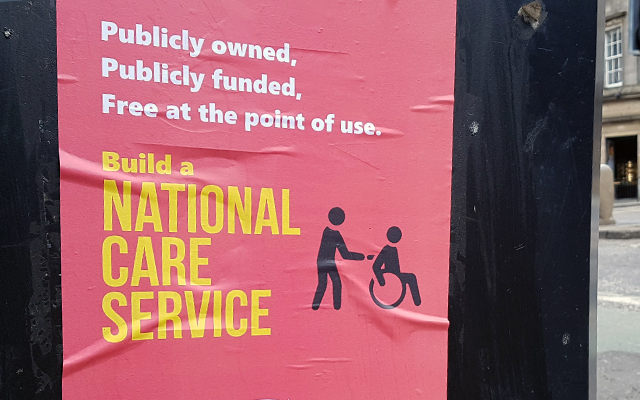
Dr Jim Elder-Woodward seems to misunderstand and certainly misrepresents Common Weal’s position on the National Care Service (NCS). Jim calls us ‘National Care Service discontents’. It is difficult to reconcile that charge with our call for “an all-ages, comprehensive, not-for-profit National Care Service, free at the point of need”. We are very much in favour of a NCS and have set out our vision for such a service in some detail in our paper, Caring-For-All.
We do, however, have concerns about many aspects of the Scottish government’s proposals and, in this respect, support the current pause. One of our foremost concerns is that we don't want the sort of top-down, undemocratic service set out in the NCS Bill, which will place powers in the hands of Scottish Ministers and remove any semblance of local understanding of community needs and control over services. Local authorities, while they are far from perfect, do nevertheless bring some democratic accountability to service provision. Moreover, over the past couple of decades they have operated in ever-more straitened financial conditions, which makes it difficult to judge their performance; if local government has failed, as Dr Elder-Woodward, claims, then there is a context to this failure, which will not be addressed without far more substantial financial investment than is proposed in current proposals. Worryingly, much of the investment that is being put into the new care service is being channelled by the Scottish government to large, global finance and consulting agencies, which have no community responsibility and no understanding of care services. If Dr Elder-Woodward and others are concerned about the ‘present neoliberal management of resources’, then the reliance on global capital is likely to be a prescription for more of the same.
The government seems intent on glossing over the lack of real bottom-up knowledge on how best to create a NCS by claiming to call on the voice of ‘lived experience’. While we absolutely support efforts to listen to those who use and depend upon services, our argument is that there are many voices of lived experience that can helpfully be brought to bear in these conversations, including those of carers, paid and unpaid, who have gained insights into how the system might work better; nowhere do we suggest, as Dr Elder-Woodward claims, that ‘able-bodied care workers’ opinions are more valid than disabled people’s’ – rather, that these voices might be joined.
Finally, while we might disagree on one of the principles Dr Elder-Woodward holds dear, the primacy given in current proposals to human rights, which we would argue to be of limited value without adequate resources to allow people to claim such rights, we probably agree on more than we disagree. If we are to realise a vision for the kind of NCS we at Common Weal and Dr Elder-Woodward would like to see, then we need to be able to articulate and discuss different possible directions of travel while building a broad alliance between those who need care and support, those who work in care and support services and informal carers.
The views of columnists and people who write other guest insights articles are their own.
Read more from Dr Jim Elder-Woodward: Where is lived experience in care regulation review?; £153 a week for bread and jam; The right to have needs met by the NCS; A rebuttal to NCS discontents; Don’t let ILF wither on the vine
Sign up to receive our bulletin for key health & social care updates straight to your inbox. |