|
Sceptical response to government’s care proposals |
Related newsBid to block IJB voting rights extension Holyrood passes Care Reform Bill Carers charities urge greater transparency in reforms National Care Service plans scrapped Minister: NCS has exposed "polar opposite" views Councils walk away from National Care Service 
|
|
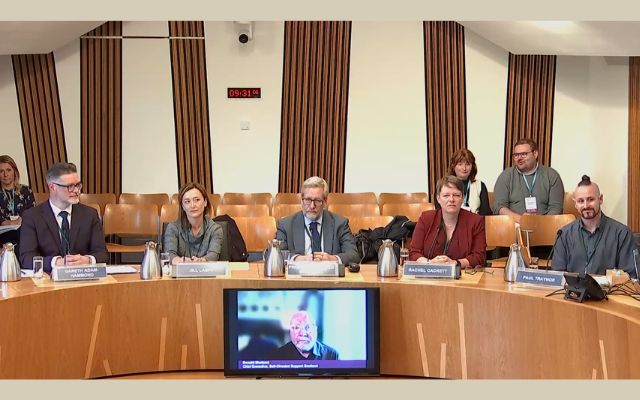
Image: Scottish Parliament TV
Witnesses at the committee (from left): Gareth Adam-Hammond (Care Inspectorate), Jill Laspa (COSLA), Donald Macleod (on TV screen), Donald Macaskill, Rachel Cackett and Paul Traynor
|
||
|
||
|
Care sector leaders are questioning the First Minister’s belief that the NHS is best placed to take the lead in a reformed social care service. Councils and care providers are now seeking assurances that ministers have not already made up their minds, saying that listening to the voices of users and providers will be vital if a reformed care system is not to lose its community roots and humanity.
COSLA, the organisation representing Scotland’s councils, says it will engage constructively with government on the public service reform plans put forward by the Scottish government at the start of this month, which include both redrawing the local authority map and rethinking local government’s role in delivering social care.
But, in a statement issued ten days after the Programme for Government was published, COSLA makes clear that it has deep concerns, and its participation in the government’s three months of dialogue over the proposals ‘must not be mistaken for agreement to any predetermined structure or transfer of responsibilities’.
Staying local
COSLA President, Councillor Shona Morrison said:
“Public service reform will only succeed if it is rooted in communities, not organisational charts. local government will engage with Scottish government, but we will not support reforms that dilute local democracy, centralise decision-making or remove accountability from the people we serve. Decisions around public service reform must be made in agreement between local government and the Scottish government and have the endorsement of councils on any issue affecting them.”
Council leaders insist in their statement that social care and social work services must remain within local government, and that social care and social work should be an equal partner to the NHS not subordinated to it, adding:
‘Any approach to social care reform must recognise that it is not simply about meeting individual needs, but about removing societal and structural barriers, advancing inclusion, and supporting people to have choice, control, and be able to participate in their communities. local government must be an equal partner in shaping future arrangements.’
For ministers who saw their plans for a National Care Service fatally undermined when COSLA withdrew its support, COSLA’s preconditions might ring alarm bells.
NHS as partner not leader
The First Minister’s statement that he cannot see the fundamental challenges facing social care being resolved without the NHS taking the lead role in “a single line of decision-making, accountability and funding” was raised as a concern when Holyrood’s Health, Care and Sport Committee took evidence from care sector witnesses.
Rachel Cackett who leads the Coalition of Care and Support Providers in Scotland told the committee:
“We, like everyone else, are now going to have to think about the implications of what that means. That statement, in and of itself, can be read in many different ways; it is not detailed enough to be completely clear.”
Donald Macleod of Self Directed Support Scotland, which represents disabled people and organisations across Scotland’s independent living movement, told the MSPs he found the idea of an NHS-led approach to care worrying:
“Our members expressed a fear of the medicalisation of social care. They fear that the medical model will be imposed when people are given treatment due to illness rather than the social model of disability, which views a disabling world, rather than impairment, as being the inhibitor.”
The head of the independent sector providers’ organisation Scottish Care, Donald Macaskill repeated his organisation’s insistence that social care must be seen as distinct from supporting the NHS – that it has a separate role in enabling people to exercise their rights, participate in their communities and live fulfilling lives regardless of disability, frailty or illness.
Professor Macaskill also told the committee that reform of social care needs to go far beyond redrawing maps to changing the way care is funded, saying government has too often come to the table with a ‘take it or leave it’ approach to funding:
“We need a radical review of existing cost models; I would put forward the national care home contract as an example. The review needs to be based on the ethical commissioning principles that we have all worked on and agree with. At the end of the day, it comes back to the adequacy of the resources, because you cannot negotiate if there is an empty packet in front of you.”
Listening to ideas
In their evidence to the committee, each of the social care sector witnesses made it clear that the people they represent would welcome changes that improve the delivery of services to people who need them – and appealed to the government to really listen to the insights of providers and users.
Paul Traynor from the Carers Trust told the MSPs not to forget the estimated 800,000 unpaid carers and local carer organisations which he said are continuously filling gaps left by stretched health and social care services:
“I just want to highlight that Scotland cannot achieve such sustainable social care change without involving unpaid carers and local carer organisations. The preventative approach is important for unpaid carers, in the sense that, if we are not investing in unpaid carers now, they will potentially require care themselves in the future.”
Donald Macaskill from Scottish Care described those receiving support, and those who offer it, as being “among the most amazingly creative, entrepreneurial and innovative people in the country”, and must be involved in the co-design of any future system:
“In particular, that community is using technology, innovation and artificial intelligence in ways that I could not have imagined two or three years ago. Any reform today has to look forward to the abilities that arise from putting real care and control in the hands of citizens, moving from a person-centred approach to person-led support. We should walk with them on that adventure.”
Rachel Cackett said she was optimistic that much more can be offered by a reformed sector – if that reform is built on the insights of providers and users:
“If we want a reformed system that enables people – whether they are supported people, unpaid carers or members of the workforce – to genuinely thrive, my plea in the whole process, to all partners who are involved, is to get us around the table.
“The ability of our sector to come up with ideas and demonstrate what works is enormous, and I think that we can do much better than we are currently doing if we have a genuinely open conversation and are willing to put everything on the table and look at what will serve people better than what we already have.”
Read more: Briefing: The 5-year plan for NHS, care and science; Donald Macaskill: Where is Scotland going? Briefing: Social care in the manifestos; Councils demand £750m boost for social care in 2026; National Care Service plans scrapped
Sign up to receive our bulletin for key health & social care updates straight to your inbox. |
