|
Bid to block IJB voting rights extension |
Related newsSceptical response to government’s care proposals Holyrood passes Care Reform Bill Carers charities urge greater transparency in reforms National Care Service plans scrapped Minister: NCS has exposed "polar opposite" views Councils walk away from National Care Service 
|
|
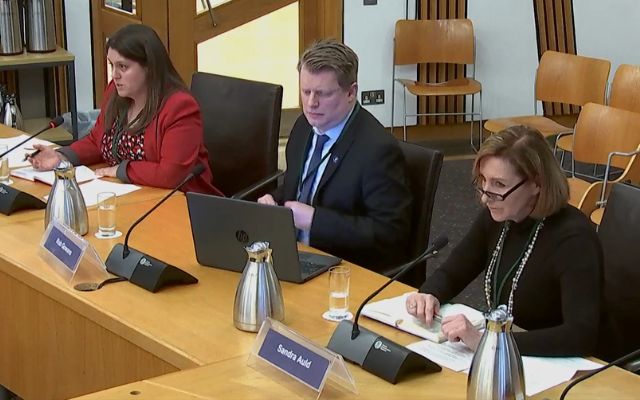
Image: Scottish Parliament TV
Left to right, giving evidence: Natalie Masterson, Third Sector Interface Network Scotland, Rob Gowans Policy and Public Affairs Manager Health and Social Care Alliance Scotland, and Sandra Auld, Service User Member on Perth & Kinross Integration Joint Bo
|
||
|
||
|
The Scottish government says it will resist moves to block legislation giving new voting rights to user representatives sitting on integration joint boards (IJBs). A motion to annul the change in the rules was lodged by Labour MSP Carol Mochan on the day councils told MSPs that the move would dilute democratic accountability.
In late December, ministers published draft legislation, The Public Bodies (Joint Working) (Integration Joint Boards) (Scotland) Amendment Order 2025, that would allow people appointed to IJBs as representatives of third sector bodies, service users and unpaid carers, to vote at board meetings.
Currently, although these representatives sit on the IJBs which oversee health and social care partnerships, only the non-executive members of NHS boards and councillors appointed to the boards can vote.
The amendment order is a so-called negative instrument, a form of secondary legislation that becomes law automatically unless the Scottish parliament annuls it, only going to a vote of the parliament if an MSP actively seeks to challenge it.
On Tuesday, the same day as Holyrood’s health and sport committee had taken evidence on the proposals, committee member Ms Mochan lodged a motion that it be annulled.
In a statement to healthandcare.scot, the government’s Minister for Social Care and Mental Wellbeing, Tom Arthur responded:
“I am disappointed to see this motion put forward and I hope MSPs will reject this annulment.
“I am determined to ensure those who access and support community health and social care services have an equal say in shaping the decisions that affect their communities.”
Democratic deficit
Earlier in the day, representatives of the local government organisation COSLA and trade unions had told the committee that, while the voices of the third sector, carers and those with lived experience are vitally important, they do not have the same democratic accountability as councillors.
COSLA’s spokesperson for Health and Social Care, Councillor Paul Kelly told the committee:
“We obviously sit on integration boards, and we leave our council hat at the door and represent the interests, as we should, of health and social care partnerships. But publicly we are accountable, and the public do come to us about decisions that we take in integration.
“So our concern is where those major decisions have been taken, that we will be in a minority as democratically elected members, and that will have a significant impact on our ability to be accountable.”
Chair of UNISON Scotland’s Social Work Issues Group, Stephen Smellie said he shared COSLA’s concerns that extending voting rights will lead to a diminution of local democratic accountability:
“Frankly, if IJBs or councils or parliament are making decisions which are wrong, we want to have an ability to vote them off. We can't do that if you are appointing people from other organisations.
“So yes, we believe fundamentally that community care services are local services… they should be accountable properly, accountable democratically, to local voters.”
In its evidence, COSLA said it was “absolutely committed” to building the role and the support for everybody at the IJB table, but suggested that some of the coming decisions being driven by multi-million pound deficits would not be appropriate or fair for public partners to take.
Better decisions
Service user representatives told the committee that having user voices around the table would mean IJBs make better and more democratic decisions.
Service User Member on the Perth & Kinross IJB, Sandra Auld suggested that the issue of finance was a good example of the widely held experience of users on boards, of being treated as less important than voting members – which this change in voting rights would address:
“I strongly feel this would drive behaviours where public and third sector partners would need to be involved in the previous discussions leading up to the decision making at IJBs, not excluded as has happened previously.
“I became aware in Perth and Kinross there was a budget review group, and when I asked about that and could I be part of that, because I'm a member of the audit and performance committee as well, I was told that the budget review group was only for voting members.
“That supports my view that this isn't just about voting, raising your hand around the table. It's about what you can be excluded from prior to that, before you even get there.”
Chief Executive Officer for Stirlingshire Voluntary Enterprise, Natalie Masterson sits on the Clackmannanshire and Stirling IJB and is part of the Third Sector Interface Network Scotland.
She told the committee it was wrong to ignore the role of all the different community and third sector providers of social care by only giving votes to the NHS and councils:
“It is a democratic deficit to only have some of this health and social care system afforded voting rights,” she told MSPs. She added that it will be essential to have the voices of experience involved in the difficult decisions ahead:
“Audit Scotland highlights major fiscal and operational pressures. Transformation is not optional. It is essential. Early intervention, prevention, is the only thing that will save our health and social care system. That requires the voice, the proper voice, of people with lived experience. 80% of IJBs are in financial difficulties, either overspending, reliant on one off savings or drawing down reserves.
“We must transform health and social care services and, to do it, we must involve the voices of the people that are most affected by the health and social care system.”
Whiff of paternalism
In his evidence to the committee, Tom Arthur MSP said the call for extension of voting rights has been consistent in both the Feeley report into adult social care and in the government’s own consultations:
“We have heard directly from individuals who have lived experience and are on IJBs that they have felt that they have not been fully included within the process, that their participation can be somewhat tokenistic.
“By enabling those with lived experience, that class of representative on IJBs, to have voting rights, it changes the dynamics, it changes the conversation, and crucially, it empowers – and that, I believe, can lead to more effective governance and decision making at the local level.”
He added:
“I believe that, quite frankly, a whiff of paternalism runs through many of the hesitations raised.”
The minister told the committee that the government has established a short life working group to support the implementation of the changes, with a commitment to ensure that there is investment in recruitment processes and additional training and support for IJB members to help them deal with having added responsibilities.
healthandcare.scot has approached Carol Mochan MSP to invite her to comment on why she has moved the motion to annul the proposed legislation.
Read more: Users to get voting rights at IJB meetings; Politicians told: “Carers cannot wait”; Government to review user voices on IJBs
Sign up to our bulletin for key health & social care updates straight to your inbox. |