|
A national care service – is it time? |
Related newsSceptical response to government’s care proposals Party health and care leads are named Briefing: Social care in the manifestos Collective bargaining promised for social care Bid to block IJB voting rights extension Councils warn of social care cuts ahead 
|
|
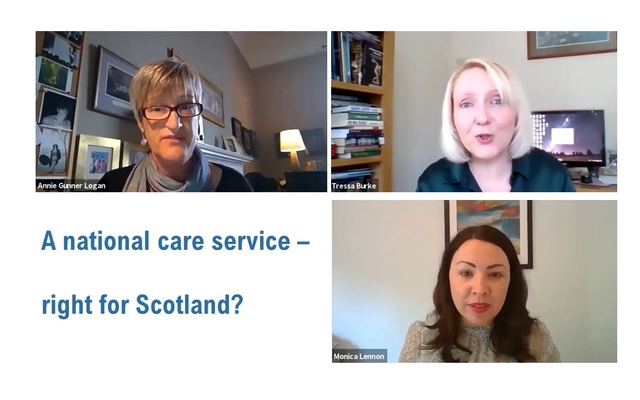
(clockwise from top left) Annie Gunner Logan; Tressa Burke; Monica Lennon MSP
|
||
|
||
|
There is no disagreement the covid crisis has shone a light like never before on the endemic problems that have dogged social care for decades, but how to fix them is a question that looms large.
Establishing a national care service was one option considered by a panel of speakers during a live healthandcare.scot online seminar last week.
The Coalition of Care and Support Providers in Scotland’s Annie Gunner Logan, the Glasgow Disability Alliance’s Tressa Burke and Scottish Labour’s health spokesperson Monica Lennon MSP considered the question of whether a national care service is the right next step.
The term ‘a national care service’ is deliberately cast, Ms Gunner Logan said, as an equivalent to the NHS.
There are benefits to that, she explained, if that were to stop social care coming second to the NHS in situations like the pandemic.
“During covid…we said ‘protect the NHS’. I don’t think it entered anybody’s head to say ‘protect the NHS and social care’, and we saw the effects of that, not least in care homes.”
But replicating the medicalised model of care the NHS operates on must be avoided, according to the Coalition of Care and Support Providers (CCPS) Chief Executive.
“Many of my colleagues have worked for years to extract themselves and those they support from a medicalised model of care…do we really want that creeping back in?
“We are seeing a little bit of that now in the way that care homes are being managed, and it’s not a pretty sight for people; these are not hospitals – these are people’s homes.
“A one-size-fits-all NHS-approach isn’t appropriate for this context – people need much more involvement and choice in their social care support.
“…if a national care service means a monolithic single provider with no choice delivery then I would say no to that.”
While the idea of a national service gains political traction, the third sector representative said she has been left “ambivalent” by a lack of any detailed proposals from proponents.
“No one who has proposed the introduction of a national care service has yet explained in any detail what they mean by it,” she said. “Given the absence of that I would say it’s quite difficult, and even irresponsible, to answer unequivocally yes or no”.
On the other hand, Ms Gunner Logan conceded mimicking the NHS by removing competitive tendering would be an attractive prospect:
“The NHS does not run as a market. We had a go at that back in the 90s…It didn’t work, so we abandoned it. We have not abandoned it for social care and we really need to because the market dynamic and, in particular competitive tendering, is in my view the root cause of many of the problems to which a national care service is being positioned as the answer.”
Ms Gunner Logan said four things have to be a priority if we are to overhaul social care:
“Number one: replace the competitive procurement model with something more collaborative.
“Number two: ensure that staff are properly valued, and that includes pay terms and conditions – not just clapping.
“Number three: look at who is providing the high quality care and support, then to do more of it, and that won’t always be the public sector.
“And then four: put more, not less care and control into the hands of the people who rely on care and support.
“And, from what I’ve heard, so far the national care service might do the first two but only by compromising the second two.”
The Glasgow Disability Alliance’s (GDA) Tressa Burke meanwhile said her organisation has thrown its weight behind a national care service, particularly now in the context of “supercharges inequalities” and widespread failure to realise self-directed support.
“Covid has highlighted how crucial yet fragile our social care system is,” Ms Burke told the healthandcare.scot seminar.
“Austerity has driven up eligibility thresholds leaving vast unmet needs, eroding disabled people’s human rights and resilience.
“When the pandemic hit, too many people were already in crisis and too many had vital support withdrawn leaving them even more trapped and more vulnerable.
“Our member engagement findings were that covid has supercharged inequalities already faced by disabled people; that pandemic responses have created new ones and have left disabled people behind; and that recovery and renewal risks leaving people even further behind unless we supercharge disabled people’s involvement and their rights and support.”
Although the duty on local authorities to provide support remained in place throughout lockdown, many service users and GDA members had their care reduced or removed completely.
“For many years GDA has proposed a national care system to mitigate the postcode lottery of a better life,” Ms Burke said.
“We are calling for a reopening of the Independent Living Fund in Scotland with immediate effect and the establishment of a national social care agency on a par with, and working alongside, our NHS.
Reopening the fund to new applicants would “bring about the system that we need to deliver social and economic benefits. And, in fact, we believe [it] could provide a model on which to build a national social care support system with rights, dignity and empowerment at its core.”
“We want to see this codesigned with disabled people, modelled on social security and our independent living fund with dignity, respect and a human rights-based approach embedded.”
Ms Burke listed what she hoped a national care service might look like:
“We want to go beyond life and limb, enabling those with social care needs to access the resources and support they need with genuine choice and control over who provides it and how they use it to live their lives.
“We want a system that is transparent and accountable to ensure that Scottish government money designated for social care support is spent on social care support; we want a system of national rights-based entitlements that gives people rights to resources that assess needs thereby ensuring portability and an end to the postcode lottery.
“We want our social care support system that is clearly distinct from the healthcare system, but which is well aligned and integrated with it.
“We want an end to competitive tendering that drives down quality, reliability, user satisfaction and wages; a system which is free at the point of use and a system co-designed with people that use and need social care support, and unpaid carers.”
Scotland’s Health Secretary Jeane Freeman says she has great sympathy for the creation of a national service – a key policy commitment of Scottish Labour as they look to the May elections.
The party’s health spokesperson Monica Lennon said it was “time for transformation” in how adult social care is delivered, particularly for its workforce.
On the social care advisory review group set up by the Scottish government, she said: “there are some fantastic people on there but my immediate observation was there was nobody there to represent the workforce…nobody from the trade unions and that to me was a glaring omission.
“We need to see pay and conditions dramatically improved…it has taken a pandemic for MSPs to realise that there are some real inequalities and actually we need to have fair work across the social care workforce. They have been undervalued for far too long.”
Over the summer, the Labour party has been surveying care users and their families and Ms Lennon said responses so far overwhelmingly support a national care service.
“At the moment 92% of people surveyed told us that they don’t think that the current system is working well for everybody and in response to the question ‘do you think that private companies should be able to profit from Scotland’s care services?’, 84% of people said no...
“They just see companies that get public money, they see it leaking out of Scotland never mind looking at the care system. There is no accountability there. And I think more than anything else, people want accountability.
“95% believe that Scotland’s care services are under-resourced and 98% told us that Scotland’s social care staff deserve better pay and conditions; and 90% said that, like the NHS, care should be under greater public control.
“So overwhelmingly they told us that they want a national care service.
“I think the job for all of us now is to work with the government to make sure that through this review we can frontload it as much as possible because I don’t want to get to January and find out that another piece of work needs to happen – we need to make sure that there is a lot of activity between now and January.
“I have always said to my own colleagues, and anyone else who will listen, that it is not about getting to an election campaign in March, April and May, and Scottish Labour having a manifesto commitment.
“It is about what we can actually deliver now, and I think there is a lot of genuine sentiment across Parliament on that.”
Watch the seminar on our YouTube channel.
Read the full transcript of the meeting.
Follow us on twitter for more healthandcare.scot events.
Supporters – If you can help support our reporting for Scotland's health and social care community, please head to our donations page.
Bulletin – Sign up for all the latest news and events.
Tags: Scottish Parliament; Social Care. |
