|
Briefing: Social care in the manifestos |
Related newsSceptical response to government’s care proposals Bid to block IJB voting rights extension Care can be valued, visible, viable and visionary Holyrood passes Care Reform Bill Carers charities urge greater transparency in reforms National Care Service plans scrapped 
|
|
|
||
|
||
|
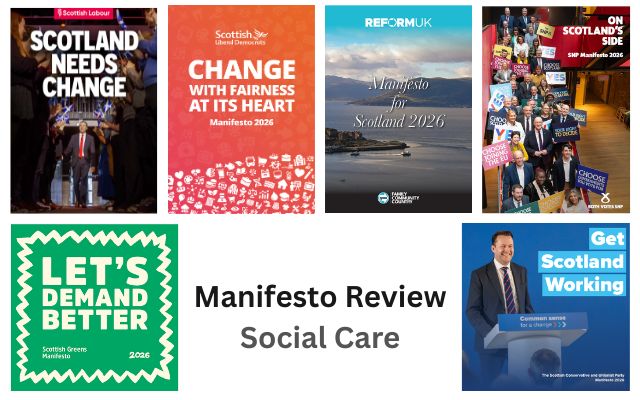
Although not afforded the same amount of space in the manifestos as healthcare and the NHS – or anything like the number of promises – candidates standing for election to Holyrood on 7 May know from hustings and campaigning that voters want to know what they are going to do to ‘fix’ social care. In the run up to the election, our first look at the manifestos of the main political parties focuses on the social care sector.
All of the parties say they will continue to invest in social care.
Both the Scottish Greens and Scottish Labour commit to ending end non-residential care charges.
Reform UK’s manifesto, which is shorter than the others, does not include specific commitments in social care. However, it does say that their ‘new deal for local government will also give councils greater flexibility and control over their social care services, while simultaneously providing a secure basis of long-term funding’.
The SNP say, in government, they ‘far exceeded’ their commitment to increase funding for social care and now want to go further. Their manifesto promises ‘recurring Complex Care Investment for Scotland, beginning with £20 million’ to allow care and adaption packages for people with complex needs to allow them to leave hospital sooner, which the SNP says will benefit some 400 people a year.
A national care service
While a commitment to create a single national care service was included in the SNP’s 2021 manifesto, having then had to abandon much of the legislation to deliver it, it is now the other parties rather than the SNP who mention it this time around.
Scottish Labour says they will work in partnership with the sector ‘to create a national care service worthy of the name’, requiring consistent standards of quality and service delivery everywhere across the country.
The Scottish Greens suggest that the national care service failed due to ‘a lack of ambition’, saying delivering the ‘radical change Scotland needs’ will require more than ‘structural adjustments’.
While not calling it a national care service, the Scottish Liberal Democrats say they want to see common national standards to support better care services – informed by a Health and Social Care Staff Assembly.
The Scottish Conservatives say they will oppose ‘any future attempts to centralise social care and take powers away from local authorities’, arguing that councils are best equipped to decide on local care provision.
Staffing and workforce
The Scottish Liberal Democrats and Scottish Labour say they want to make careers in social care more attractive and that staff retention will be improved by providing better career pathways.
In a unique approach to recruitment and retention, Scottish Labour also want to introduce a new ‘NHS work requirement’ for future Scottish medical, dental and nursing students – including those working in social care – who will be required to work in Scotland’s for at least five years after graduation or be forced to pay back their tuition and bursaries.
The SNP says they will ‘empower our NHS and social care staff’ by investing in recruitment of specialists, creating more training places and addressing workforce issues in rural and island communities.
In the last weeks of the last Scottish parliament term, the SNP made a commitment to national bargaining on pay and conditions, a move supported by the Scottish Greens and Scottish Liberal Democrats.
The Scottish Liberal Democrats also say they want to see investment in dedicated key worker housing to benefit care workers and others.
On pay, Scottish Labour and Scottish Greens say care staff should be paid not less than £15 an hour. The Scottish Liberal Democrats want to increase pay for all care workers to a minimum of £28,500 per year.
The Scottish Greens are also backing RCN calls for pay parity between NHS and social care nurses.
The SNP says it will expand its Displaced Workers Scheme to support international social care workers to settle in Scotland, saying an additional investment of £750,000 could deliver ‘45,000 extra hours of care a month’.
Care homes and care providers
Both Scottish Labour and the Scottish Conservatives want to fund additionalcapacity in care homes and community settings to allow people to be discharged from hospital sooner.
Scottish Labour says they will immediately fund an additional 1,000 care at home packages and 300 step-down beds.
The Scottish Conservatives want to provide increased funds for the NHS so it can secure a place ‘in a suitable care home’ within 48 hours of a person being declared fit to leave hospital, allowing them to be cared for outside hospital while a care package is put in place for them.
The Scottish Greens want to see the introduction of ethical commissioning of care services and an end to competitive tendering ‘to ensure that care services are being provided on the basis of their quality, rather than ‘value for money’’.
Scottish Labour says it will ‘crack down on poorly run care homes’. They want to see increased inspection of services and publication of information that allows people to identify the best services.
The Scottish Greens go further, saying they want to see ‘failing care homes’ transferred into public or community ownership – with the entire Scottish care home estate transferred out of private ownership ‘over time’.
Third sector
The SNP, Scottish Labour, the Scottish Greens and Scottish Liberal Democrats acknowledge the importance of third sector providers, committing to ‘long term’ or ‘multi-year’ funding agreements.
The Scottish Green party, which says it will recognise the third sector as ‘an equal partner in the delivery of social care’, is also campaigning for the UK government to reimburse the third sector for the cost of the increase in employer national insurance contributions.
There is a sting in the tail for third sector providers in the Scottish Conservative manifesto with the promise of a policy requiring all charities to declare ‘taxpayer funding’ ‘so that the public and parliamentarians alike are aware of these potential conflicts, should an organisation make a public intervention in favour of a government programme’.
The Scottish Conservative manifesto adds: ‘if third-sector organisations are almost entirely reliant on taxpayer funding in order to survive, that begs the question of whether they should be considered charities’.
Reform UK meanwhile says that it will ‘form a department of government efficiency to cut waste and duplication and the endless funding of lobbyist charities by taxpayers’.
Read about some of the manifestos published by Scottish organisations ahead of the Scottish election: BMA: 2026 can be “watershed moment” for NHS; Parties must explain how they’ll save the NHS; Call for care home nurses to be given pay parity; More younger Scots dying from stroke; Call to address climate impact of medicines
Sign up to receive our bulletin for key health & social care updates straight to your inbox. |