|
Island paramedics get new point of care diagnostics |
Related newsScotland’s CMO on cutting-edge sepsis gene research Gathering of CLANS to boost CVD research Rare condition screening for newborns across Scotland Health and charity leaders join forces for NHS reform Call to expand Huntington’s specialist care Government boosts health innovation funding 
|
|
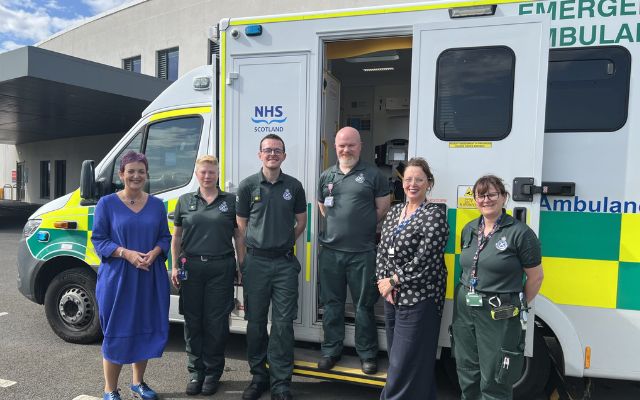
Image: © NHS Orkney
Ms Constance is joined by Pippa Easener, Team Leader, Scottish Ambulance Service (SAS); Adam Lloyd, Head of Research & Innovation, SAS; Steven Thomson, Paramedic; Hazel Dempsy, North of Scotland Innovation Hub; and Emma Rosie, Ambulance Technician
|
||
|
||
|
Ambulance crews in Orkney and Shetland are to be equipped with portable diagnostic devices under a new pilot scheme aimed at cutting unnecessary journeys to hospital. The NHS boards and Scottish Ambulance Service believe that, if paramedics are given fast access to additional diagnostics tests while with a patient, they’ll be able to identify many more people for whom a sometimes lengthy ambulance transfer is not needed.
Project SOUND will see point-of-care testing technology introduced into Orkney and Shetland, allowing paramedics to carry out a range of rapid tests, that would traditionally require hospital admission, to support the assessment of a range of common and serious health conditions closer to the patient.
According to NHS Orkney, 77% of ambulance callouts in the islands currently result in a trip to hospital. More than three quarters of people experiencing breathing difficulties are taken to A&E, rising to 86% of patients experiencing chest pain.
The 21-month pilot project, backed by funding from the Scottish Government’s National Islands Plan, will equip paramedics with handheld diagnostic devices to perform a series of blood tests to help inform the decision on whether a person needs to go to hospital.
On a visit to Orkney, Health Secretary Angela Constance said the initiative is based on the principle that everyone should be able to access the care and support they need, regardless of where they live:
“That’s why we’re backing this trial of rapid diagnostic testing directly to patients in Shetland and Orkney, giving paramedics the tools they need to make faster, safer decisions on the spot.
“This means fewer unnecessary journeys, less pressure on our ambulance services, and more people able to stay safely at home surrounded by their families.
“It’s a brilliant example of Scotland using innovation to close the gap between island and mainland healthcare, and I’m confident the lessons learned here will benefit rural and remote communities right across the country.”
The Head of Research and Innovation at the Scottish Ambulance Service, Dr Adam Lloyd says staff and island communities will also benefit as well as patients:
“Project SOUND is an exciting opportunity to trial how we improve the care we provide to patients in some of Scotland’s most remote and rural communities.
“By equipping our paramedics with point-of-care testing technology, we can support faster clinical decision-making, helping more patients receive the right care in the right place, while reducing unnecessary journeys to hospital where it is safe to do so.”
Smarter decisions
Dr Anna Lamont, Medical Director for NHS Orkney, says Project SOUND is still in its early stages:
“It is a great example of how remote and rural services can come together to test innovative ways of working to the benefit of their communities.
“The ability to complete blood tests in a person’s own home is a new and exciting opportunity that will help us make smarter care decisions at the most urgent of times – both when it is safe to stay at home, and when someone really must be transferred.”
Director of Pharmacy and Interim Depute Chief Officer for NHS Shetland, Anthony McDavitt says the trial will help inform how point-of-care diagnostics can be best used in remote community settings across Scotland:
“In Shetland, urgent care relies on strong links between our remote island health centres’ 24/7 on-call services, the Scottish Ambulance Service and the Gilbert Bain Hospital.
“Geography, weather and transport can all affect how quickly patients can access hospital-based diagnostics.
“Working with NHS Orkney, the Scottish Ambulance Service and the North of Scotland Innovation Hub, this pilot will help us understand how this model could improve urgent care for island communities and reduce unnecessary travel by treating people effectively close to home.”
Read more: Radiographers pioneer doorstep diagnostics; Thrombectomy limitations laid bare; Patients benefiting from clinical trials progress
Sign up to receive our bulletin for key health & social care updates straight to your inbox. |