|
Pressures on psychiatry leaving posts unfilled |
Related newsNHS is working to address “unacceptable” abuse Watchdog criticises homelessness health service cuts ‘Invaluable’ impact of mental health volunteers Scots honoured in health, care and sciences Call for ‘right to rehabilitation’ after covid Strategy to make mental health services peer-led 
|
|
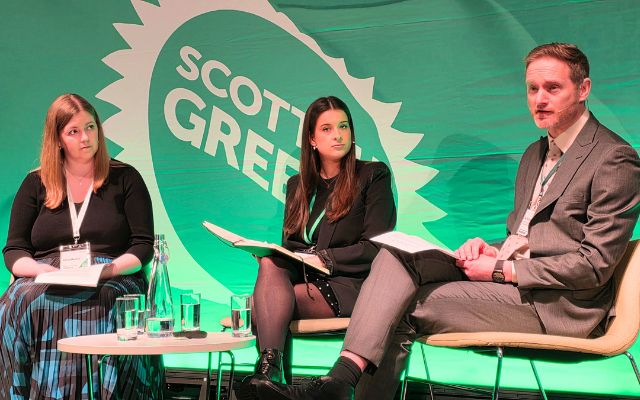
Dr Jim Crabb (right) sitting alongside RCPsychiS policy manager Jane Gordon (middle) and Gillian Mackay MSP at a meeting arranged by the Royal College of Psychiatrists in Scotland at the recent Scottish Greens conference.
|
||
|
||
|
A Scottish psychiatrist has been talking about the pressures created by an unprecedented rise in the number of people waiting for assessment and support for neurodevelopmental conditions such as ADHD and autism. His comments were made ahead of the publication today of a survey showing that Scotland is failing to recruit permanently to one in four consultant psychiatrist posts.
The number of people presenting to their doctors with potential neurodevelopmental conditions (NDCs), most notably autism and Attention-Deficit/Hyperactivity Disorder (ADHD) – or both – has increased exponentially.
The Royal College of Psychiatrists in Scotland (RCPsychiS) says in some areas demand has surged by 2000% since 2020.
A survey of NHS boards by the Scottish parliament information service last autumn showed 65,000 people waiting for an NDC assessment, 42,000 of them children.
The pressures on staff are having an impact on recruitment to the speciality.
Dr Jim Crabbe, a general adult psychiatrist working in NHS Scotland and policy lead for the RCPsychiS Scotland, told a session at the recent Scottish Greens party conference that the NHS simply does not have the capacity to cope:
“This is nobody’s fault. No country saw this coming and no country was prepared.
“About three years ago, psychiatrists in Scotland began asking: what is happening. what is the help that people coming to your service are asking for, why are they not getting that help? And we found a complex picture – but it was clear that, to help, we have to think radically differently and do several different things with patients, families – and across wider society.”
RCPsychiS has put forward a 10-point plan for change, including setting national standards for ADHD and autism assessments, a new four-tier service model across all age groups, school and workplace support that, crucially, does not depend on a formal diagnosis, and a dedicated funding to improve awareness and reduce stigma.
Dr Crabb says the next government should take all ten recommendations forward if they are to begin to address a problem that the NHS and wider society are not currently equipped to deal with:
“We're currently trying to get 20% of the population into a system that is designed and resourced for 1% and of course that's never going to happen. It's impossible.
“Mental health systems and people working within them are completely overwhelmed with this demand. Staff are burning out and there's a sense of moral injury.
“It's a horrible feeling coming to work knowing people have waited five or six or seven years to see you. You feel you have failed them the minute they walk through the door. And, every day, you are responding to complaints that people aren't being seen. It's terrible. And people can't sustain that. They vote with their feet and leave our mental health services, and we're losing really good people each day.”
Dr Crabb says those waiting for an assessment for a loved one understandably question why it’s taking so long:
“There's this ridiculous toxic link where places can actually spend most of the day responding to complaints regarding people that they're not seeing, rather than actually getting on and seeing people who need help.
“My own personal highest number of complaints in one day was 15. It took me about a week to answer those. I didn't see any patients that week.”
Some NHS boards have now closed their ADHD and autism pathways amidst concerns that services for acute mental illnesses were being badly affected.
A broader pathway
Jim Crabb says autistic people and those with ADHD need to be given the right help much sooner:
“If we keep trying to do the same things the same way and expect a different result, it's never going to happen,” he told the conference fringe audience.
“This is much bigger than health. This is a society-wide problem.
“We have to ask: ‘what help and support do people need, and why are they're not getting it? Why do they have to be referred into a specialist psychiatrist like me, to wait seven years for a six hour assessment to then say they need help when they need help now?
“Let's bring our help and support downstream.
“There will always be some people that, despite all these first line interventions, second and third, still need wraparound specialist, multidisciplinary care. But, this way, everyone gets help sooner.”
Workforce worries
Today the Royal College of Psychiatrists in Scotland is publishing its annual workforce census which it says shows a “worrying” trend, with a quarter of consultant posts not permanently filled.
In the North of Scotland, 45% of consultant posts are empty or filled by locum staff, raising concerns that access to specialist mental health care will increasingly depend on where people live.
The survey does not capture the reasons behind the vacancies.
The Chair of the RCPsychiS, Dr Jane Morris says repeated warnings that Scotland is struggling to retain experienced psychiatrists have not been heeded:
“Behind these figures are overstretched teams, longer waits for patients and a growing pressure on clinicians.
“Despite repeated warnings in successive workforce censuses, we are continuing to lose experienced consultant psychiatrists from Scotland’s services.
“The regional variation is particularly alarming as this has real implications for patient care.
“We cannot afford to let this trend continue. Without focused investment and workforce planning, services – particularly general adult psychiatry – will remain under severe strain.”
Read more: Inpatient CAMHS care too variable ; ‘Whole-system shift’ needed on ADHD and autism support; Autistic Scots push MSPs for neurodivergent-led change; New taskforce to drive ADHD and autism improvements
Sign up to our bulletin for key health & social care updates straight to your inbox. |
