|
Government says BSL service not under threat after all |
Related newsParty health and care leads are named First Minster pledges people will see GP sooner New palliative care strategy for Scotland Government promises to up NHS activity New shape of National Care Service emerging Workforce and public to inform NHS reform 
|
|
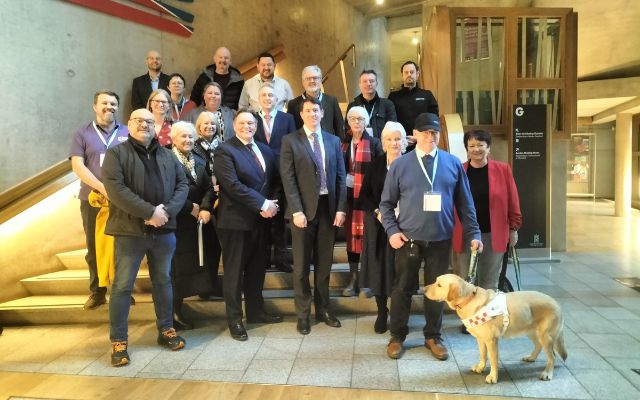
Members of a delegation representing deaf and deafblind people are joined by MSPs at the Scottish parliament
|
||
|
||
|
Members of Scotland’s deaf community have welcomed assurances from the Scottish government that a vital interpretation service will not be closed, and there will be no impact on users when the service is put out to tender in 2025.
The Scottish government wrote to the provider of Contact Scotland BSL in November saying that ministers would not retender a British Sign Language (BSL) video relay service that links people to public service and voluntary sector organisations.
Contact Scotland BSL provides a 24/7 free interpreting service for people who use BSL as their first language, through online interpreting Video Relay Services, Braille displays, and speech synthesisers. It handles some 3,000 to 4,000 calls a month.
Users say it is essential for their daily living needs and is an internationally recognised success of the BSL (Scotland) Act 2015.
Fearing the loss of the service, a delegation of people from deaf, deafblind and sensory organisations were at the Scottish parliament to lobby MSPs to try to get ministers to change their mind.
However, in response to a question in parliament from Mark Griffin MSP, First Minister John Swinney said he was sorry that the impression had been given that there was to be no retendering of the service:
“The Scottish government wrote to the supplier of Contact Scotland BSL on 4 December notifying it that its contract would come to an end on 31 March 2025, in accordance with its terms.
“First, I want to be clear that there will be no break in service for users of Contact Scotland BSL while we retender for the free service.
“We will work closely with BSL users in Scotland and the current supplier of Contact Scotland BSL to design the service to ensure that it best meets the needs of those who use it and that it raises awareness of the availability of the service and, therefore, also increases the number of users.”
Mr Griffin told parliament that the service is game-changing for the way people engage with, for instance, health providers.
“We should put ourselves in the shoes of a deaf person and imagine that we are not feeling well so we go to our general practitioner and are referred for further tests,” he said.
“When we go to the consultant’s appointment, we cannot get an interpreter. Previously, before we had the service in place, people would often have to take family members with them. Can members imagine taking a teenage family member to interpret the devastating news that they could potentially receive?”
Mr Griffin and a subsequent questioner, Stephen Kerr MSP, welcomed what they suggested was a change in position of the government, given that the letter to the contractor was clear that the service would not be retendered.
Mr Swinney apologised if the impression had been given that there was to be no retendering of the service, and added:
“There is clearly an issue here, which I need to get to the bottom of, because, if I am getting it from both sides of the chamber, I had better make sure that it is absolutely watertight.
“However, that is the commitment that I give to the parliament and, because I have given parliament that commitment, that is what is going to have to happen.”
The commitment to continuing the service after retendering was reinforced in a letter from Deputy First Minister Kate Forbes MSP to members of the BSL National Plan Implementation Advisory Group, the body set up to oversee the implementation of the 45 commitments within Scotland’s BSL National Plan 2023-2029.
Read more: Parliament urged to recognise deafblindness; Self management projects share £1.8m; Scotland failing deaf and disabled
Sign up to our bulletin for key health & social care updates straight to your inbox. Tags: NHSScotland; Scottish Parliament; Social Care. |
