|
Government promises to up NHS activity |
Related newsChief Medical Officer: ‘Critical connections’ priority First Minster pledges people will see GP sooner Workforce and public to inform NHS reform Winter funding for ambulance services Respiratory care vision unveiled Scotland at the table with UN healthy air commission 
|
|
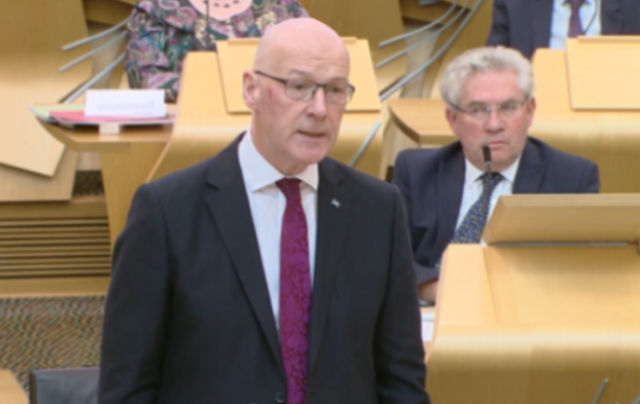
Image Credit: © Scottish parliament TV
|
||
|
||
|
Addressing NHS backlogs, so-called “intelligent investment and innovation”, supporting the workforce and tackling poverty are among government commitments for the coming year announced by First Minister John Swinney.
Just a day after “difficult” budget cuts to health and care were laid out, the First Minister launched the government’s ‘Serving Scotland’ plans in parliament today.
While Finance Secretary Shona Robison told parliament that yesterday’s mini-budget promised to protect emergency services, the Programme for Government highlights the importance of preventative health and care.
Against a “challenging fiscal environment” the First Minister told MSPs Scotland cannot deliver public services as it has in the past:
“Intelligent investment and innovation will be key here.”
Mr Swinney said the plans for healthcare will build on the success of programmes like the rapid cancer diagnostic services which has improved patient outcomes, adding that earlier diagnosis and intervention means better outcomes and less strain on the system, adding that public services must be easy to access and navigate:
“Nowhere is this more notable than with our National Health Service. We’ve seen terrific successes in our NHS, including the best performing core A&E departments anywhere in the UK.
“We need to ensure our NHS has the resources it needs, both for today and for the years to come.
“We will increase health boards’ baseline funding to reduce waiting list backlogs.”
As part of efforts to drive down delayed discharges, the government commits to working with local health and social care partnerships to provide targeted improvement support for areas with highest delays.
Meanwhile, the Programme for Government promises to eliminate unnecessary hospital attendance by freeing up 210,000 planned care outpatient appointments through targeted programmes.
The government says the NHS will deliver 20,000 more orthopaedic, ophthalmology and general surgery procedures annually through the National Treatment Centres.
It also outlines £120m additional funding to NHS boards to support improvements across mental health services, including an aim to clear CAMHS backlogs by 2025.
By the end of 2026, the government commits to increase capacity and access to general practice, community pharmacy, dental and community eyecare services.
This follows a £1m boost to extend a GP scheme helping practice engage with ‘lost patients’ announced by Mr Gray in July.
The Programme for Government details plans to reduce alcohol and drug-related harms by widening acess to rehabilation services, promising that by 2026, the government will fund 1,000 rehab places annually.
It states that the government will also extend dedicated support to family and loved ones affected by alcohol and drug use.
The government has also again committed to identify options to remove non-residential care charges as part of wider social care improvements.
In parliament today, Mr Swinney promised to support the workforce delivering public services by continuing to “award fair pay settlements, reduce workloads and improve conditions”, including work towards a 36-hour week.
Additionally, the plan commits to increasing the pay of social care staff in adult social care, early learning and childcare services to at least the real living wage from April 2025.
Chid health and poverty
Mr Swinney said focusing on prevention and early intervention can “pay big dividends down the line”, including in pregnancy and the first years of a child’s life:
“Addressing risks and problems at this stage can have positive impacts that last through to adulthood – support healthy development, prevent illness and ease future pressure on services, making the entire system more sustainable.”
This comes after researchers revealed that people who face more stressful childhood experiences, including poverty and mental health challenges, face an increased risk of ill health later in life.
As a key tenet of the plan, eradicating child poverty work includes prioritising women receiving the same care from the same midwife from pregnancy through to birth.
This will be prioritised for those most likely to benefit, including minority ethnic women and women with additional social care needs.
Investing in innovation
Mr Swinney also told parliament that the government will promote entrepreneurs and innovators.
The Programme for Government states:
‘Transforming our approach to innovation across health and social care by building a new partnership between government, the NHS, academic institutions, and industry.
‘We will accelerate the ability to undertake commercial clinical trials, introducing new technologies through three Regional Innovation Hubs, providing new opportunities to grow Scotland’s cluster of life science businesses, and using our Accelerated National Innovation Adoption pathway to adopt research proven innovations.’
Read more: Chief medic: Innovate to tackle health & planet crises; ‘Unprecedented' crisis in community health and care; Pay and balance “crucial” to stop doctors leaving; Urgent workforce reforms needed for Scotland's NHS; “Constructive talks” on doctors’ pay underway; Cancer patient support bolstered by new funding; UN told rights of disabled people in ‘crisis’
|