|
Community hub blossoms in Moray’s green haven |
Related newsAwards celebrate great link working Community link workers now “indispensable” Link worker profile: Small grants and big impacts Call to rethink rollout of walk-in GP services Edinburgh GP to chair BMA in Scotland IJB costs driving councils’ unsustainable funding gap Care home staff numbers increase after record low Rural alcohol and drug rehab centre opens Call to expand Huntington’s specialist care Highland GPs to reclaim vaccine services Highland to end unique health and care model Highland willing to give up its care integration model 
|
|
© Halfpoint
|
||
|
||
|
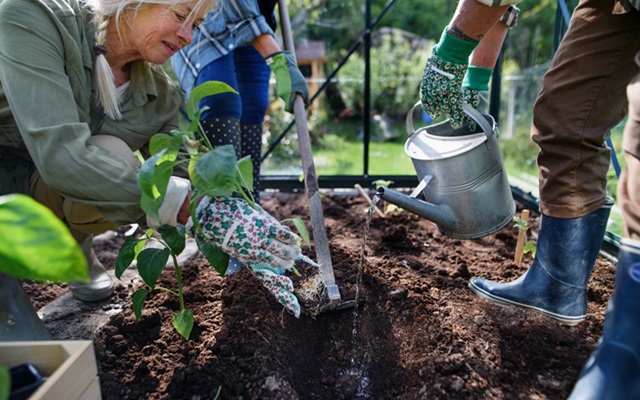
A local grassroots environmental charity based in Moray is providing a place for the local community to learn, share and enjoy growing food together.
In this next edition of Connected Communities, the ALLIANCE’s Calum Clark speaks with the founder and the secretary of Forres Friends of Woods and Fields about how they hope to liven the land for the communities on the Moray coast.
Forres Friends of Woods and Field’s main aim is to conserve and regenerate the land for the benefit of both the community and the local wildlife, with the charity dedicated to working collaboratively across sectors to transform local knowledge of the land, foster authentic relationships, and enhance the wellbeing of the community.
The organisation’s 26-acre area of land in Forres, Moray, consists of both a community garden and a children’s garden, which are used for both recreational and educational purposes.
Founder, Nick Molnar, and secretary, Kerry McInnes, say this is a place where the community can come together to learn how to grow their own food, care for the environment, and find a connection with one another.
“I think a big part of it is the community aspect, with people able to come and socialise whilst doing some gardening”, Kerry says. “Quite a lot of our volunteers are elderly, and I think it’s about being part of something, so it really helps with mental and physical health”.
By working in partnership with organisations such as Wild Things – a local environment education charity – as well as with local schools, the organisation ensure that children can learn to grow their own food whilst learning about the environment they live in. They also work with students from the nearby Glasgow School of Art campus, who have used the community garden as a source for innovative inspiration.
“Some students visit us and begin developing innovative projects in connection to activities throughout the area”, Nick says. “They come and do some gardening, ask some questions, and sometimes develop a project around that – for example, one student went away and developed a high-tech electronic game that aims to educate people on red squirrel conservation”.
In line with this commitment to working in integrated ways, the organisation has collaborated on the ‘Scotland The Bread’ project, which encourages communities to bake healthier bread using heritage wheat – a variety of wheat that contains a lower gluten content, making it healthier to digest.
“We contributed to an outdoor class for students from the local academy by showing them how to bake their own bread using heritage flour”, Kerry adds. “We got them to sow the wheat, and many of them commented on being thrilled to learn about ‘proper bread’”.
The charity recently received a grant from the Just Transition Commission to build a community hub, which will be an eco-friendly centre providing classes on conservation gardening and environmental activities, as well as a base for their volunteers.
It is hoped that by continuing to champion integrated ways of working, the charity will further strengthen their collaborative and transformational relationship with the community.
“We have big hopes going forward, but most importantly, we hope we can liven the land for the people of Forres and the Moray community more widely”, Nick says. Kerry added: “I think in this area, a lot of people say that there’s not an awful lot for young people to do, and so by offering this community space, we hope it will encourage more young people to come and learn how to grow their own food, whilst caring for the environment too”.
The views of columnists and people who write other guest insights articles are their own.
This article was originally published as part of the Connected Communities series by the Health and Social Care Alliance (the ALLIANCE).
The original can be accessed here: Nurturing both healthy relationships and the environment in Moray
Read more from Connected Communitites: Serving the community “more than a meal” in Inverness; New Scots pedalling toward resettlement; Hutting for health; Community power against chronic pain; Borderers saddle up for health; Self-management empowers Highland communities; Ten years of Men's Sheds in Scotland; Transforming attitudes to ADHD in Scotland Tags: GP & Community. |