|
Breastfeeding in Glasgow: A collective responsibility |
Related newsScotland at the table with UN healthy air commission NHS Scotland net zero efforts expanded Greener NHS research funding boost GPs are the solution to NHS crisis, says College Rare condition screening for newborns across Scotland Glasgow LEZ success sparks call for expansion Glasgow district nurses ready to strike Glasgow LEZ success sparks call for expansion Government to act on A&E failures Watchdog criticises homelessness health service cuts Community support ‘vital’ to asylum-seeking families 
|
|

|
||
|
||
|
Breastfeeding not only benefits population health but also the environment, Glasgow health leaders shared at an event this week as they called for more awareness and tailored support for mums to breastfeed.
Hosted by Glasgow Centre for Population Health (GCPH) in collaboration with NHS Greater Glasgow and Clyde, the Glasgow City Health and Social Care Partnership and the Glasgow Food Partnership, the event focused on raising awareness around breastfeeding.
Public Health Manager at the GCPH and Chair of the Glasgow Food Partnership, Jill Muirie said breastfeeding is well-known as a “healthy, cheap and a sustainable way for babies to be fed”.
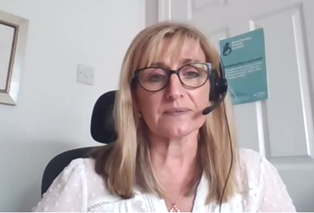
Glasgow-based infant feeding advisor Janice Moodie, who has a background in nursing and midwifery, said there is a need to protect, promote and support breastfeeding:
“I am pleased to say that we are improving in Glasgow. Our breastfeeding rates at 13 to 15 months in 2019 were sitting at 9.1%, but in 2022, they were 14.7%.
“The first 1,000 days of a baby’s life – from pregnancy to aged two – this is a crucial window of opportunity.”
The World Health Organization recommends breastfeeding for the first six months of a child’s life as breastmilk contains all the energy and nutrients required and helps establish a healthy immune system.
While WHO also recommend breastfeeding to provide a large proportion of a child’s nutritional needs throughout the first two years of life, it notes a “widespread misconception” that breastmilk can be replaced with artificial products without detrimental consequences
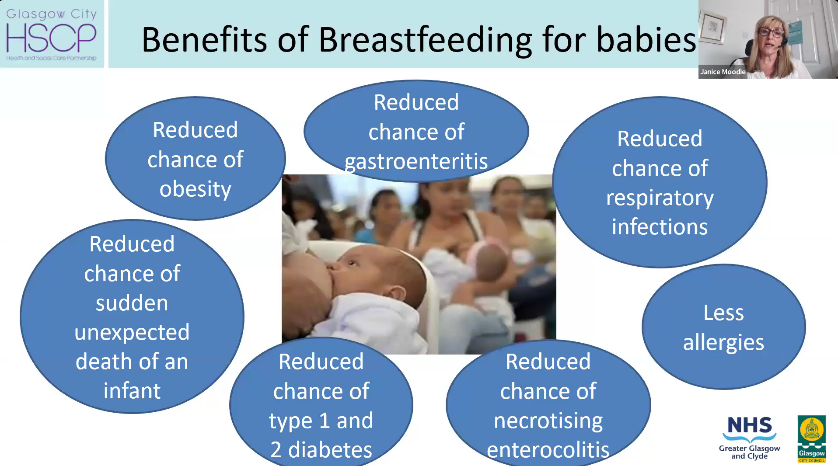
Ms Moodie said that the benefits from breastmilk span from fewer allergies, to even a reduced risk of respiratory infections, adding:
“Now if we look at epigenetics – which is just the study of how your behaviours and environment can cause changes which affect the way your genes work – breastmilk can change a child’s epigenetics with long-lasting health benefits.
“So how does this work? It can affect brain development, the immune system, the metabolic system.”
She said breastmilk helps ensure better cognitive development at age 5, particularly for preterm babies.
Ms Moodie explained that a hormone leptin is in breastmilk which helps regulate appetite and energy needs – while formula “dampens” this and has been associated with increased levels of obesity.
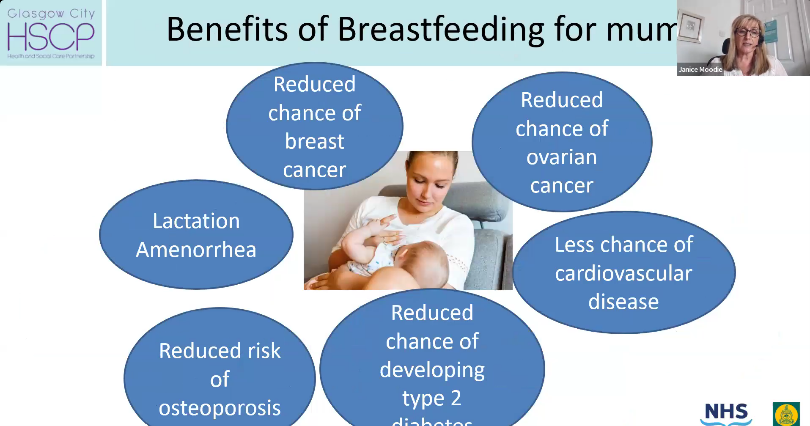
She added that the benefits extend to breastfeeding mums too, who see reduced risk of type 2 diabetes, breast cancer, ovarian cancer and even cardiovascular disease.
There is also a link between mothers who breastfed and a reduced risk of osteoporosis, but Ms Moodie said more research is needed on this.
However, she also recognised that some mums face challenges trying to breastfeed, noting that breastfeeding is not the sole responsibility of the mother.
From improving workplace policies, to ending exploitative formula milk marketing, she said governments and health organisations hold a collective responsibility to support breastfeeding.
She said if mums are unable to express or pump milk, the local donor milk bank can provide spare breast milk from others. Peer support networks also exist across Scotland.
Lyndsay Thomson, Glasgow Health Improvement Senior, said:
“It’s important to take this opportunity to consider the barriers and why breastfeeding mothers need some tailored supports.”
The UK has some of the lowest levels of breastfeeding worldwide, and eight in 10 women stop breastfeeding before they are ready.
Ms Thomson said while still not where it needs to be, there is some “excellent work” going on in Glasgow:
“Mothers will receive information booklets, antenatal appointments and health visitors to provide support around decisions about breastfeeding and have hospital-based peer support.
“Even if mums never intended to breastfeed, giving their breastmilk in the early days is like a medicine and spending lots of time with skin-to-skin contact has been shown to shorten hospital stays and help babies learn to feed.
“Mums can be supported with milk supply and transitioning onto breastfeeding if that’s what they want to do. Scotland’s safe, screened donor milk is available to all neonatal units and some parents in communities across Scotland.”
Ms Thomson highlighted that there are also community supports, including the Breastfeeding Friendly Scotland scheme that works to improve awareness with individuals and organisations, Glasgow’s Breastfeeding Buddies and the national breastfeeding helpline which is open 24/7.
However, event speakers said these initiatives need longer-term funding and families need more support from organisations, health boards, Scottish and UK governments.
Deprivation and breastfeeding
Ms Moodie added that the link between deprivation and breastfeeding cannot be ignored:
“For breast and formula feeding, in each area of the city the most deprived zones have lower levels of breastfeeding.
“It’s worth considering that an Executive Director of UNICEF described breastfeeding as a natural safety net against the worst effects of poverty. It gives the child a fairer start in life against the injustices of the world into which it was born.”
A recent study by the GCPH found that breastfed infants needed fewer healthcare services and had better health outcomes than formula-fed infants, no matter the level of deprivation of where they lived.
Intersecting inequalities
Mairi McLachlan, Health Improvement Senior in Infant Feeding for Glasgow City’s Health and Social Care Partnership, said that addressing health inequalities and the climate crisis go hand-in-hand:
“From production and transport to the waste from infant formula containers, formula-feeding has a substantial impact on the environment.
“Climate change induced emergencies have a detrimental effect on public health and contribute to increased mortality.”
Earlier this year, medics warned that rising pollution is risking children's health, urging the Scottish government to fund air quality monitoring across schools.
Ms McLachlan added that in emergencies, including storms and flooding where water can be contaminated, breastfeeding is the “safest, most nutritious food source for infants”, adding:
“Good quality food is usually more expensive but should be available to everyone, but it’s also true that generally it’s the small percentage of the more affluent in our society that can afford this.
“But the paradox of breastfeeding that struck me is that people are paying a lot of money for an inferior product, whereas the good stuff is free.
Read more: Children's care workers secure £12 an hour minimum; Medics warn pollution is risking children's health; Children's health not improving despite good policy; Health poverty hits children halfway through pregnancy; Regulation key to reducing obesity; ‘Bold action' needed for children's health
Sign up to our bulletin for key health & social care updates straight to your inbox and you can follow healthandcare.scot on Google News. |