|
NHS receives extra cash from medicines scheme |
Related newsRespiratory care vision unveiled Briefing: The 5-year plan for NHS, care and science Pharmacy’s road to stigma-free drug dependency care Chief Medical Officer: ‘Critical connections’ priority Government boosts health innovation funding Protecting public health through pathogen genomics Cancer patient support bolstered by new funding National Treatment Centres on pause Funding boost for neurological projects More ambitions than pharmacists Piecemeal approach to serious NHS errors handling NHS problems ‘still need fixed’ despite pandemic focus 
|
|
|
||
|
||
|
Scotland's NHS boards have received an unexpected windfall of more than £350m under a scheme to limit the costs to the public purse of medicines – allowing at least one NHS board to reduce the amount it will need in loans from the government to meet its deficit.
The UK government has for many years entered into an arrangement with the pharmaceutical industry to keep a lid on medicines spending, with any excess over an agreed amount repaid to the Treasury.
The UK government, in turn, pays the Scottish government a share of that money which ministers have, for the last decade, ring fenced as the New Medicines Fund. Because the amount varies, the New Medicines Fund has been distributed to NHS boards as additional, non-recurring, payments.
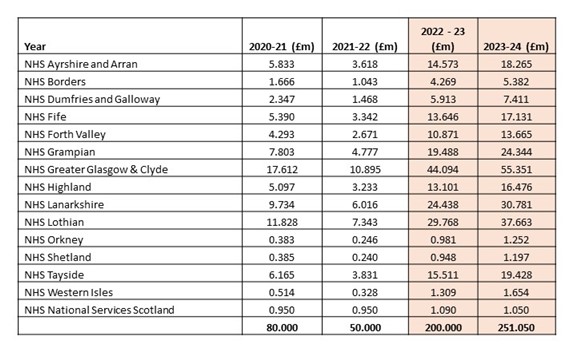
Between 2014 and 2022, NHS boards shared annual amounts that varied from £85m in 2015-2016 to £50m in 2021-2022.
At the height of the pandemic, the Scottish government chose to augment the New Medicines Fund with an additional £30m from the health budget to help boards deal with an increase in their spending.
Figures released to healthandcare.scot following a freedom of information request show that the amounts paid out under the New Medicines Fund in 2022-2023 and 2023-2024 (the current financial year) increased significantly, to £200m and £251m respectively.
The medicines industry trade body, ABPI, says that branded medicine spending ‘ballooned’ following the pandemic, and 2023 saw members of the previous scheme pay pack 26.5% of their medicines sales.
Funding more than medicines
In reports to their boards, NHS finance directors have been talking about the additional payments.
A report to the board of NHS Lanarkshire made it clear that the additional funding was to be used to help address shortfalls beyond the medicines budget, while NHS Ayrshire and Arran received a rebuke from the Scottish government for using the income from the Fund and other variable payments to paint a rosier picture of their board finances than the government felt was justified.
In her update on the year to 31 December, the NHS Lanarkshire Director of Finance stated that the New Medicines Fund represented the largest of the ‘non-recurring measures’ that had improved the board’s overall financial position.
Last November, the Director of Finance in Lothian told his board that, even with the additional funding, the board would overspend on medicines:
'Drugs expenditure is showing a year to date overspend of £8.7m. This is despite the additional £15m of in year New Medicines funding received from the Scottish Government and distributed against existing pressures earlier in the year. Acute drugs expenditure accounts for £7m of the financial pressure, with a further £1.7m sitting against the Partnerships and Mental Health Services budgets'.
NHS Scotland chief executives have included targeting medicines spending and prescribing as one of their 15 actions to help balance the NHS books citing growing NHS medicines bills.
Last week, Audit Scotland’s report on the NHS in 2023 stated that costs associated with primary and secondary prescribing rose by 0.6% (£12.5m) in real terms in 2022/23, to £2.1bn.
The report acknowledged that a total of £200m, including money from the New Medicines Fund, was provided to boards in the summer 2023, but did not state whether the numbers for the increase in spending on medicines had been modified to consider the additional income from the New Medicines Fund.
How the scheme works
At the end of last year, the UK government on behalf of all four UK nations negotiated a new scheme with the industry.
The medicines industry trade body, ABPI negotiated the previous and new schemes on behalf of the industry.
Alison Culpan, Director of the ABPI in Scotland, the new scheme will help make Scotland and the rest of the UK more attractive for companies looking to invest:
“Under the 2019 voluntary scheme (VPAS), the NHS branded medicines budget growth was capped to 2% growth per year. When spend went above that, industry returned all the additional spend back to the health departments in England, Scotland, Wales and Northern Ireland.
“Following the pandemic, NHS spending on branded medicines ballooned, driving industry repayments from 5% to 26%.
“The previous voluntary scheme (VPAS) has ended and been replaced by a new voluntary scheme for pricing, access and growth - ‘VPAG’.
“Payment rates over the next five years depend on medicines growth, although they will still be in the middle to high teens in 2024. The VPAG is designed to make sure medicines spend overall is affordable across the UK, and help make Scotland and the whole of the UK more attractive for companies to invest in. We continue to monitor this closely to make sure the new deal works for both industry and the NHS in the coming years.”
The new voluntary agreement between the UK government’s health and social care department, NHS England and ABPI will run for five years until December 2028.
This agreement still includes a yearly cap on branded medicines sales to the NHS, with sales above that cap being paid back to the government via a levy.
While 2024 will see this annual sales growth cap remain at 2%, this will double to 4% by 2027.
Under the new agreement, the pharmaceutical industry will also invest £400m over five years to driving forward UK innovation, sustainability, and growth through the Life Sciences Investment Programme. This will include bolstering the NHS’s capacity to deliver clinical trials research, supporting sustainable manufacturing and innovative health technologies.
NHS boards have been told to work on the basis that in the coming financial year receipts from the new medicines fund will be around £80m nationally, closer to the amounts seen before 2022.
Read more: Government explains cut in new medicines fund; Joint pharmacy project cuts adverse events; Realistic medicine to help the climate; ‘Bleak picture': health leaders react to NHS review; Cancer outcomes worse for rural patients
Ettrickburn, the health and care communications consultancy company founded by the publisher of healthandcare.scot, supports some of the work of ABPI in Scotland. This article is editorially independent and ABPI's only inpute was to supply the quote used above.
Sign up to our bulletin for key health & social care updates straight to your inbox and you can follow healthandcare.scot on Google News. |