|
Briefing: The 5-year plan for NHS, care and science |
Related newsNHS receives extra cash from medicines scheme Research enabled innovation spotlighted Scotland’s NHS and social care app timeline unveiled Rare condition screening for newborns across Scotland Chief Medical Officer: ‘Critical connections’ priority ALLIANCE: Action needed from Scotland’s leaders 
|
|
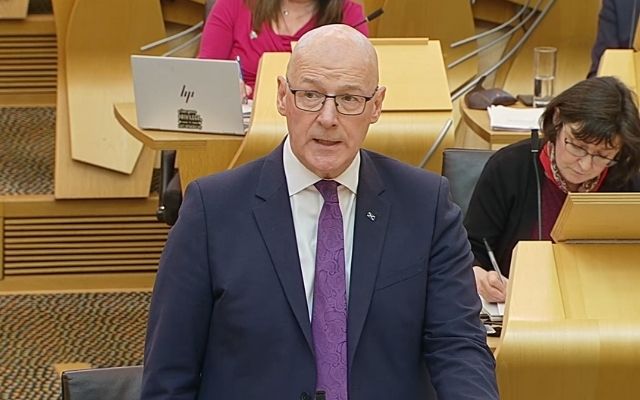
Image: Scottish Parliament TV
First Minister John Swinney presents the Programme for Government to the Scottish parliament.
|
||
|
||
|
The Scottish government is to radically change the structure of NHS Scotland, reduce the number of councils and place the leadership of social care into the hands of the NHS under plans unveiled by the First Minister.
Unveiling his government’s five year programme for government, John Swinney in his speech to the Scottish Parliament set out what he said was a vision for “more modern, more flexible, more person-centred public services, delivered by a Scottish state that is rewired and reimagined.”
A central driver of public service reform is also money. Without corrective action, the Scottish government has estimated it will have an annual funding gap approaching £4.8bn by 2029-30 made up of some £2.6bn for day-to-day services and over £2.1bn for capital.
A new NHS map
Central to the government’s plan is what Mr Swinney called “the most significant structural reform of our NHS in the era of devolution”: replacing Scotland’s current 14 territorial NHS boards with two strategic health boards.
Although no details were included in the speech or document, the proposals will be based on last year’s plan to create two sub-national NHS groupings for the East and West, but now with the potential for a separate approach for the three island groups - Shetland, Orkney, and the Western Isles – potentially seeing the creation of combined island local government and health organisations.
The main long-term savings are likely to be made through employing fewer people. However, Mr Swinney told BBC Radio Scotland this morning that the current arrangement of there being no compulsory redundancies in the NHS will remain.
Across all public services, the government says it is committed to more effective use of technology, with staff working on the frontline, Mr Swinney said, “encouraged, and enabled, to break through silos between organisations, in order to respond to the real-life needs and experiences of the people that they serve”.
The government says reorganisation and best use of digital will deliver more efficient use of resources across Scotland, freeing up more time and capacity for treatment, and improving patient access through more joined up care.
As a result, ministers promise, by the end of 2031 no one will wait more than 26 weeks for treatment.
Health announcements
The Programme for Government covers the five years of the new parliament and includes a large number of commitments in health.
Many focus on data and digital, including integration of data systems, creating a single Digital Health and Care Record for every person in Scotland, setting up an AI Hub to accelerate safe adoption of AI across the health and care system, and continued rollout of services on the MyCare.scot patient app.
In secondary care, there will be support for broadening same day services in hospitals, expanding Hospital at Home to reach 10,000 patients this coming winter, and what ministers call a “discharge without delay” principle for every person admitted to hospital.
Ministers now accept that thrombectomy services have not been adequate and Mr Swinney told MSPs the NHS will move to “deliver 24/7 thrombectomy cover, regardless of geography”.
In diagnostics there are commitments to employ more radiographers, but not radiologists, expand Rapid Cancer Diagnostic Services, and rolling out phase 1 of national lung screening in 2027/28. There is a commitment to develop infrastructure for genomics, including ‘early development of a registry for people at increased genetic risk of cancer’.
The second phase of the Women’s Health Plan will be taken forward alongside the National Plan for Gynaecology.
Primary care services will continue to be expanded including locally based diagnostic services and the delivery of additional of walk-in GP centres.
As part of the ambition to increase the focus on prevention, the government wants to investment in ‘health MOTs’ and to examine lowering the age for bowel screening.
In mental health, there are commitments to improve services: creating new walk-in mental health hubs across Scotland based on SAMH’s ‘Nooks’ model, getting ‘Mental Health Triage Cars’ on the road across Scotland and including psychological therapies in an expanded NHS24 mental health hub service.
Ministers say they will now implement the Royal College of Psychiatrists’ 4-tiered national pathway for neurodevelopmental conditions for adults, and continue to implement the Children & Young People’s National Neurodevelopmental Specification ‘to ensure anyone with or without a formal neurodevelopmental diagnosis can access the support they need when and where they need it’.
No mention is made in the programme of the policy government was developing on long term conditions, which sought to move away from delivery plans for specific conditions to a wider multi-conditions Framework, which was delayed when several patient advocacy groups raised concerns.
To attract more clinicians, there will be a review of ‘Golden Hello’ initiatives for GPs, consultants and dentists in rural Scotland, and moves to widen recruitment into nursing. Meanwhile the Programme for Government says pathways to progression from band 5 to band 6 for nurses will be improved.
Social Care
Public sector reform looks set to redraw the local government map as well as that of the NHS.
Mr Swinney told the parliament:
“In Scotland today, we are faced with the reality that some of our councils are too small to be strategic and some are too big to be local. The government believes that should change.”
And he said council reform is necessary to reduce capacity pressures on the NHS:
“Decisions on social care at a council level impact on the health service and the NHS’s ability to deal with problems like delayed discharge. That means money is being spent in ways that do not deliver the best results for citizens. This too must change,” he said, adding,
“I do not seek to be prescriptive, but I cannot see us resolving the fundamental challenges facing social care without a single line of decision-making, accountability and funding, with the NHS taking the lead.”
Beyond local government’s role in social care, the government also committed to:
Wider policies impacting on social care will be a commitment to work with the third sector ‘founded on trust, collaboration and mutual respect, strengthening and embedding the sector’s contribution to delivering key priorities’; and moves to enact a long-promised Human Rights Bill.
Life Sciences
Scotland’s life sciences and research sector is recognised in the Programme for Government as one of four innovation priorities for economic growth.
The government says it will:
‘Drive innovation in health and care through a partnership between industry, NHS Scotland and other care providers through innovative procurement and support for an industry led Life Sciences cluster and our £35 million Life Sciences Accommodation programme,’ adding, ‘Over the course of this Parliament, we will grow Scotland’s clinical trials capacity to attract more clinical research and investment for the benefit of all.’
There are to be new ‘regulatory sandboxes’ where new innovations and technology in healthcare and life sciences ‘can be introduced, tested and implemented at pace’.
A High Growth Unit will be set up to ‘accelerate support for high-potential businesses to scale, anchor and grow in Scotland’, while a there will also be a consultation on legislation ‘to address further opportunities to modernise procurement, maximise economic and social impact and protect Scotland’s interests, including how to drive innovation in health and care’.
Read more: Briefing: NHS reform in the Holyrood manifestos; Briefing: Social care in the manifestos; Briefing: Mental Health in the manifestos; Manifesto briefing: Life sciences & clinical research
Sign up to receive our bulletin for key health & social care updates straight to your inbox. |