|
Eye provides a window to kidney health |
Related newsScots to benefit from new NHS heart treatment Government boosts health innovation funding Scots kidney disease patients urge politicians to act Rare condition screening for newborns across Scotland AI for lung cancer care to help tackle “hidden killer” Health and charity leaders join forces for NHS reform Edinburgh IJB faces judicial review over cuts New Edinburgh hub set to transform global healthcare Edinburgh welcomes outdoor brain health centre NHS Lothian escalated over CAMHS performance Youth mental health pilot looks to the future Veteran support cut in ‘stark’ review 
|
|
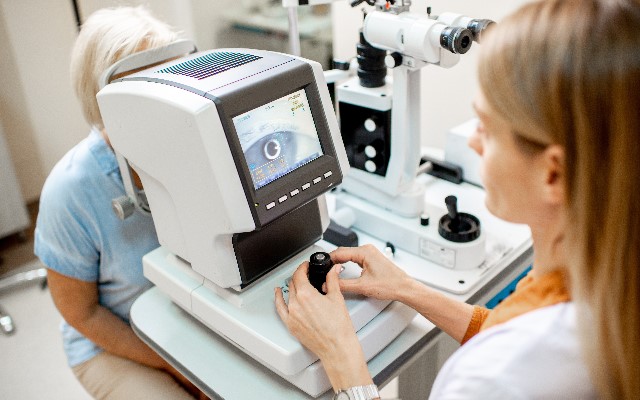
Image Credit: © rh2010
|
||
|
||
|
Edinburgh researchers have revealed that ‘crucial insights’ are being gained into kidney health by looking first at the eye – with a new study showing that 3D eye scans can help detect and monitor kidney disease in its earliest stages.
Published in a peer-reviewed study, the University of Edinburgh team says their research shows that the eye provides ‘vital clues’ about kidney health that could help to track the progression of disease and advances in technology could ‘revolutionise’ the way we monitor kidney disease.
Kidney disease often progresses without symptoms in the early stages.
Previous research by the university has looked to repurpose old drugs to treat acute kidney injury which can often lead to chronic kidney disease (CKD).
Now, this study provides hope that kidney health could be monitored and kidney injuries or disease screened for by turning to the retina – the tissue at the back of the eye which senses light and sends signals to the brain.
Using highly-magnified images to detect changes to the retina, researchers found that the images offer a ‘quick, non-invasive’ way to monitor kidney health of participants by looking at the blood flow, which is affected by kidney disease.
Dr Neeraj (Bean) Dhaun, Professor of Nephrology at the University of Edinburgh’s Centre for Cardiovascular Science, said:
“We hope that this research, which shows that the eye is a useful window into the kidney, will help identify more people with early kidney disease – providing an opportunity to start treatments before it progresses.
“It also offers potential for new clinical trials and the development of drug treatments for a chronic disease that, so far, has proved extremely difficult to treat.”
The eye is the only part of the body that allows a non-invasive view of microvascular circulation – the flow of blood through the body’s tiniest vessels – which is often affected by kidney disease.
The University of Edinburgh team utilized optical coherence tomography (OCT) to take 3D images of the retina which then enabled them to identify and accurately predict the progression of kidney disease.
OCT scanners – used in most high street opticians – use light waves to create a cross-sectional picture of the retina, displaying each individual layer, within a few minutes.
Looking at OCT images from 204 patients at different stages of kidney disease, including those patients with kidney transplants, alongside 86 healthy volunteers, researchers identified key changes.
They found that patients with chronic kidney disease had thinner retinas compared to healthy volunteers – and this thinning of the retina progressed as kidney function declined.
Hope for the future
Researchers say that this technology has the potential to support early diagnosis in ways current blood and urine tests cannot as they often only detect the condition once it is causing a relatively high loss of kidney function.
Funded by Kidney Research UK, the study also found that the retinal changes observed were reversed when kidney function was restored following a successful transplant.
Researchers observed that patients with the most severe form of the disease who received a kidney transplant experienced ‘rapid thickening of their retinas’ following surgery.
They say that – with further research – regular eye checks could form part of a national screening and monitoring process for kidney health which could prevent the disease from progressing.
Additionally, researchers say, this could support patients to make lifestyle changes that reduce their risk of health complications.
The Edinburgh team says the technology, supported by Heidelberg Engineering’s imaging platform, could also aid in the development of new drugs by using changes in the retina as a measure of success for potential new treatments.
The researchers say further studies – including longer-term clinical trials in larger groups of patients – are needed before the technology can be routinely used.
Dr Aisling McMahon, executive director of research and policy at Kidney Research UK, said:
“Kidney patients often face invasive procedures to monitor their kidney health, often on top of receiving gruelling treatments like dialysis.
“This fantastic research shows the potential for a far kinder way of monitoring kidney health.
“We are continuing to support the team as they investigate whether their approach could also be used to diagnose and intervene in kidney disease earlier.”
Earlier this year a report for Scotland by Kidney Research UK’s detailed that chronic kidney disease diagnoses often come as a ‘complete shock’ to patients.
Read more: Renal research needed to advance care, says nurse; ‘Smart' scalpels for surgical training; Redefining clinical meaningfulness; Microwaves offer less invasive cancer therapy; Chief Scientist calls for more research volunteers; Genome research sees £46.3m boost
Sign up to our bulletin for key health & social care updates straight to your inbox and you can follow healthandcare.scot on Google News. |
