|
Unpaid carer: Funding is vital to delivering the NCS |
Related news“Relentless focus” on health inequalities All public bodies must focus on health, urges charity Carers charities urge greater transparency in reforms Chief Medical Officer: ‘Critical connections’ priority Health and charity leaders join forces for NHS reform Highland to end unique health and care model Treatment-resistant cancer focus of new study Enhancing independent living with robotics Law change needed for Scotland’s drug crisis Libraries offer light lift for low winter mood Medics warn pollution is risking children’s health Peer support ‘crucial’ in suicide prevention 
|
|

Image Credit: © fizkes
|
||
|
||
|
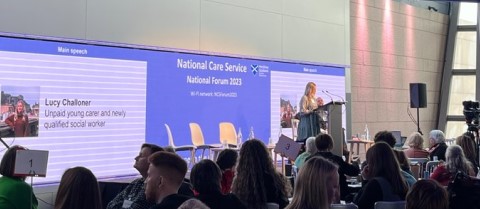
A social worker with experience of being a carer since childhood says reforming social care in Scotland will not succeed until more money is invested in the sector and its staff are properly valued. Lucy Challoner spoke at the National Forum on the National Care Service held in Glasgow last week.
healthandcare.scot has reproduced her address in full.
My name is Lucy Challoner. My personal experiences growing up showed me some of the many challenges faced by social care in Scotland.
I have always been interested in social care and this drew me towards working in this area. I spent time working as a support worker and have recently qualified as a social worker.
I would now like to give you a brief summary of my experience with social care and the insights I hope can contribute towards improving care in Scotland.
The road towards becoming a carer began when my dad passed away.
I was 9 years old at the time and my mum struggled to cope. She became unwell with mental health issues, and this led to an alcohol addiction.
Temporary care for long-term conditions
My mum’s drinking worsened over the years and her health deteriorated.
She was eventually diagnosed with alcohol-related brain damage (ARBD), a condition where there are changes to the structure and function of the brain as a result of long-term, heavy alcohol use.
People with ARBD can have problems with their memory, their mobility, and their ability to live independently.
After her diagnosis, my mum was discharged from hospital and admitted to an ARBD rehab unit in Edinburgh.
I became a kinship carer to my younger brother at the age of 18. I found life very challenging during this time, and this was made harder without financial support for my role.
I was very anxious about my mum’s situation and the possibility of her returning home and relapsing.
Looking after my younger brother caused tension between us.
As the rehab unit was temporary, we had to find a care service for my mum to move onto.
Finding an appropriate service for my mum felt impossible at times.
While I had support from social work, there were no suitable services in Edinburgh. This led us to find an ARBD unit in Glasgow.
After spending several years there, my mum moved to another service in Glasgow. She eventually moved back home, largely as a result of lockdown restrictions.
This experience taught me many lessons about the reality of care faced by many across the country.
It showed me the lack of suitable services in Scotland. There needs to be a greater diversity of services that suits the complexity of people’s needs and conditions.
Care should not be a “one size fits all” approach.
Finding the appropriate support made all the difference for my mum’s recovery. However, this was not always easy to access, and it required her to move to another city.
I feel that without strong advocacy from a family member or friend, it is too easy for someone to fall through the cracks and receive unsuitable or little to no support.
Recognition for carers
With the proposal for an overhaul of the Scottish care system, there are broader issues that must be addressed for its successful implementation.
Greater financial investment is the main avenue towards creating better care. This could be used to commission new services and improve pay for the sector.
If we want to uphold human rights and strive towards “choice and control” then we need the funding.
We must place more value on the social care workforce. It is a highly skilled sector that is often overlooked. Without better recognition we cannot address the social care crisis.
Increased funding would address this as it could create improved pay and conditions. This could attract and retain more people to a vital sector of society.
Unpaid and informal carers also deserve greater recognition. We must end the reliance on unpaid carers to fill the gaps in social care.
Figures published in August 2023 by Social Security Scotland show that out of the estimated 800,000 carers in Scotland, only 83,407 receive Carer’s Allowance.
This is a reminder that 90% of all those who provide unpaid care in Scotland receive no financial support to help with the cost of caring.
As a former informal kinship carer to my younger brother, I know what a difference additional financial support and recognition could make.
The power to transform lives
Based on my experience, we must increase, diversify, and improve service provision in all communities.
This includes rural, island and urban communities, which all face their own unique challenges.
We also need to place greater recognition on unpaid carers and the wider social care workforce.
This all starts with increased funding.
Without this step, the National Care Service will not provide the level of care that the people of Scotland deserve.
I used to become frustrated with the care system when I felt not enough was being done to help my mum, but now as a social worker I better understand the challenges brought by the lack of funding and service provision.
Without adequate funding, the care sector’s ability to make a meaningful impact on society is severely constrained.
This tension will not be resolved if there is an overhaul of the sector without sufficient funding behind it.
We must place greater value on the sector if we are going to make meaningful change.
It is likely all of us, or our family or friends will need to access social care at some point in our lives.
Creating a better future for care is a choice, and it’s a choice that holds the power to transform lives.
Read more: Holyrood scrutinises self-directed support 10 years on; Auditor General: Difficult choices for Scotland's NHS; Carers in ‘devastating' financial hardship; Holyrood committee fails to back Transitions Bill; Plea to hear the voices of drug death families
Sign up to our bulletin for key health & social care updates straight to your inbox and you can follow healthandcare.scot on Google News. |