|
Economic change key to Scotland’s health inequalities |
Related newsChief Medical Officer: ‘Critical connections’ priority Health and charity leaders join forces for NHS reform “Mayday”: voices from NHS emergency departments Doctors say GP funding boost “just the start” Plea to see social work as ‘backbone’ of health & care Less than full-time – behind the NHS trend Treatment-resistant cancer focus of new study Enhancing independent living with robotics Law change needed for Scotland’s drug crisis Libraries offer light lift for low winter mood Medics warn pollution is risking children’s health Peer support ‘crucial’ in suicide prevention 
|
|
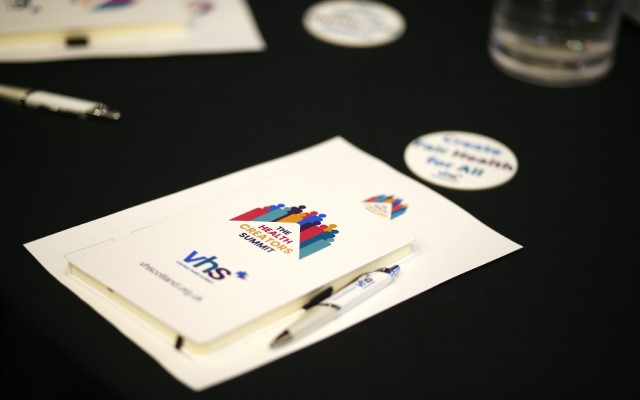
Image Credit: © Voluntary Health Scotland (VHS)
|
||
|
||
|
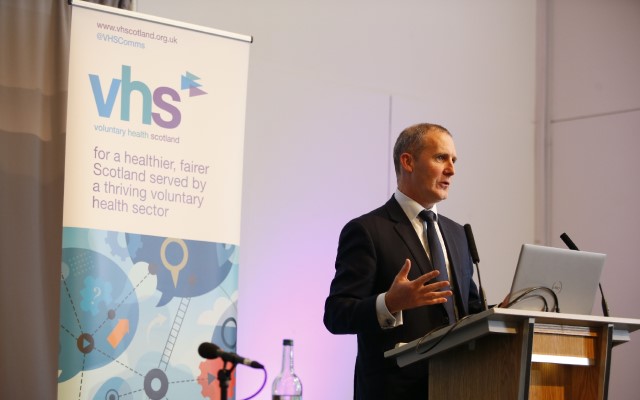
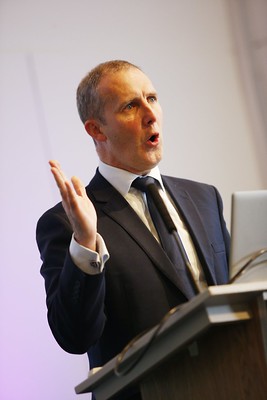
Addressing attendees at the Voluntary Health Scotland annual conference, Michael Matheson said that economic change and collective voices from across sectors are essential to “making a difference” to health inequalities.
The Cabinet Secretary for NHS Recovery, Health and Social Care told an audience of workers, researchers and leaders in the voluntary health sector that “system change” is needed and their voices are essential to this.
He said that without changes in economic policies to tackle social inequalities, the healthcare system will not be able to meet the health demands of people across Scotland:
“The health inequalities that we face as a society in Scotland are actually the consequence of social determinants rather than actually being the healthcare system itself.
“So this historical view that the healthcare system and health have to fix health inequalities, in my view, is actually the wrong way around.
“The healthcare system very often ends up dealing with the consequences of social inequality and that results in health inequalities within our society.
“Probably much more significant from my perspective is that, as we look forward – do we expect healthcare inequalities to decline? Do we expect mortality rates to decline? Do we expect to have a healthy society going forward?
“And right now, my answer to you would be no we don’t.”
Echoing concerns raised in his SNP conference speech, Mr Matheson explained that UK government austerity policies have been “exacerbating” health inequalities:
“It has been economic policy – it has been austerity that has resulted in quite literally killing people. That’s the nub of what is happening here, economic policy is having a direct impact on health outcomes.
“If we want to address issues around tackling health inequalities, we need to stop thinking that the healthcare system has to become more preventative. I’m not entirely sure many of us could define what we mean by a preventative healthcare system.”
He added that the reality is that unless there is a change in the economic policy which upholds these gaps in health and wellbeing, we will continue to see worsening trends in health inequalities.
He said that, as Scotland’s Health Secretary, he sees the challenge now is in owning up to and accepting the consequences of the existing approach to economic policy and the impact it has on health.
Creating health
On the theme of this year’s VHS annual conference, ‘Health Creators’, Mr Matheson told attendees that current economic policies will not create a healthy society.
To change this, he says, policy teams across portfolios need to work together to address the factors underpinning health inequalities, adding:
“I believe we need to have an unrelenting focus on tackling the social determinants of poor health and that means challenging the status quo around developing and setting economic policy.
“If I go to some of the parts of Glasgow where we know there are marked and very stark health inequalities, I can see people living in better housing but they’re probably poorer today than they were four or five years ago.
“Their ability to actually afford some of the basic necessities of life has become more challenging because of the cost-of-living crisis we’re facing at the moment as well.
“We almost have a perfect storm, we can tackle some of the social determinants like housing can have an impact – improving the quality of housing stock, but actually finding that households are poorer at the same time.”
Earlier this year, charities and researchers called for immediate action from the Scottish government to address the ‘devastating’ impacts of the cost-of-living crisis on disabled people.
Just a few weeks ago, Carers Scotland urged the government to uprate all devolved benefits with inflation as its annual report painted a ‘bleak picture’ with carers cutting back on both food and heat.
Audit Scotland has since called for urgent workforce reforms to ensure Scotland’s NHS and wider public sector can deliver services effectively amid and expected £1bn budget gap.
Meanwhile, Mr Matheson said that an unrelenting focus on the social determinants of health inequalities and economic policy is crucial to prevent a “legacy” of harm for decades to come.
He told attendees at the VHS conference that putting money into households pockets makes a “big difference” to health outcomes and the current system’s ways of working must be challenged:
“We need to challenge the way in which the system presently operates and the way in which the system presently understands and tries to address health inequalities.
“And that requires collective voices, the voices of people involved in third sector, statutory sector organisations, academics and helping to create that collective voice for change to try and ensure we create the system change necessary to address these issues.”
While the Scottish government’s own winter plan does not detail direct financial support for households likely to experience the worst impacts of poor health this winter, the government has since announced a consultation on care leavers funding.
Mr Matheson said that without change in social and economic policy, the health and social care system “won’t be able to sustain itself”, adding:
“We can’t expect the healthcare system to soak up the challenges and difficulties we’re experiencing as a result of misguided and misdirected social and economic policy.
“It won’t be able to meet the demand. We only need to look at the burden of disease set to increase over the course of the next 20 years – the marked inequalities that are becoming more and more exacerbated, to realise that more of the same won’t work.
“I’m very open to and up for a debate on how we can collectively use our voices to create system change and deliver change that provides better outcomes for the future.”
Read more: Doctors ‘deeply concerned' for care homes over winter; Auditor General: Difficult choices for Scotland's NHS; Winter funding for ambulance services; Cut to Glasgow link worker service
Sign up to our bulletin for key health & social care updates straight to your inbox and you can follow healthandcare.scot on Google News. |