|
The app for more ‘dementia friendly’ communities |
Related newsDementia home care tech collab invites partners Using VR to understand lived experience of dementia Scotland commits to change the dementia story Music’s potential to help with dementia Scots honoured across health and care Accelerating digital innovation in social care Law change needed for Scotland’s drug crisis Medics warn pollution is risking children’s health Peer support ‘crucial’ in suicide prevention Cancer workforce “not on right trajectory” Support grows for LEZs in Scotland Rural communities experience less loneliness 
|
|
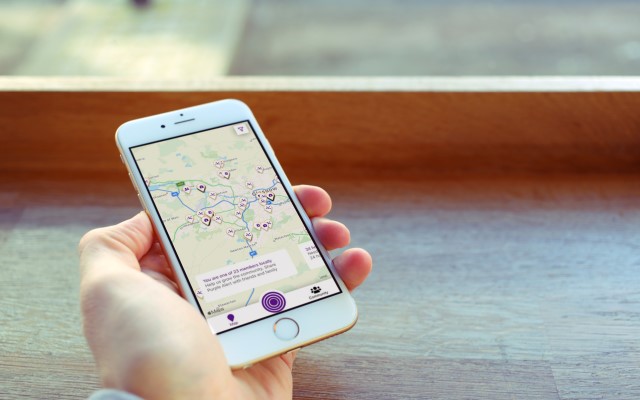
Image Credit: © Alzheimer’s Scotland.
|
||
|
||
|
A free-to-use missing persons app from Alzheimer's Scotland, heralded as ‘pioneering’, aims to support people living with dementia and their carers by harnessing the power of community care and digital technology.
Purple Alert is designed to help families and carers before, during and after someone with dementia has gone missing.
There are around 90,000 people living with dementia in Scotland and 40% of them are reported missing at some point.
At the Alzheimer's Scotland annual conference held in Edinburgh, Tommy Petillo, Senior Service Designer and Purple Alert Coordinator at the charity, said the app has been developed to support efforts led by Police Scotland.
He told healthandcare.scot that Purple Alert has the potential to save lives but highlighted that the first thing someone should do when a loved one goes missing is call the police as soon as possible.
Since 2015, Alzheimer’s Scotland has been working with Police Scotland, emergency services, and health and social care partnerships to ensure Purple Alert aligns with services in Scotland.
Purple Alert provides a space for carers to input information about their loved ones and create a profile with key information – from a description of the person to health issues and places of importance.
The profile remains private until a person is reported missing with the police and the carer has raised a Purple Alert. The app then notifies Alzheimer's Scotland and any nearby Purple Alert users that a someone with dementia has gone missing.
Mr Petillo explained how Purple Alert has tried to recreate the sense of community care of ‘1950s living’ in Scotland to make areas more dementia friendly:
“We realised very early on in the development stage how powerful communities can be when they get together. In some of the early focus groups in 2015, there was a common thread about 1950s tenements living, where members of the community looked out for each other and if someone was missing someone, somewhere, would have known something!
“We then asked ourselves... ‘how do we recreate 1950s tenements living in a 2015 digital Scotland?’”
“Purple Alert is designed to make people living with dementia safer when out and about.
“One of the positive aspects of the app is that it relies on the community looking out for vulnerable members rather than the person with a diagnosis of dementia using (or not) wearable technology.”
While the app is designed primarily for carers, the charity has created dedicated toolkits for both carers and community members who want to help make their area dementia friendly.
The brief guidelines highlight how people can engage with the app directly to share and use relevant information provided to stay aware in their local area and, where appropriate, check their local vicinity for a missing person.
The toolkit for community also details how members of the general public might approach the missing person with dementia if they do see them.
Mr Petillo told healthandcare.scot that Purple Alert forms one part of the puzzle for missing persons:
“However, even if a family doesn't feel comfortable using Purple Alert, they may ask their extended family, friends, colleagues, and neighbours to download it. The more people that have the app, the safer Scottish communities will be for people with dementia when out and about.”
Despite around 30 to 50 new users every week, he added that there are still underserved areas. Mr Petillo says there is a “growing community out there ready to help” and the more people use the app, the more communities are empowered.
Mr Petillo shared that the biggest challenge to extending support is that many people are unaware of Purple Alert despite an international presence:
“There are still many who haven't heard about the app, that's been the main challenge, reaching into communities and raising the profile of the app.
“However, Purple Alert is being heralded as a pioneering project by many around the world.
“We have been collaborating with some organisations in the rest of the UK for some time. Our dream would be a UK-wide rollout – and we have also been contacted by organisations in Canada, the US, Australia, Italy and Denmark who are very keen to learn more about Purple Alert.”
Looking forward, he shared that Purple Alert is continually developing:
“The app works really well right now, but we have 1,000 ideas on how we could make it even better. Due to developing costs we have to be careful in what we prioritise, but we're always open to conversations with funders and stakeholders to find the right partner to develop the next feature of Purple Alert.”
Read more: Unheard: Care workers and COVID; Voices of experience key to dementia care; Carers at a health and poverty tipping point; Doctors ‘deeply concerned' for care homes over winter; Briefing: Scotland's ‘new story' for dementia policy
Sign up to our bulletin for key health & social care updates straight to your inbox and you can follow healthandcare.scot on Google News. |