|
FM commits to £12 an hour for care staff |
Related newsFirst Minster pledges people will see GP sooner New palliative care strategy for Scotland Workforce and public to inform NHS reform Psychiatrists in ‘disbelief’ over cut funding Winter funding for ambulance services Party health and care leads are named Briefing: Cabinet Secretary plans for health and care Watchdogs: Scotland’s IJBs face £124m gap Joint pharmacy project cuts adverse events Analysis: Why people are left behind Health and care in programme for government 
|
|
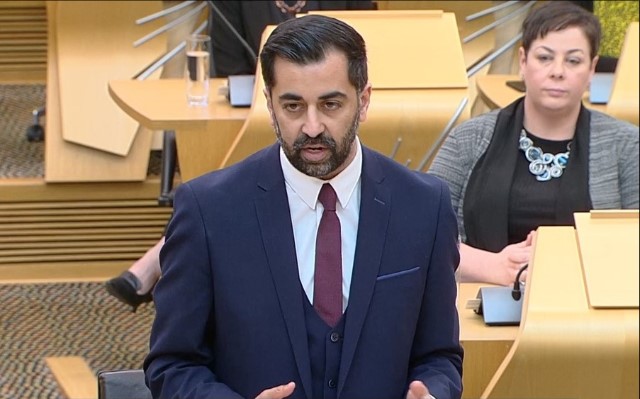
Image: Scottish Parliament TV
First Minister Humza Yousaf
|
||
|
||
|
Scotland’s First Minister has said he will increase the minimum wage for social care staff to £12 an hour – but not “absolutely immediately”.
Scotland’s First Minister, Humza Yousaf, addressed parliament yesterday as he launched a new policy prospectus, ‘New Leadership – A Fresh Start’, outlining the Scottish government’s commitments for the next three years – focused on ‘equality, opportunity and community’.
He promised greater investment in general practice and social care, and to make tackling the recruitment and retention crisis across the health and care workforce a ‘top priority’. He also confirmed that, while he remains committed to a National Care Service, discussions to shape it will now continue through the summer.
Major unions for nursing staff and physicians have welcomed some commitments but called for clarity on achieving targets and for the government to focus on the workforce crisis.
Meanwhile, his announcement that he was sending plans for restrictions on alcohol advertising “back to the drawing board” came on the eve of the publication of a call by 34 campaigning and clinicians’ organisations for the First Minister to show strong leadership in reducing alcohol deaths.
Mr Yousaf’s new prospectus commits to increase adult social care workers pay to £12 an hour, though while addressing parliament he said £10 an hour – a pay cut – which was later amended when his speech was published.
“I know well the workforce challenges that the adult social care sector in particular faces,” Humza Yousaf told MSPs.
“That is why I will commit to a timetable that sets out how this government will get to £12 an hour for adult social care workers. While we are not able to afford to do this absolutely immediately, I want to send a signal to the sector that we are absolutely serious about improving pay, about improving terms and conditions for those who care for our most vulnerable.”
Mr Yousaf also announced that government will reduce NHS waiting times and waiting lists with its new National Treatment Centres, currently established in NHS Highland, NHS Forth Valley, and NHS Golden Jubilee and those still in development:
“The NHS in the last three years has faced the greatest challenge in its 74-year existence. Its staff have performed magnificently in the face of the pandemic.
“We will invest in the NHS to help it recover from the pandemic – so that over the next three years, waiting lists will fall and the outcomes for cancer treatment will improve. We will continue to support primary care, and we’ll invest more in general practices particularly in the most disadvantaged areas in the country.”
Clinicians give guarded welcome
Commenting on the First Minister’s statement, Professor Andrew Elder, President of the Royal College of Physicians of Edinburgh welcomed some of the commitments but called for the return of the older people’s ministerial portfolio:
“We welcome the Scottish government’s commitments to reduce waiting times year on year, to reduce drug deaths and alcohol deaths, to increase physical activity, and to improve workforce planning and wellbeing. This is an ambitious agenda and these are the issues that must be prioritised.
"In addition, we welcome the opportunity to spend more time exploring the detail of how a National Care Service might deliver the outcomes desired. We request, given the appropriate emphasis on equality, that the reinstatement of a specific ministerial portfolio for older people is considered.”
Trade unions and charities submitted a joint letter calling for a pause to the NCS Bill, and a further delay was announced earlier this week.
Royal College of Nursing (RCN) Scotland’s Director, Colin Poolman, also welcomed the pause, adding that further engagement is essential:
“The further pause to the National Care Service Bill is welcome. The RCN has serious concerns about the Bill and we are calling for the Scottish government to take time to engage properly with stakeholders – including staff working at all levels within the social care and community health sectors - to develop detailed plans for reform prior to taking forward primary legislation.
“Rather than simply pushing through expensive and disruptive structural overhaul without a clear understanding of how to fix the current problems facing the sector, Ministers need to focus now on tackling the workforce crisis in social care and community health.”
Calls for more engagement, money and reform
Earlier this year, the Auditor General called for more transparency from the government on the recovery and reform of the NHS amidst growing financial and workforce challenges.
In response to the First Minister’s speech earlier this week, Professor Elder warned that the government’s new package of policy ambitions will be difficult to meet without working with health and social care professionals and patients:
“Based on current trajectories, we suspect that meeting these ambitions will be difficult. Therefore, the Scottish government must be innovative in its approach.
“It must seek advice on innovation from a wide range of experts – including doctors and other professionals working in our NHS and social care, and the Medical Royal Colleges. Patients and their families are experts too – and must be engaged more effectively in system redesign.
“It’s only by working with the healthcare professions and the patients they care for that government can find solutions to the challenges in our healthcare system. This includes delayed discharges, understaffing, care quality in remote and rural settings, rota gaps, and the “brain drain” of talented medical professionals to health systems around the world.”
Read more: National care service delayed again; Briefing: Cabinet Secretary plans for health and care; Who are Scotland's new health and care ministers?; Doctors: Action on alcohol “desperately needed”
Sign up to our bulletin for key health & social care updates straight to your inbox and you can follow healthandcare.scot on Google News. |
