|
The birthing charity for new Glaswegians |
Related newsBoard recruits big cohort of new midwives New NHS staff data makes case for workforce plan Nursing pressures creating high risk of harm Call for care home nurses to be given pay parity Mum scrubs-in to help deliver her baby by c-section Scots honoured in health, care and sciences Glasgow district nurses ready to strike Glasgow LEZ success sparks call for expansion Government to act on A&E failures Watchdog criticises homelessness health service cuts Community support ‘vital’ to asylum-seeking families 
|
|
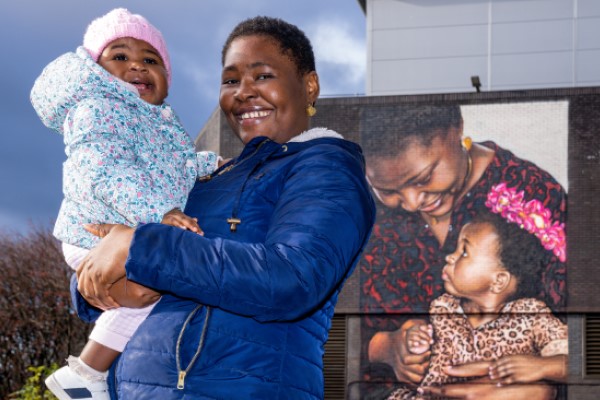
Photo credit: Stuart Wallace Photography
Amma Family member, Albright, and her daughter, Adelia (mural artist: mural artist, Frank Carty)
|
||
|
||
|
The pandemic brought into sharp focus the importance of support and companionship during pregnancy and beyond.
Many refugees and those seeking asylum in the UK, face giving birth and coping with early parenthood alone – in a brand-new city, unable to speak the language.
Maree Aldam, CEO of Amma – a Glasgow charity that provides care, information and advocacy to those who face barriers to support during pregnancy, birth and early parenthood – has spoken with healthandcare.scot about the growing need for specialist ante and pre-natal care and her growing charity’s hopes for the future.
In the almost four years since Amma Birth Companions was established, its volunteers have supported more than 200 parents who are refugees, asylum-seekers, and survivors of human trafficking, during their pregnancy, birth, and postnatal months.
The charity was set-up in response to the ‘hostile environment’ those seeking asylum face when settling into the UK, which often leaves the additional needs of people going through pregnancy, birth or the postnatal period unmet.
Maree Aldam, CEO of Amma, says as many as four in five of the people Amma supports face inhumane conditions within the asylum system:
“We see pregnant women who are unable to get the nutritious food that they need through pregnancy. We see mothers who are unable to buy formula for their babies, while being housed in completely unsuitable accommodation and some who are moved, incredibly close to birth or right after, without warning. They are facing huge amounts of uncertainty throughout the asylum process.
“I think it’s a real crisis and it doesn’t look like that’s going to improve any time soon. In fact, we’re seeing it getting worse and worse. And that’s really, really concerning for us.”
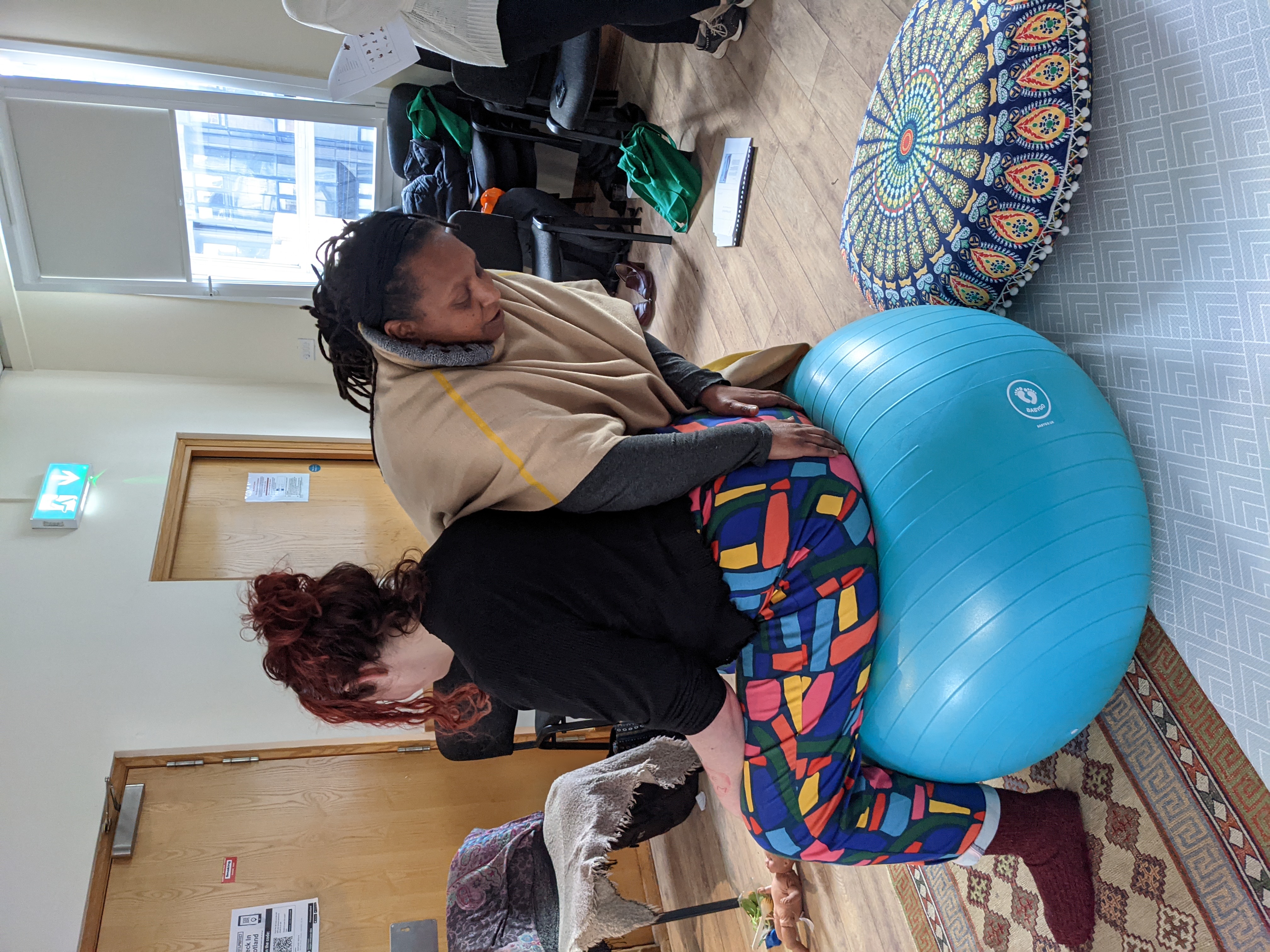
A team of dedicated volunteers, equipped with at least 60 hours of specialist training, are there to provide companionship and practical and emotional support from the third trimester of pregnancy right up until a few weeks after birth.
But Amma’s outreach also now stretches long into parenthood – an area the charity is looking at embedding and expanding even further as it expands. The charity supports its clients in the creation of much needed social infrastructure and peer networks that many people the charity supports may struggle to find themselves in a new city:
“We do support with the pregnancy, birth, postnatal side of things, but we also increasingly provide peer support programmes. Our clients really see the value of supporting each other and it’s a bit more sustainable as well because we just don’t have the capacity to support people long term ourselves.
“As we’re getting more and more referrals in, we need to look for ways to help people build little communities themselves and to support each other.
“There’s no better person than someone who has maybe been through something similar, who maybe shares some similar life experience with you, and maybe even lives in the same area.”
The commitment to going above and beyond to support and welcome refugees and people seeking asylum was recognised formally earlier this year, when Amma was
named Scotland’s first Maternity Service of Sanctuary.
The charity was also shortlisted for two Scottish Health Awards this year; one to recognise the work of its volunteers and for the charity’s efforts in tackling health inequalities.
Amma has also been recognised nationally for its work in advocating for mothers, babies and midwives.
The charity was a lead contributor to a damning report by Scotland’s Children and Young People’s Commissioner, that led to all mothers and babies being moved out of a cramped and unsafe housing unit earlier this year. Volunteers and staff have also been involved in campaigns to raise awareness of the maternity crisis within the NHS.
The lack of interpreter provision is another key point of focus for the charity, with almost half of the people Amma supports speaking little or no English.
Other systemic issues, including higher rates of inductions and c-sections, are also felt most by the groups Amma serves. The charity works closely with the NHS Health Equalities Team to help tackle these disparities in perinatal care. Volunteers play a key role in ensuring people feel informed and empowered in all aspects of their birth experience, as they strive to achieve safe and equitable care for each of their clients.
Ms Aldam says the way Amma’s volunteers are trained is integral to the charity meeting its ambitious goals:
“Cultural competency has been really baked into Amma’s DNA from the start and it’s something we really pride ourselves on. The trauma informed approach we take with our volunteers is also valuable. It’s really important to us that we don’t add to the trauma that our clients have and are still facing – either with the asylum process or with the healthcare system – so we are really working with people and making sure that informs the approach we take.
“There’s something in all of that that makes us quite unique. We don’t want to lose that as we expand, as we go forward.”
And Amma is a charity with no shortage of ideas about where to go next.
The charity has just undergone a series of expansions – moving into a new office in Glasgow city centre, appointing Ms Aldam as its first CEO in April, now with 16 staff now on the payroll to support a growing team of more than 40 volunteers - and is looking to expand its reach in Glasgow even further over the next year.
Young parents have been identified as a priority. A consultation with Amma’s referral partners showed this group are felt to be least well served by antenatal educational resources currently available on the NHS, and that Amma is well-placed to provide additional support to members of this group throughout the perinatal period.
Other groups facing specific hardships through pregnancy – including care experienced young people and the Roma community – have also been identified by Amma’s referral partners in the NHS and third sector as likely to benefit from the charity’s work in the future.
But Ms Aldam says plans for further expansion for the charity that is already “bursting at the seams” are still a way off yet:
“We’re already really at capacity with referrals, despite our recent expansion to a larger office space in the centre of Glasgow. So we’re quite mindful of that and we’re going to tread carefully. We want to make sure we’re building something sustainable. We don’t want to create an expectation that there’s need there we can’t meet.”
The impact Amma has is so visible, not only to the communities in which it serves and the dozens of women it supports each year, but to the city’s social infrastructure itself. The challenge now is for the charity to further embed itself on Glasgow’s map:
“We want to become an organisation that is known in Glasgow for doing some of that crucial work with vulnerable communities and work together in the community. We can’t do this alone.”
Amma Birth Companions takes applications for volunteers on a rolling basis, with the next block of training set to begin in March 2023.
You can donate to support the vital work of Amma here.
Tags: Nursing & Midwifery. |