|
Health Secretary: No double standards on NHS and care |
Related newsRise in non-covid deaths prompts call for NHS rethink Frailty services supported with £85m Chief Medical Officer: ‘Critical connections’ priority Scotland’s frailty services to help address NHS waits New palliative care strategy for Scotland Concerns at rise in care home dementia drugs 
|
|
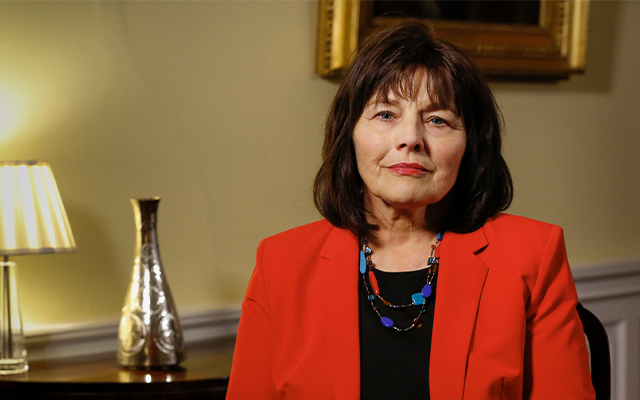
Image courtesy of the Scottish Government
|
||
|
||
|
Jeane Freeman has disputed suggestions the NHS was protected at the expense of social care during the pandemic, and suggested social care should perhaps be added to her job title to show the government does not think the NHS is a higher priority.
Scotland’s Health Secretary has said she should “maybe be the Cabinet Secretary of Health and Social Care” to try to ensure both sectors are seen as equally important in the aftermath of the pandemic.
Jeane Freeman’s comments came after concerns were raised by former Scottish Care CEO, Ranald Mair, about a “double standard” separating the health service and care homes. He suggested people were worried there “was not a level playing field in terms of how the government approaches [health and social care].”
Speaking at a Scottish Care conference this week, Ms Freeman said: “In my job I value each equally, but I think sometimes recognition in the form of titles and accountability is really important. I consider myself accountable for the way in which government works with and supports the social care sector, or in the views of some, doesn’t do that enough.
“…I am the Cabinet Secretary for Health and Sport – maybe I should be the Cabinet Secretary for Health and Social Care, so that there is an equity of recognition.
“There is a levelling up that needs to be done I think on how we have focused our work on health and social care.”
On the independent review of adult social care in Scotland – due to report by the end of this month – Ms Freeman said government would “look at how we could further enhance the social care sector and support it, including regulation and funding”.
She said there would be “real choices” for people in Scotland to make about how much they valued social care, and how much they wanted the government to financially support the sector.
“That is a choice, that’s a political choice – and it will come pretty soon,” the Health Secretary added.
Addressing suggestions the NHS had been protected at the expense of social care, Ms Freeman responded: “I think we have tried very hard to protect the care sector – a degree of additional financial resource, a great deal of time and attention.
“The key difference though is that the NHS is a national service – it isn’t run by private, independent or public sector providers and consequently what I can do is direct the national health service to do certain things.
“Don’t hear this in any way other than as a statement of fact: I can direct the national health service to do certain things. I can’t do that in the care sector because it is a mix of public sector, independent and third sector and private providers, so the approach has to be one of trying to work together to get to a particular end.
“But, and actually the social care support fund is a classic example, if it was up to me, people would not be on terms and conditions where, if they were off sick, all they got was the statutory sick pay.
“I wouldn’t allow that in the NHS – that is the way it is in some parts of the care sector and that is what the support fund is there for. That is additional government money because terms and conditions by some employers don’t meet what I would consider fair work principles.
“We need to be realistic in recognising some of the fundamental differences between the NHS and the care sector.”
The Health Secretary also provided the first details of her vision for social care in Scotland since she commissioned the review, tasked with laying the ‘foundations of a national care service’.
A move by the First Minister earlier this month to appoint a minister dedicated to addressing drug deaths prompted questions around why a dedicated social care minister was not being appointed in the wake of covid-19.
Sign up to our bulletin for key health & social care updates straight to your inbox.
A full transcript of Ms Freeman’s speech to the Care Home Gathering on the 19th January is available below:
“I can’t think of a better use of my time than to be able to speak to all of you in this particular session, this particular day, remembering a year of pain and professionalism.
“I think it is really important. I can’t claim to understand completely what the past year has been like for so very many of you – a year of longs hours, new demands on your skills and time, and your own anxieties and worries about yourself, your family and a very strange and different world that we have all been living in.
“And I know, in that year, so many of those you care for have died and that you have often a very personal connection with them. The pain and the difficulty that has caused so many of you I can only imagine.
“And in thinking about all of that as I do, the words ‘thank you’ don’t feel quite good enough; but you do have my heartfelt thanks and my deep gratitude for everything you have done and are doing, and most importantly for the compassion and the care that you show every single day.
“As we look towards moving out of this pandemic, and we will, I want us to also think about not just what we do in the here and now, but also how we can better value your work but also the important work of your sector and how we can look at adult social care as a whole, of which this sector is a critical part, and see how much we can learn from the experience of this pandemic and how much we can make sure our resilience and our strength and our valuing of that work is much better placed than it was and has been for very many years.
“The pandemic will pass but right now it is still with us and we have even more to ask of you. In what you do to protect those you care for, it is important that we do everything we can to protect you.
“From weekly testing of care home staff that has been underway for some time now, supplemented during those weeks with lateral flow testing.
“The PCR test I know is not a pleasant experience at all, but I am so grateful to all of you for week in week out taking part in that testing. It is a really critical part of protecting your residents and those you care for but also yourself and your family.
“You could be easily a-symptomatic and not know that you have the virus and I know the last thing you want to do is pass this virus on to anyone else.
“To support that with additional PPE – making sure where private supplies of PPE that normally work perfectly well are overwhelmed sometimes or breakdown because of the demand on them – that government nationally can step in and have those distribution routes and make sure that those additional supplies are provided, knowing too that covid requires more use of PPE than in normal times.
“I am going to come to vaccinations now too. That is a programme that kicked off at the very beginning of December, that ramped up as we go, and I hope many of you will have been able to be vaccinated.
“We have completed about 90% of care home residents now – we will certainly complete that programme by the end of this month and I hope that when our NHS staff were in the care home vaccinating our residents that there was the opportunity for you to be vaccinated too. And that if that has not happened yet, it will soon and then we will be back within that 12-week period, all of that being planned out in the overall vaccination programme.
“You can find details of all of that and our planning on the government website as well as through NHS Inform.
“And lastly protecting you so that you can protect others through infection prevention and control measures. That has been the foundation on which the work you do and the work we do in our health service together to make sure that we guard as best we can against infection but also infection spread.
“So pandemic or no pandemic, infection prevention and control – knowing what that is and feeling confident in our practice of it is really, really important.
“And to support all of that with not only the one-off thank you payment of £500 – and that is all it was, a small gesture just to say thank you – but the social care staff support fund so that if and when you are tested and are positive, we don’t put you in a position where you are having to choose between doing the right thing, which is to self-isolate and get better, but that may come at a financial cost because your terms and conditions are such that all you are going to get is statutory sick pay.
“We wanted to make sure that wasn’t going to happen. And that impossible choice was not one that you were faced with.
“The other side of trying to help you to look after yourself is our national wellbeing hub – I hope you have found it, I hope you know you can use it for psychological support and wellbeing support at the website www.promis.scot – and it has a 24hr helpline. I hope all of that and more – which again you will be able to find easily through the government’s website or NHS Inform – helps you to understand a bit about just how much I value the work you do.
“And part of the work you do is caring about the health and wellbeing of residents and I want to touch on visiting.
“I know that in an ideal world there is nothing you would want to do more than make sure the residents you care for have maximum access to their family and friends, to going out as they did before the pandemic, to living a life as full as they possibly can. And I know it hurts you as it hurts them and their families that that has not been possible.
“I want to talk a little bit about the importance of essential visits. Essential visits aren’t just about when someone is reaching the end of their life – they shouldn’t be confined to a fixed time or fixed length of time. Essential visits are exactly that, when an individual’s mental health or physical health is failing, perhaps because of the restrictions and the isolation, as well as if they are coming towards the end of their life, then those visits are essential.
“And with PPE for visitors and the lateral flow testing that you have now, those essential visits can be made as safe as possible.
“As we vaccinate more and more complete care homes and all our health and social care staff we are looking actively at what more can be done then to introduce safe indoor visiting for designated visitors.
“I was talking with care home relatives and our clinical advisors about this just the other day and what I said was everything we do carries risk, everything – as individuals, in your work – everything we do carries risk. We can’t make living risk free, and certainly not right now in the middle of a pandemic.
“Every time somebody goes into a care home there is risk – that is why we have testing and PPE and all the other measures we have touched on.
“So, what we need to do to make sure indoor visiting can happen is look at and take all the steps to mitigate the risk.
“So, a designated visitor per resident – making sure every resident who can be and agrees to be vaccinated; PPE; lateral flow testing – all of that is about minimising the risk, recognising that we can’t ever get completely rid of that risk.
“But the balance is so important; minimising the risk in order to ensure we do no more harm to someone’s mental health and wellbeing, their feelings of isolation and loneliness.
“I think together we can work through how we, in the course of the coming weeks, find the safest way possible to reintroduce indoor visiting.
“The last thing I want to touch on is looking forward. I can’t tell you how soon it will be before the current pandemic situation ends. We know case numbers have risen really sharply over recent periods and we know your sector and perhaps your individual home is pressed really hard as residents and staff are affected by a new and very infectious strain of the virus.
“As the First Minister said, we are in a race here. This new strain of the virus is highly infectious, spreads very quickly and against it are all the measures I have talked about – PPE testing, good quality infection prevention and control measures, and importantly the vaccine.
“Those are the tools that we have to win that race.
“I don’t know how long that will take. What I do know though is that I can utterly and confidently rely on all of you to do your very best to help us win that race. As we look forward to the day when we are not where we are right now, when that light at the end of the tunnel is blazing, then the independent review of adult social care that I commissioned last year – which will report at the end of this month into early February – is part of us beginning to look at what more do we need to do to make sure the adult social care sector – of which the care home sector is a critical part – is as valued and as supported as it needs to be.
“And its workforce is value and supported, given the status the work you do every single day deserves.
“I know Derek Feeley who led the review at my request has spoken to many staff across the entire sector, providers, others including Scottish Care, to hear people’s personal perspectives on all of this, their experiences and all of that has fed into the recommendations he will make.
“I don’t know what those are, but I will know them when you know them after they are published, and then we will work together to see how much of this we can implement- whether that is some or all, or we agree with it all or not. But there is a future that lets us build on this experience from this pandemic, listening to those who have led us in the front line of working to suppress the virus, care for those who most need our care and every single day do the very best professional job, often regardless of the personal pain that can cause each one of you.
“I am so grateful for all of that and I look forward to continuing to work with all of you in the remaining months that I have as Health Secretary, and I hope thereafter in the future.” |
