|
Concerns at rise in care home dementia drugs |
Related news‘Rethink’ dementia support, says government Dementia care services need urgent reform Care home visits promote wellbeing Plea for dedicated government dementia unit Failure to understand social care ‘unsurprising’ Health Secretary: No double standards on NHS and care 
|
|
© samuel
|
||
|
||
|
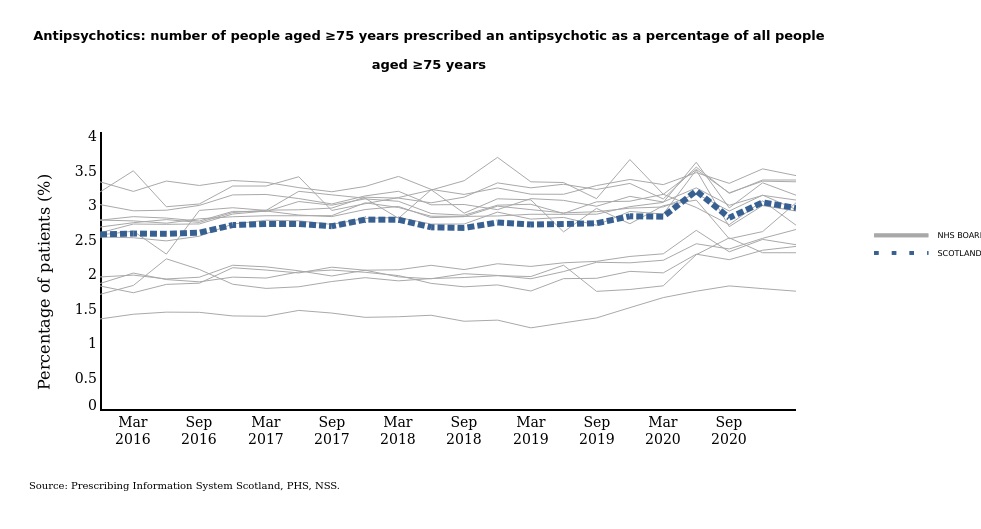
The Scottish government is to review the use of psychiatric medicines in care homes, as figures show the controversial practice of prescribing antipsychotics to older people rose to its highest level in recent years during the first lockdown and continues to remain above pre-pandemic levels.
Antipsychotics, which are used to treat people with dementia when they are distressed but can cause a raft of effects, had seen a sustained push to reduce their usage before the pandemic.
The sharp rise is being labelled “extremely worrying” by charities, who suggested the closure of support services because of the virus and the lack of human contact among care home residents could be behind the rise.
A Scottish government spokesperson told healthandcare.scot use of the drugs should be carefully monitored and stated that a “range of therapeutic alternatives are available”.
But experts suggest the lockdown, restrictions on visits to care homes and disruption to normal support services have caused increased distress among people with dementia.
Antipsychotic drugs, also known as psychoactives, should be used with caution, according to the Royal Pharmaceutical Society.
A spokesman for the Society, which is the professional body for pharmacy, said antipsychotics should only be used in “limited circumstances when all other strategies have failed for patients at risk of harming themselves or others, or who are severely distressed, and at the lowest dose and for the shortest time possible.
“They should not be routinely prescribed to treat the behavioural and psychological symptoms of dementia.
“We also recommend that patients with dementia being prescribed antipsychotics are regularly reviewed to reduce inappropriate use whenever possible.”
Public Health Scotland figures show prescriptions of antipsychotics to over-75s rose sharply from April to June.
The figures from PHS are for all prescribing to people aged over 75 and do not state either the setting where the medicine was dispensed, or the diagnosis of the patients receiving them.
In NHS Greater Glasgow & Clyde, Scotland’s largest health board, 3.6% of people aged over 75 were prescribed the drugs, compared to 2.8% before the pandemic.
Despite a reduction from the early 2020 peak, levels of prescribing rose again later that year and continue to remain slightly above pre-pandemic levels.
When a patient with dementia becomes distressed, staff try a range of other strategies such before reaching for medication, says Professor June Andrews, a dementia expert.
Professor Andrews, a former director of nursing for Forth Valley and senior civil servant, says antipsychotics are “horrible” drugs that could be regarded as a form of “chemical restraint”.
But she argues staff had little alternative in what was an emergency situation:
“It is well known that during the pandemic, some of the infection control and quarantine rules which were applied in a vain attempt to reduce deaths in care homes required restraint of older people.
“They were often not allowed to leave their room, mix with others, have visits from friends and families, go about in the community etc. Those providing care hid their faces behind masks, reducing communication and human understanding.
“Under this awful pressure, people with dementia became distressed and staff had limited options to manage that distress.”
The Scottish government told healthandcare.scot that it plans to commission a study looking at use of the drugs in care homes.
Alzheimer Scotland chief executive Henry Simmons said he had been raising concerns about antipsychotic prescribing among people with dementia for “some time”.
He is worried there may be “some correlation” between the increase in the use of the drugs and measures to control the pandemic shutting down alternative options to manage distress.
“If this is the case, then it is imperative that we quickly re-establish non-pharmacological supports and interventions, and reduce any over and/or inappropriate use of these medications,” he said.
Cuts to support services began in March 2020 as staff had to self-isolate and authorities focused on getting patients out of hospital, with Scotland’s largest local authority declaring that it would only provide ‘life and limb’ social care in people’s homes.
Other areas followed suit, despite then Health Secretary Jeane Freeman pledging that extra money was available and bluntly stating that reducing care packages was “not acceptable”.
But following a scathing report later that year that said the removal of help had a ‘direct and detrimental’ effect on people’s human rights, Nicola Sturgeon insisted reductions were “unavoidable”.
Figures from National Records of Scotland showing deaths from dementia and Alzheimer’s rose above usual levels between April to June of 2020, prompting concerns that reductions in support could be behind the rise.
Brian Sloan, of Age Scotland, says his organisation had heard from families who had seen a “significant deterioration” in their loved ones during the pandemic, due to reduced social contact and usual support channels such as groups and activities not continuing.
He said the increase was "extremely worrying", telling healthandcare.scot: “We worry there is an overreliance on antipsychotic medication, being used as a short-term replacement for social contact whilst community services are suspended or adapted to remote support.
“Remote support is unsuitable for many older people who have hearing or sight impairments and, when coupled with dementia, this can make interacting remotely confusing and distressing.
“Antipsychotic medication only masks the symptoms of lack of stimulation and may prolong an inappropriate support situation for longer, allowing isolation to further progress.
“As part of the ongoing drive to reduce the inappropriate prescribing of antipsychotic drugs, we would hope they are used only when absolutely necessary and when the benefits far outweigh the risks – and that particular care is taken when treating people living with dementia with this type of medication.”
A Scottish Government spokesperson said: “Our national dementia care standards are clear that if symptoms develop that cause stress and distress in people with dementia, there should be an integrated assessment and care plan.
“When psychoactive medication is prescribed, the prescribing doctor should regularly review its continued use and ensure correct dosage in line with the patient’s symptoms.
“A range of therapeutic alternatives are available and we continue to fund two national dementia workforce programmes to help expand staff knowledge and expertise in responding to the needs of people with dementia across all care settings.”
Read more: Dramatic rise in deaths among home care recipients Care home families: "we are not unnecessary footfall" Care home virus control ‘fundamentalism’ criticised
Sign up to our bulletin for key health & social care updates straight to your inbox. |