|
Council exit frees seat at NCS table for care sector |
Related newsSceptical response to government’s care proposals Scotland’s IJBs becoming "financially unsustainable" Bid to block IJB voting rights extension Users to get voting rights at IJB meetings Search on for permanent Care Board chair The in-between: what’s happened to care reform? 
|
|
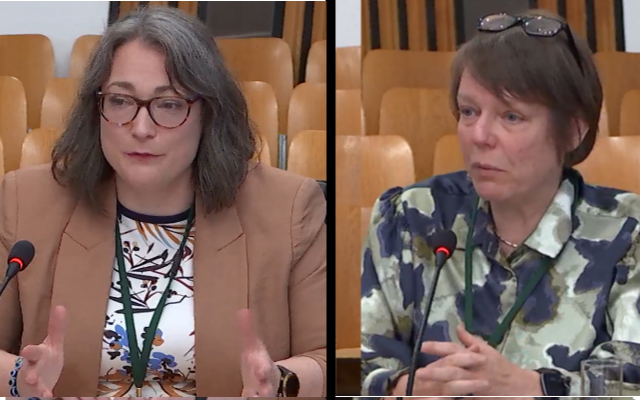
(L-R) Karen Hedge, deputy CEO of Scottish Care; Rachel Cackett, CEO of Coalition of Care and Support Providers in Scotland (CCPS)
|
||
|
||
|
The decision of councils to withdraw from the National Care Service Bill could give the real experts a seat at the negotiating table, say social care leaders.
MSPs in the health and social care committee heard that the “power-play” between local and national government, which came to a head earlier this month, symbolises the issues in the social care sector.
Social care leaders told the committee that private discussions between Scottish ministers, the NHS and council organisation COSLA have for too long dictated the direction of the National Care Service.
With COSLA now on the sidelines, casting doubt over the future shared accountability deal, the leaders said that the people and organisations they represent may now have a proper chance to get involved.
Rachel Cackett, chief executive of CCPS which represents third sector providers, said there is now a window of opportunity for social care partners to get around the table and return the proposals for a National Care Service back to the original vision laid out by Feeley in his independent review:
“We have had a year in which national and local government have negotiated an agreement in which those of us who are meant to be equal partners in social care, if we believe the winter plan, have had very little influence.
“The one advantage [of COSLA’s withdrawal] is that there might now be a space for those of us who have been sitting waiting to have these conversations to get involved in shaping something that might get us closer to Feeley than either the original or the amended draft of the bill has proposed.”
COSLA’s discontent around draft amendments, which they earlier explained to MSPs would reduce councils’ role in social care governance and would give ministers the power to remove other functions from councils in the future, proved too fractious for them to continue to work with government to develop the Bill.
Karen Hedge, deputy chief executive of Scottish Care, told MSPs that the implications of COSLA’s exit underline how the National Care Service Bill has been developed in a vacuum.
Many people with expertise, she explained, have not had an opportunity to contribute effectively as a result – something she said has likely contributed to the sector’s widespread discontent with the proposals as they stand:
“We know that negotiating with people works better when there is a diverse mix of individuals representing the different parts of the system.
“If we had been having those conversations with representation from across the whole system, we might well be in a different position.
“However, when negotiating is reduced to two individual partners, it highlights the power play in that space.”
Both social care leaders spoke with MSPs the same week Scotland’s Health and Care Secretary told a National Care Service forum that “the door is open” for further negotiation and compromise on the Bill.
CCPS’s Rachel Cackett said her organisation will do its best to steer the government in a different direction to deliver the change needed:
“There may be more space for us to be listened to. If that happens, it will be great.
“We have ideas, as many of our partners in the sector will have. People are full of ideas. We know what needs to change.”
A Scottish government spokesperson said:
“Creating the National Care Service is about improving people’s lives and ensuring consistency of care across Scotland.
"We have undergone extensive co-design work with service users and stakeholders about the development of the National Care Service over the past two years, as well as regular engagement through our steering groups.
“It’s crucial we continue to ensure the people who use or work in the social care, social work and community healthcare service are at the heart of our reforms. They have been clear the system needs fundamental and sustainable change.
“We remain open to working constructively with local government through continued progress on the National Care Service Bill.
NOTE: Scottish government comment added at 9:15 on 16/10/2024.
Read More: Disability group feel “used” by care service co-design; Are ministers divided on council care service exit?; Council care failures echo Shakespearean tragedy; A timeline of Scotland’s National Care Service
Sign up to our bulletin for key health & social care updates straight to your inbox. |