|
Dr Finlay and the making of the NHS |
Related newsScotland’s Clinical Entrepreneur initiative returns From 14 to 5 – one lesson from Denmark NHS Scotland chief named as battle lines emerge Briefing: The 5-year plan for NHS, care and science Scottish health research register celebrates 15 years Medical trainee abuse reports ‘shut down and silenced’ Politicians must take ‘bold’ action on child poverty Glasgow district nurses ready to strike NHS and Glasgow rethink routes into healthcare ‘Major’ update to One Health AMR register Glasgow LEZ success sparks call for expansion 
|
|
Hulton Archive/Getty Images
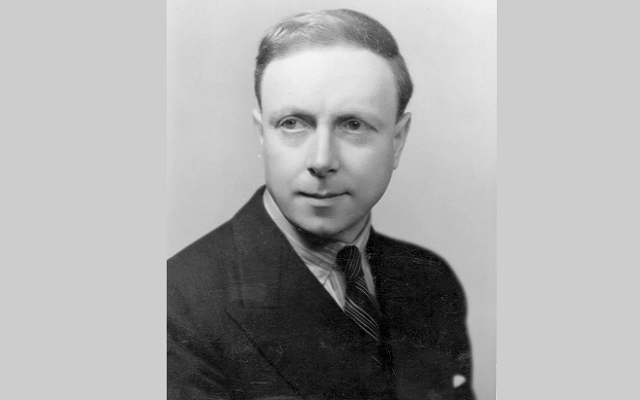
AJ Cronin c.1930
|
||
|
||
|
In his most recent insight into Scotland’s medical history and modern healthcare landscape, Chris Holme looks at how a novel from doctor-turned-author, AJ Cronin, influenced the formation of the NHS.
In his era, the public could not get enough of AJ Cronin.
His novels became international best sellers. Hollywood seized on them to make films which proved even more popular.
One novel, The Citadel, was hugely influential in stirring public opinion before the birth of the National Health Service.
Archibald Joseph Cronin (1896-1961) was born in Cardross and graduated in medicine from Glasgow University in 1919.
He married Agnes Gibson, also a doctor. They spent three years in South Wales where he worked for the Tredegar Medical Aid Society.
Similar local schemes operated in other parts of Britain. Tredegar was one of the most advanced, offering free care to workers and their families based on graduated payments. Tredegar was also the hometown of Aneurin Bevan, the charismatic socialist, who created the NHS in 1948.
The Cronins then settled in London, but in 1930 he was told to rest after being diagnosed with a chronic duodenal ulcer. This prompted the family to head north, renting a house at Dalchenna Farm near Inverary, where Cronin started writing.
His first novel, Hatter’s Castle, was completed in just three months. Cronin wrote quickly – five thousand words a day. He wasn’t that confident about the book, but it proved an instant success.
The Citadel followed in 1937 with the film released the following year. It had top star treatment – King Vidor as director and Robert Donat, Rosalind Russell, Ralph Richardson and Rex Harrison in leading roles.
The film was nominated for four Oscars and an estimated nine million people flocked to see it – and wept with emotion or anger afterwards.
The plot is simple:
Young idealistic Scottish doctor Andrew Manson comes to South Wales. Faced with a typhoid outbreak, he energetically pursues the authorities to take it seriously. When that dynamism fails, he resorts to dynamite and blows up the old sewer – the source of the outbreak.
Doctors are variously portrayed as able, committed, drunk, or useless. When he moves to London to seek his fortune, Manson teams up with a clique of greedy and incompetent doctors.
There is no mistaking the message. Medical care for working people along the Tredegar model was pure and noble but the system as then practised in London’s Harley Street was totally corrupt and immoral.
The Citadel broke all records in the USA for its American publisher Little Brown – even outselling its previous blockbuster All Quiet on the Western Front.
The novel was republished in 1946 and the film’s impact was sufficient to merit a re-release in 1948 when the NHS started.
The Medical Aid Society provided inspiration for both Bevan and Cronin. It wasn’t a direct organisational model for the NHS, which was funded by central taxation. Cronin didn’t believe nationalisation would cure the many other ills of medicine he outlined in The Citadel.
For those who seek common ground: both had an interest in miners’ diseases such as nystagmus, the spasmodic eye movement which afflicted Bevan, and pneumoconiosis which killed his father.
Cronin’s British publisher, Victor Gollancz, also set up the Tribune newspaper which Bevan edited.
Bevan’s wife, Jennie Lee, was only able to go to university thanks to a Carnegie scholarship, as was Cronin.
Given their public profiles, it seems unlikely that the two were unaware of each other but there is no evidence that they actually met during the three years they both lived in Tredegar.
The Medical Aid Society’s records show that Bevan was elected to its management committee but not until April 1926 – by which time Cronin had long departed.
Cronin’s later creation, Dr Finlay, went on to do for television in the 1960s what The Citadel did for the cinema.
If you are under thirty-five, just ask your granny.
It was story telling at its best – a hard edged bite of medical drama, spiced with large dollops of sentimentality and fine characterisations.
The BBC TV series based in a fictional village of Tannochbrae, drew weekly audiences of twelve million. It started a trend in primetime BBC drama which later evolved into All Creatures Great and Small, Casualty, and Call the Midwife.
Cronin wrote the first scripts for the series featuring Finlay (based on Cronin himself) full of youthful enthusiasm, Dr Cameron, as the wise older doctor and Janet, their ever so solicitous housekeeper.
It made stars out of Bill Simpson, Andrew Cruickshank, and Boston-born Barbara Mullen.
And it spawned a range of jokes around the school playgrounds – ‘Dr Finlay, would you like a cup of tea? Janet can a man nae go to the toilet in peace.’
Dr Finlay was a fictional character. The real Dr Finlay of medical fame belongs to Cuba.
Dr Carlos Juan Finlay, the son of a Scottish doctor father and French mother, discovered that mosquitoes transmitted yellow fever. There is an institute, society, and series of postage stamps in Cuba named after him and a street in Paris.
A far cry from Tredegar and Tannochbrae…
Chris Holme is a former Reuters Foundation fellow in medical journalism.
Read more by Chris Holme: TB and the Edinburgh physician; The father of evidence-based medicine; The Glasgow mother of the C-section; Long read: The CMO who spoke the unspeakable
Sign up to our bulletin for key health & social care updates straight to your inbox and you can follow healthandcare.scot on Google News. Tags: NHSScotland. |