|
GP capacity at lowest level in a decade |
Related newsCOVID jags end for staff and chronically ill Deprivation gap in cancer “unacceptable” says charity We “cannot be complacent” on breast cancer rise Partnership working for Scotland’s population health Cancer workforce “not on right trajectory” ‘Bleak picture’: health leaders react to NHS review 
|
|

© Monkey Business_
|
||
|
||
|
Scotland’s general practice capacity has shrunk to its lowest level on record, amidst a series of cuts that have left the profession in what one trade union head has called a ‘vicious cycle’ that is forcing GPs out of their jobs.
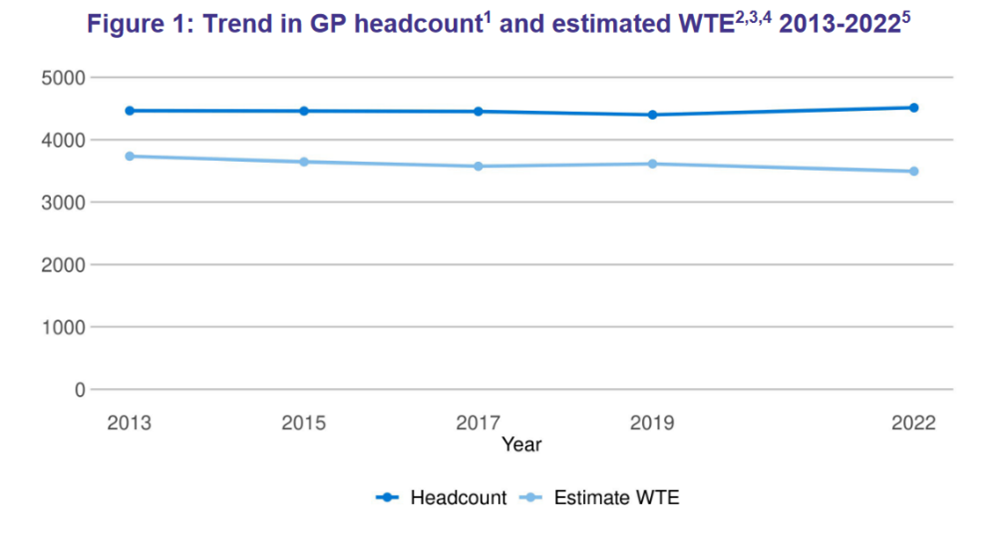
The whole-time equivalent number of GPs in Scotland has fallen by 81 – despite a 2017 Scottish government commitment to boost numbers by at least 800 within the decade.
The headcount figure of the total number of doctors working in general practice has increased by 114 (3%) since 2019, but increased part time working means the whole-time equivalent workforce has fallen by the same rate.
The new Public Health Scotland workforce survey comes as the chair of the GP branch of the doctors’ union in Scotland warns the majority of GP surgeries are buckling under demand.
A survey by BMA Scotland found that 81% of Scotland’s GP practices were facing demand that exceeded capacity, with more than a third of practices reporting having at least one GP vacancy.
Dr Andrew Buist, chair of the BMA’s Scottish GP Committee, says that there is less GP capacity now than at any point since 2009, at the same time that demand for care has increased:
“It should be little surprise on that basis that some practices are collapsing, with GPs cutting hours or leaving the profession due to workload pressures and patients struggling to get the care they need. This is a vicious circle, as the more pressure increases, the less manageable or bearable working as a GP becomes for those left in practices – forcing them in turn to cut hours or leave.
“I believe we really are at a tipping point for GPs and practices in every single area of the country and are approximately 1000 WTE GPs short.”
Part of the Scottish government’s recent emergency budget review exercise saw IJB’s primary care improvement funding cut relative to what they already had in their reserves, leaving many with significant challenges to meet in terms of developing sustainable local primary care models.
A government fund to make a sustainability payment for all GP practices, to be paid in two instalments of £15m, has also been cut by £5m due to funding constraints.
Mr Buist has called for these cuts to be reversed urgently:
“Aspiration needs to be matched with investment to grow the WTE workforce, so that capacity in general practice increases as we know it needs to.
“Unfortunately the lack of investment is being borne out in what we are seeing with these recent figures. Urgent direct investment is needed to allow GP recruitment, we need a focus on easing the workload burden driving so many out of the profession and we need recent funding cuts to be reversed.”
Scottish Labour spokesperson for health, Jackie Baillie, said the government is failing NHS staff and patients:
“This situation cannot be understated. Pressures are increasing, but GP numbers are falling and funding is well below expectations.
“Our services are at breaking point and hardworking staff have been left to pick up the pieces. GPs face increasingly worse conditions, and many have chosen to leave the profession entirely. We will likely see numbers continue fall unless this dilemma is fixed.”
The Public Heath Scotland report says a falling rate of WTE GPs is likely to be partly due to a growing proportion of women entering the profession, who are more likely to work part time than their male counterparts.
Women make up 2,779 (61%) of Scotland’s current total of 4,514 GPs.
Read more: Planned primary care improvements on pause; Lack of structure holding back social prescribing; Integration Joint Boards’ £151m budget gap
Sign up to our bulletin for key health & social care updates straight to your inbox and you can follow healthandcare.scot on Google News. |