|
Legal experts: NCS Bill too vague on human rights |
Related newsSceptical response to government’s care proposals Bid to block IJB voting rights extension Holyrood passes Care Reform Bill Carers charities urge greater transparency in reforms National Care Service plans scrapped Minister: NCS has exposed "polar opposite" views Auditor General: Difficult choices for Scotland’s NHS NHS problems ‘still need fixed’ despite pandemic focus NHS whistleblowing champions appointed NHS ‘financially unsustainable’, auditors say Briefing: Scotland’s health & care intelligence “Snapshot” of dentist recovery underway 
|
|
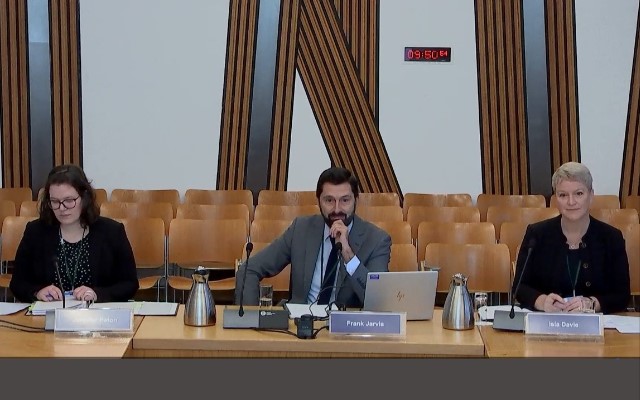
Image: Scottish Parliament TV
LtoR: Jennifer Paton, Law Society of Scotland; Frank Jarvis, Scottish Human Rights Commission; Isla Davie KC, Faculty of Advocates.
|
||
|
||
|
Lawyers have questioned the Scottish government’s commitment to human rights in its bill to establish a national care service (NCS), citing “unhelpfully vague and subjective” language and lack of detail on how care providers will be held accountable.
The Scottish government has committed to ‘embed and mainstream human rights throughout the development of the national care service’.
However legal professionals have told members of the Scottish parliament’s Health, Social Care and Sport Committee that there is a lack of substance and assurance around this – specifically around enforcement and accountability.
A parts of the bill which details ministers’ commitment to create a charter – a document describing rights, responsibilities, and mechanisms for upholding them within the service – was described by Frank Jarvis, a legal officer at the Scottish Human Rights Commission, as “unhelpfully vague”.
The Bill also makes no reference to international treaty standards, such as Article 19 of the Convention on the Rights of Persons with Disabilities (CRPD), which are due to be incorporated into Scotland’s legal framework through a Human Rights Bill later this parliamentary session.
Mr Jarvis told MSPs a lack of concrete human rights standards in the current Bill could risk the entire framework needing to be “retrofitted” later:
“It feels unhelpfully vague and subjective, and it hasn’t been scrutinised, examined, or explained in the way these well-established legal concepts in the CRPD treaty have been
“I think what we would like to see is that actually built into the charter so that people are clear as to what we can expect.
“The Bill requires further specification of human rights standards in order to make this a meaningful vehicle for delivering improved quality and consistency.”
The National Care Service (Scotland) Bill says the charter neither creates nor alters existing rights or responsibilities.
Mr Jarvis said that this will amount to the document being little more than a “presentational device” that simply repackages rights that people who use care already hold.
In its response to the parliamentary committee’s earlier call for views on the NCS, the Scottish Human Rights Commission called for the creation of an independent scrutiny body to monitor delivery and address where rights are not being realised.
New rights within the NCS?
Two rights will be created by the bill: the right to breaks for carers and the right of care home residents to be visited by their loved ones, more commonly known as Anne’s Law.
The development of Anne’s Law follows a Care Home Relatives Scotland petition to the Scottish parliament, and will strengthen care home residents rights to see friends and family during future outbreaks or pandemics.
However, Mr Jarvis highlighted that care home residents already have these rights, and that the focus should be placed on strengthening the complaints process when they breached, which is not fully addressed by the Bill in its current state.
“What if the problem [in care homes] wasn’t a lack of rights but the rights people already held weren’t being respected and protected?
“Placing visiting rights on an explicit statutory footing, it will bring benefits in terms of visibility and perhaps public awareness but, on its own, it doesn’t improve the adequacy and accessibility of mechanisms for reviews of challenging decisions of what you actually do when you are prevented from visiting relatives in care homes.
“Some of those prohibitions on visiting were already breaches of human rights. So we need to understand how that was permitted, why that wasn’t challenged, why that wasn’t addressed. And it’s not clear that legislation in and of itself addresses that problem.”
He also raised concern that decisions to pause visitation are an exercise in balancing human rights of staff, visitors and residents and that a blanket approach is “probably not a sufficiently sophisticated and nuanced tool for realising everyone’s human rights”.
The National Care Service (Scotland) Bill will also amend the Carers (Scotland) Act to make local authorities responsible for ensuring carers get support to take ‘sufficient breaks from providing care’.
Another panel member, Isla Davie KC, representing the Faculty of Advocates, told MSPs that the wording of this section is open to interpretation and could open the floodgates to disputes down the line:
“If you have wording like ‘sufficient’, it is very clearly going to raise issues and disputes about what that means and what would be appropriate in every circumstance. So, if we can already see at this stage that this will give rise to some disputes, then you have to have a mechanism in place to determine what would constitute ‘sufficient’.”
Earlier this year Carers Scotland called for the right to carers’ respite to be made universal but suggested that inconsistent services would mean this is “rather meaningless” in practice.
Co-design
The Scottish government says it has established “a robust and open co-design process”, establishing a Lived Experience Experts Panel and National Care Service Stakeholder Register to aid in the planning and development of the NCS.
However, Jennifer Paton from the Law Society of Scotland questioned the ability of the government, under current arrangements, to ensure this process is meaningful.
She told MSPs on the committee that her organisation welcomes the involvement of people with lived experience in the development of the NCS, but that “there is no statutory basis for the co-design process and therefore no statutory guarantee for meaningful engagement with the full range of stakeholders”:
“Co-design is mentioned in the principles, but our concern is that the principles are very broadly drawn and it’s not clear at the moment to whom they are addressed and how they’ll be supported by attributable duties and methods for accountability.”
A strengthening of consultation duties could offer a safeguard alongside the co-design process, according to the Law Society’s consultation response, to ensure there is meaningful engagement throughout.
Ms Davie, for the Faculty of Advocates, also raised concerns that co-designing ‘the meat’ of the NCS could result in an unworkable framework that will then need to be changed down the line.
The bulk of the development of the NCS will be introduced to parliament later in the form of secondary legislation or directions made by ministers.
Ms Davie told MSPs:
“From a legal perspective, ensuring that we don’t end up with ideas at this stage which actually don’t translate through – so it goes through the process of that co-design then actually we discover what’s here [in the Bill] doesn’t really fit with the substantive part that’s going to go in later.
“Putting the framework in place at this stage without knowing what’s coming further down the line, you can end up having to come back to revise parts of this which has only become necessary because decisions made further down the line have changed aspects of this in a fundamental way.”
Read more: Cuts will delay national care service plans;NHS leader: NCS threatens smaller boards; Joint call for major National Care Service rethink;
Sign up to our bulletin for key health & social care updates straight to your inbox
You can now follow healthandcare.scot on Google News. |
