|
Renewed campaign to divert people from going to A&E |
Related newsDoctors: ‘Shocking’ A&E figures require action Less than full-time – behind the NHS trend Drug harms on the rise in Scotland Doctors invited to shape medical workforce reforms Charting Scotland’s future health and hospital demand Health and charity leaders join forces for NHS reform Phage therapy approved for resistant infections 580% rise in mental health calls NHS problems ‘still need fixed’ despite pandemic focus NHS whistleblowing champions appointed NHS ‘financially unsustainable’, auditors say Briefing: Scotland’s health & care intelligence 
|
|
|
||
|
||
|
With targeted TV, radio and online engagement work, the Scottish government today launches a healthcare awareness campaign urging Scots to “play their part” in supporting the NHS with increased pressure expected this winter.
The campaign is the latest attempt to try to encourage people to get the care they need in the appropriate healthcare setting through clearer information on what sort of help is best for their circumstances.
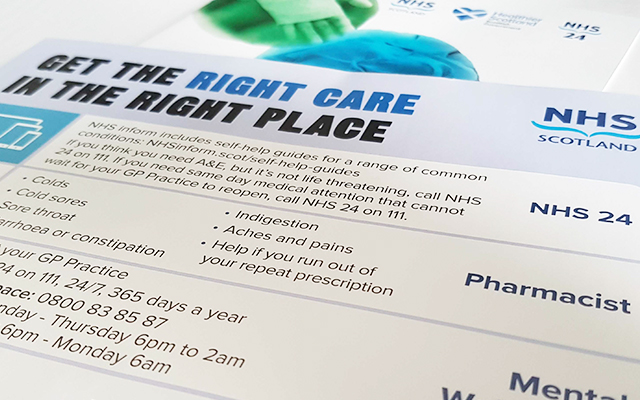
One area this work will particularly focus on is looking to divert people away from busy A&E wards if attendance is not necessary. To do this, the work from the government and NHS Scotland will make clear that conditions which are not life-threatening can be supported through different pathways.
These include signposting to Scotland’s NHS Inform website, attending local pharmacy, calling NHS 24 on 111 or contacting their GP.
Between the beginning of the pandemic and last summer, £43m had been spent on a mix of initiatives – including a national ‘right care, right place’ marketing campaign – with the overall aim of dissuading people from going to A&E unless they have a serious injury or illness.
Visiting Bangholm Medical Centre in Edinbrugh to hear experiences of how teams are embracing a multi-disciplinary approach, Health Secretary Humza Yousaf said:
“I am under no illusion that this winter will be the toughest in the history of our great NHS, which is why I am pulling every lever at my disposal to help ease pressure where possible.
“This campaign will make it easier than ever to know where to go to get the right care in the right place – saving patients time and freeing up space in our emergency departments.”
With pandemic backlogs causing increased waiting times across services including cancer diagnosis and treatment and worsening pressures on staff already facing shortages across the NHS, the Scottish government’s winter plan has focused on supporting the workforce with additional funding and recruitment.
This awareness campaign is part of the £600m winter resilience plan for Scotland, which includes a further commitment to recruit an extra 1,000 staff, vaccinate the public from both the flu and covid-19.
Despite this, unions involved in pay negotiations for NHS Scotland staff have responded that the latest offer is a real-terms pay cut which does not reach far enough to address the workforce crisis.
The winter plan also commits to prioritising care of the most vulnerable amid calls for more to be done to make Scotland’s health fairer from many charities and third sector organisations.
Peju Adeyemo, a Physician Associate at Bangholm Medical Centre highlighted the importance of other healthcare professionals operating effectively as part of a multi-disciplinary team to tackling increased pressures:
“Physician associates are healthcare professionals with a generalist medical education, who work alongside doctors providing medical care as an integral part of the multidisciplinary team. We are able to alleviate pressure on GPs because we can see a broad spectrum of patients, provide holistic care and follow up.
“Furthermore, we are able to see more acute patients thereby freeing up time for GPs to see more chronic conditions where 15 minutes appointments may not be suitable.”
Multidisciplinary work was reported in the Mental Welfare Commission’s review of wards as a valuable contribution to patient care, but again reports highlighted the detrimental impact of staff shortages.
While the new campaign aims to ease pressures on the NHS in Scotland, concerns over pay may lead to increased pressure if staff decide to take strike action. With the RCN Scotland’s ballots for nursing staff closing today, if members vote for it, this will be the first time in Scotland’s history that nursing staff take strike action.
Meanwhile, the GMB union yesterday reported that 4,000 of its members, including paramedics, technicians, nurses, porters, domestics, and radiographers, across the Scottish Ambulance Service and Scotland’s biggest health boards have voted in favour of strike action.
Read more: Latest pay offer for NHS “deeply insulting”; Cash needed for disabled people and carers; Go ahead for vulnerable teenagers' inpatient unit
Sign up to our bulletin for key health & social care updates straight to your inbox and you can follow healthandcare.scot on Google News. |
