|
Drug consumption rooms backed by leading medics |
Related newsRehab centre & St Mirren FC team up for community hub Rural alcohol and drug rehab centre opens Drug harms on the rise in Scotland Unmet need in Scotland’s drug crisis revealed Scots living with liver disease set to rise by 54% Law change needed for Scotland’s drug crisis 
|
|
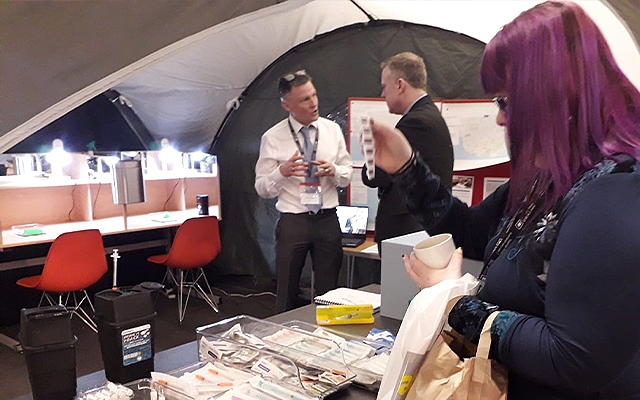
A demonstration drug consumption room courtesy of the Scottish government
|
||
|
||
|
The introduction of a drugs consumption room should be part of the immediate response to rising drugs deaths in Scotland, a medical royal college has said.
The Royal College of Physicians of Edinburgh has called for drug consumption rooms – spaces where people are supervised while taking illicit drugs, given safer injecting advice and help if they overdose – to be established as Scotland reaches the grim milestone of the highest number of drug related deaths in more than 20 years.
The UK government has repeatedly rejected calls to sanction drug consumption rooms, citing ‘too many legal difficulties’ that lie in the way.
The figures published today show the number of drug-related deaths in Scotland increased by 6%, from 1,187 in 2018 to 1,264 in 2019, representing the highest number since records began in 1996.
The Royal College’s Professor Angela Thomas says action must be taken without further delay to address the “absolutely heart-breaking” number of deaths:
“This is a public health emergency, which requires a collaborative approach between government, public health agencies, political parties and the clinicians who are dealing with the crisis on the front line.
“Although the issue of drug related deaths has been around for decades, there is an immediacy which must be addressed now, without further delay.
“The College believes that some key interventions can be taken now including the introduction of a drugs consumption room, and a heroin assisted treatment programme in all major centres in Scotland as we see already in Glasgow. This could be particularly useful, as the 2019 statistics indicate that heroin continues to be a heavy cause of drug related deaths in Scotland.
“We also support the targeted administration of Naloxone, and we call for action to tackle stigmatisation of people who use drugs – something we note that the Drug Deaths Taskforce is looking at.
“Importantly, there must also be action to improve the socio-economic factors associated with drug use, especially given the negative health and economic impacts of covid-19 on Scotland’s most deprived communities”.
Deaths were concentrated in five health board areas, with 404 recorded in Greater Glasgow & Clyde, 163 in Lanarkshire and 155 in Lothian.
Nearly seven in ten deaths were men and more than two-thirds were between 35-54. The average age of someone dying has increased from 28 to 42 over the last two decades.
Professor Thomas added: “Drug related deaths are a complex issue caused by a wide range of factors including high levels of deprivation in the affected communities, an ageing population of people who use or have used drugs in the past, psychological trauma, high risk patterns of drug use, the risky behaviours of some people who use drugs and stigma.
“…We believe that the creation by the Scottish Government of a Drug Deaths Taskforce in July 2019 was a positive step. We are confident that the Taskforce is having the right sort of conversations about how to tackle Scotland’s drug deaths problem, and that its actions already have been positive.
“The College has been working to promote the clinical voice on this issue since autumn 2019 and we held a conference in October 2020, with a report to come early next year.
“It is vital that clinicians are included in the national conversation about how we can treat people who use drugs and prevent as many drug related deaths as possible.”
Sign up to our bulletin for key health & social care updates straight to your inbox. |
