|
Unequal health benefits of retirement revealed |
Related newsHome adaptations – council spend will prevent NHS cost Link workers outlook: sustainability top of agenda Health researchers recognise gambling addiction Scotland commits to change the dementia story Scots honoured across health and care Strategies for female healthcare innovators 
|
|
Image Credit: © Mercedes
|
||
|
||
|
Edinburgh researchers have found that the impact of retirement on mental health depends on income level, the nature of the job a someone is leaving and the age at which they leave.
Researchers at the University of Edinburgh have reported that although retirees’ wellbeing has generally been considered to improve once they finish working, the picture is not straightforward.
Using data from 17 different longitudinal studies, the researchers looked to better understand income disparities in people’s mental health in retirement.
The study is among the first to assess the three phases of retirement – before, after and during leaving work – and measure the mental health impacts associated with factors including what people did in their pre-retirement job, income and age.
Study co-lead, Professor Aja Murray said the findings could inform the provision of more tailored support through the transition of retirement:
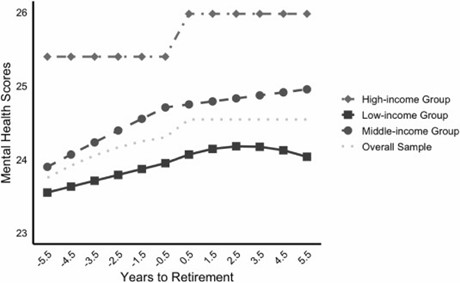
“All income groups showed a general improvement in mental health during the transition to retirement, yet there were multiple phases of development where mental health can take a dip.
“During these vulnerable times people may benefit from targeted support.”
High-income earners were defined as those with a monthly income above £2,600, while middle-income was defined as between £1,900 to £2,600 and low-income anywhere from no income to below £1,900 monthly income.
The 1,583 participants in the study completed surveys and researchers tracked measures of psychological wellbeing, anxiety and depressive symptoms from 2007 to 2023.
Researchers found a significant short-term improvement in individuals’ mental health at the year of retirement for high-income groups, while middle- and low-income groups did not display a sudden wellbeing change at the year of retirement.
Mental health scores were seen to trend with income within the cohort – with those in the higher income cohort found to have improved baseline mental health.
While age-at-retirement played a role, researchers reveal that people on low incomes are, as a group, at risk of poorest mental health and require greater policy attention.
Individuals on lower incomes reported the lowest levels of mental health during the retirement period and, while their mental health generally improved following retirement, researchers found a drop after an initial “honeymoon” phase around two and a half years after retiring.
Researchers are recommending that policymakers develop financial support mechanisms and mental health services tailored to the needs of people throughout and beyond the initial retirement period.
They say the heightened mental health risks for those on low-income point to a need to review pension schemes, financial safety nets and for targeted policy interventions and resource allocation.
With one in six pensioners in Scotland living in poverty, charity Age Scotland policy director Adam Stachura says urgent and cross-government action to support this group of people, adding:
“Persistent failure to tackle the issue is not only damaging the lives those affected today but is responsible for a looming crisis of older people on low incomes who will likely require increased health and social care as a result of living in poverty and battling the challenges of financial insecurity.”
Women on a low-income who are single at the time of leaving work reported ‘significantly lower levels of mental health’, the Edinburgh team found.
Meanwhile, among those who on a high-income, variables such as gender and education-level did not have a significant impact on mental health during and after retirement.
Generally, high-income retirees reported stable mental health before retirement, a ‘significant sudden increase’ during the process of retirement which then remained stable.
However, those on a high-income who retired a later age were found to have significantly lower mental health during this retirement transition.
People who had a physically demanding job before they retired are at a greater risk of ‘feeling low’ during the retirement transition.
People on an average income saw a ‘substantial’ improvement in mental health before retirement followed by a relatively modest increase post-retirement.
Living well in retirement
Volunteer Scotland has heard that those 60 years and older can experience loneliness and social isolation, physical ill health with changing daily pattern, and a shifting identity with the loss of employment, partners or children leaving the family home.
The charity reported that the contribution of volunteering can have an ‘inoculation effect’ for those in older age.
Heriot-Watt University researchers also recently reported that tailored interventions that foster social connection are particularly important for older adults facing increased risk of isolation from retirement.
Co-lead in the Edinburgh University-led study, Xuefei Li said the research “sheds light on the adjustment processes” people undergo when faced with the internal and external challenges of retirement.
However, one area not assessed is the impact of voluntary retirement.
The team suggest future studies could provide insights on the effect of personal choice on leaving work and a person’s mental health.
Read more: Social deprivation linked to frailty; Economic change needed for Scotland's health inequalities; “Significant and lasting” change on poverty?; Austerity policy harm to newborns laid bare; Money matters for poverty and health in Scotland; ‘Unprecedented' crisis in community health and care; Watchdog criticises homelessness health service cuts; The health benefits of being able to work; Growing health concerns for Scotland’s unpaid carers
Sign up to our bulletin for key health & social care updates straight to your inbox. |