|
Pilton, Paisley and people-based medicine |
Related newsThe nurse helping GPs trial ‘tomorrow’s medicine’ Scots ‘completely unaware’ they can inform policy Home testing reduces stroke and heart attack risks Public to have greater say in local health & care Briefing: GPs at the Deep End 10 years on Scots honoured across health and care 
|
|
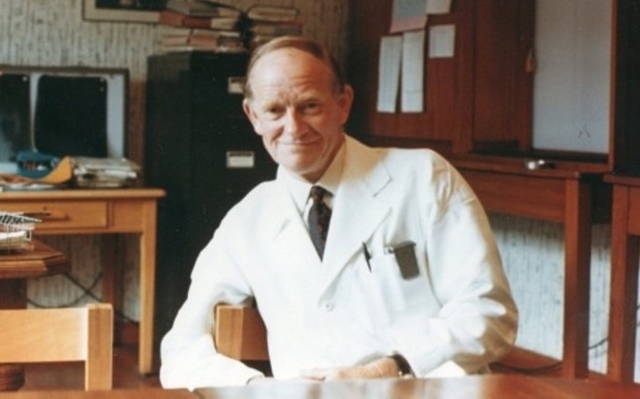
Sir John Crofton
|
||
|
||
|
As the debate continues over how to refashion and reform the NHS, historian Chris Holme looks back at earlier efforts to build a health promoting, rather than disease treating, health service – and asks what we can learn from them today.
It started in 1982 with a modest proposal, ostensibly from two GPs in north Edinburgh.
It was written by Sir John Crofton. The application was for a grant to the Chief Scientist’s Office to evaluate the then rather dangerous concept of actively involving local people in shaping their health services.
The grant was approved for two years. What came out of it was the Pilton Community Health Project, which this year celebrated its 40th anniversary.
Over that time, it has served as an umbrella across north Edinburgh for various initiatives in Muirhouse, Drylaw, Granton, Royston and Wardieburn. Similar projects also took hold in Craigmillar and Wester Hailes.
Crofton had led the Edinburgh team which developed the world’s first cure for tuberculosis (TB) and this made him a fervent advocate of social medicine – looking at wider influences affecting a patient’s health.
In his retirement he was sole clinician on the committee which set Scotland’s health priorities for the 1980s and he wrote another report on health in areas of multiple deprivation.
Along with his friend and colleague David Player, he had been impressed by John Hubley’s work in Paisley on community health initiatives.
Hubley provided local people with cameras so they could gather their own evidence. Jane Jones did the same with video cameras in Pilton. Damp housing was their common theme.
Crofton arranged a special screening of Jones’s film for the Scottish Office chief medical and nursing officers.
Then, as now, people in poor areas died 10 or more years earlier than those in affluent districts.
Poverty, high levels of smoking, alcohol and drug misuse went side by side with poor housing, stigma, and unemployment.
There had been previous efforts. The pioneering GP Ekke Kuenssberg had set up a group of local councillors, ministers, social workers and doctors in Granton to look at social problems and try ways of addressing them.
By the late 1970s, fresh impetus for change came from the women’s movement.
At the same time, though, there was push back from Mrs Thatcher’s government against the idea that poverty determined poor health.
General pessimism about public health was punctured by reports of success in Finland, where North Karelia had the dubious distinction of having the world’s highest mortality from heart disease.
Local people petitioned the Finnish parliament, and the North Karelia project was established in 1972 to change underlying causes including diet and smoking.
It proved an enormous success, due in part to active community support and hundreds of ‘parties of long life’ organised by local women serving tasty and nutritious food.
The Scottish Office reached an agreement with Finland in 1978 and arranged several exchange visits.
In Pilton, the focus was to help local people build their skills and confidence as leaders. Groups were set up for mothers and toddlers, older people, tranquiliser users and, later, to highlight issues like the Granton ‘pong’ and campaigns against the closure of the accident and emergency unit at the Western General hospital.
Jane Jones was appointed co-ordinator of the project.
The diminutive John Crofton cut an unlikely figure at meetings in Pilton in his suit, coat and Homburg hat. He was more used to leading discussions of groups of international luminaries in Paris, Geneva and London. But he had always preferred the bus to a limo, and in Pilton he was really in his element.
The guiding principle was to seize the original meaning of the word agenda – ‘things to be done’.It worked better actually doing things, rather than as a list of bullet points for discussion.
One of the early successes was Barri Grub.
Pilton was a desert for fresh fruit and veg. So, a group of mums organised a van to go to the wholesalers so they could serve fruit to kids in three primary schools. First oranges and apples, but guava, passion fruit and mango were added when cheap and in season, and strawberries proved the favourite.
Barri Grub inspired food co-ops and also attracted international interest. A group of Russian visitors were puzzled at the name until a translation (great food) was offered.
Forty years on
The fact that it has survived after 40 years is a testament both to the perseverance of those behind it and the continued need.
All new ideas face resistance from vested interests, financial crises, and a myriad of complexities.
What’s clear is that things have become a lot worse.
We now have hundreds of food banks which were virtually unknown 40 years ago, health inequalities have deepened, and previously rising life expectancy has flatlined.
There are hundreds of grassroots projects across Scotland run by NHS staff, volunteers and charities. Organisations like the Queen’s Nursing Institute are training future leaders.
This is where change will come about – on the ground rather than imposed from above. It involves taking risks, learning from failures, and an urgency about the things that need to be done.
History can help. As the American historian and Congressional Librarian Daniel Boorstin once observed: making policy without due regard to history is like planting cut flowers and hoping for the best.
Further reading:
Jane Jones, Private Troubles and Public Issues, A Community Development Approach to Health. Community Learning Scotland
John Crofton, Saving Lives and Preventing Misery. Fastprint, 2013.
Chris Holme is an award winning journalist and founder of The History Company.
Read more by Chris Holme: TB and the Edinburgh physician; Scotland’s first chief scientist; Dr Finlay and the making of the NHS Tags: GP & Community; Healthier Scotland. |
