|
Carers leave a stepping stone, says minister |
Related newsThe in-between: what’s happened to care reform? “Relentless focus” on health inequalities A timeline of Scotland’s National Care Service Unpaid carer: Funding is vital to delivering the NCS Scotland’s IJBs becoming "financially unsustainable" Scientists to help cut NHS medical device waste Edinburgh IJB faces judicial review over cuts Scotland’s new Chief Nurse appointed Urgent plea to safeguard advocacy amid local cuts New gene study offers arthritis treatment insights New Edinburgh hub set to transform global healthcare 
|
|

|
||
|
||
|
New legislation that gives carers the right to take unpaid leave from work is a ‘vital’ first step, but extending paid carers leave is required to help those most in need access employment and avoid poverty, attendees at a Carers Scotland conference heard.
With over 80% of the around 800,000 unpaid carers in Scotland being of working age, conference attendees heard of the importance of employment to “not just make ends meet, but also to provide for carers’ futures”.
Carers Scotland brought together stakeholders from across the UK and Scottish government, third sector groups and employers to discuss how to better deliver for carers.
Conference chair Kate Guthrie, Non-Executive and Group HR Director at Clydesdale and Yorkshire Bank, said that the benefits of being able to work go beyond earning a wage.
Ms Guthrie said employment also provides “an identity outside of their caring role” for carers, who experience high levels of isolation, adding:
“One in three people with unpaid caring roles have been forced to leave employment because of the demands of caring.
“That isn’t just bad news for carers – we know that unemployment is the single biggest predictor of poverty – it’s bad news for employers, too. The economy loses vital skills and experience.”
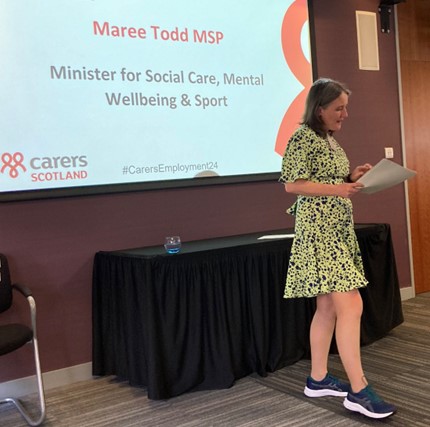
Scotland’s Minister for Social Care and Mental Wellbeing Maree Todd told attendees that the “invaluable” role of unpaid carers should not be underestimated, but said she knows many carers feel left out when it comes to work:
“We know that sometimes their own aspirations are sidelined because they don’t get the support they need.
“People who provide care to loved ones must be supported do so in a way that helps them to lead a balanced and varied life.
“The Carers (Scotland) Act 2016 aims to ensure that carers have choice and control, to make support more consistent and personalised to individuals’ needs – including each carer’s right to a personalised plan to identify what’s important to them.
“While a significant step, I know there are still many challenges impacting many carers and people with care needs.”
It comes after legislation giving carers entitlement to five days’ unpaid leave from work a year came into force across the UK in April.
Duty of care
Ms Todd said that alongside the government, local councils and employers have a “duty” to embed support for carers in the workplace, starting with the Carers Leave Act:
“It’s a win-win, enabling more carers to stay in work as well as supporting businesses to retain their staff.”
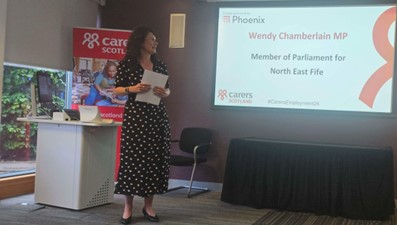
Wendy Chamberlain, the former Fife MP who introduced the Carers Leave Act, told attendees that governments must do whatever they can do lighten the load faced by carers:
“Carers leave provides time and flexibility. It should mean carers are no longer forced to use their holiday days to look after others – days that are so desperately needed to take a break for themselves.
“It is important that we work towards making carers leave paid. People might know about the leave but they don’t feel able to take it as they can’t afford to do.
“I know that unpaid leave is the vital first step but when we know that carers are overwhelmingly more likely to live close to or in poverty, then we also know that taking unpaid leave may simply not be an option.”
She recognised that it is necessary to “go further” and have 10 days of paid carers leave to reach the carers not able to make use of this entitlement.
For now, Ms Chamberlain urged governments and employers alike to raise awareness of the new legislation and ensure that carers are cared for.
Ms Todd said the Scottish government will work to expand support for carers in employment and “drive forward long-term changes” to improve their lives:
“Employers can play a unique role in promoting awareness and openness about caring roles and that can encourage people to identify themselves as carers. One of the biggest challenges we have is people often don’t identify as carers or ask for help, because they think that’s just what you do in a family.
“Carer-friendly policies, awareness and access to flexible working arrangements within an organisation can support carers to remain in work alongside a fluctuating caring role, benefiting both the employer and the carer.”
She said that Scottish government is working with local employability partnerships and referral teams to connect and reach more people and improve support in and into employment:
“Collectively, we’re building an employability system that tackles inequalities in Scotland’s labour market by creating a more responsive, joined-up and aligned employability system that meets the needs of employers and the local labour market, helping people of all ages achieve their potential.
“We have the opportunity to shape and to simplify employability support in Scotland.”
Read more: Carers at a health and poverty tipping point; Employment support needed for Scotland’s carers; Insight: The health benefits of being able to work; Uncovering the hidden role of carers in Scotland; Carers facing full force of health and care crisis
Sign up to our bulletin for key health & social care updates straight to your inbox and you can follow healthandcare.scot on Google News. |