|
Financial balance pursued by NHS Lothian |
Related newsLong COVID putting Scots at risk of poverty Greener NHS research funding boost GPs are the solution to NHS crisis, says College Call for ‘urgent’ review of ADHD and autism services Call for ‘new way’ to assess dementia drugs New Alzheimer’s drug rejected for NHS Scotland Profile: First NHS Sustainability Fellow New sick kids completion date agreed Carer support included in city mental health plans Edinburgh Sick Kids hospital opens doors a year late Interim NHS Lothian head takes up chief exec role Larger care homes more at risk of covid outbreaks 
|
|
GWatkins
|
||
|
||
|
Efforts to save money in NHS Lothian have escalated, with a Scottish government-led financial improvement group now looking to ‘rapidly develop and implement’ ways to bring the board’s finances back into the black.
A financial recovery plan identifying £54m of savings across NHS Lothian was approved by the Scottish government earlier this month.
However, a £50m funding gap remains, which board papers say are unlikely to be achieved by local savings schemes alone.
Immediate opportunities to support NHS Lothian, and other NHS boards, to achieve financial balance will now be explored by an executive-led financial improvement group.
The work has already identified a further £11m in savings in Lothian.
It comes after NHS chief executives across Scotland agreed to take forward a 15-point plan in attempts to reach a Scottish government target of 3% savings in 2024/25.
One workstream in NHS Lothian will look to ‘pause and assess’ treatment options for patients, which could see changes to treatment threshold and the phase-out of procedures and medicines of ‘low clinical value’.
The board’s medical director Gillies told the finance committee that ‘more constraint and challenge’ on drugs prescribing would be needed to reduce spend.
She explained that prescribers will be supported to change treatment thresholds, with the use of risk assessments.
A review of the way new medicines accepted by the Scottish Medicines Consortium (SMC) are introduced locally throughout Lothian is also being considered.
Decisions about new drugs being used in Lothian are currently taken by the East Region Formulary Committee, which reports to local Area Drug and Therapeutics Committees (ADTCs) in NHS Lothian, NHS Fife and NHS Borders.
It currently considers prescribing patterns, clinical evidence, safety, cost effectiveness and patient acceptability when making recommendations.
The proposals also outline plans to completely halt the use of agency staff in all professions across the health board.
At the same time, NHS Lothian is planning to further reduce workforce costs by cutting the number of whole-time equivalent posts.
The sale of the Royal Victoria Hospital site, which has now been formally declared as ‘surplus to requirements’, will be sped-up, while controls on corporate spending will be tightened.
Board papers say the plans are in early stages and that NHS Lothian remains ‘some way off achieving balance’. Papers say the group will continue to seek further cost reduction opportunities.
Medical and dental costs, GP prescribing and acute drugs remain key pressures.
Its financial plan says high-cost drugs spending continues to grow, while funding available from the New Medicines Fund, a scheme designed to limit costs faced by boards for medicines, remains uncertain.
More than £250m was split between Scotland’s NHS boards under the fund in 2023/24, though future funding will now depend on medicines growth under a new voluntary scheme agreed between the UK government and the pharmaceutical industry.
Spiralling medicines spending
Neighbouring health boards have also raised concerns around growing medicines costs.
At a meeting of the Resources and Performance Committee at NHS Borders earlier this year, members said the SMC is not fully engaged about the growing medicines bill facing boards.
They say the organisation, which is responsible for evaluating whether new medicines can be used in NHS Scotland, has changed its rules, so decisions on new drugs are now taken without financial oversight.
While local affordability of new medicines is not considered directly by the SMC, the decision-making body does examine clinical and cost effectiveness of medicines.
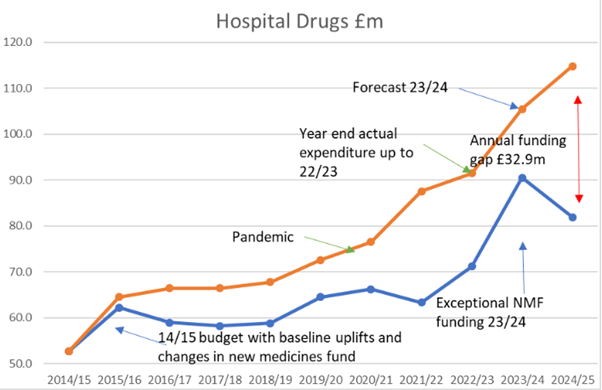
NHS Lanarkshire board members have similarly voiced unease over the adoption of new higher cost treatments, with annual spending on hospital medicines now far outstripping annual allocations.
They are predicting that expenditure will increase by 8.8% per annum over the next three years, the costs of which must be met by reducing spending across other services.
By 2024/25, the board predicts around £32.9m will be needed each year from other services will be needed to plug the gap.
Board papers say an unprecedented £30.781m in New Medicines funding received in 2023/24 will help towards costs accumulated ‘over many years’ from the introduction of high-cost new medicines.
However, this non-recurring funding is due to drop by 28% this year in NHS Lanarkshire alone.
NHS Lothian received an additional £15m within its New Medicines funding packet last year, but is predicting its hospital drugs bill to rise by 10% this financial year.
Read more: NHS chief execs agree 15-point plan to cut costs; Health boards to soon accrue £380m in lifeline loans
Sign up to our bulletin for key health & social care updates straight to your inbox and you can follow healthandcare.scot on Google News. |