|
Questions for “fundamentally changed” NCS |
Related newsHolyrood passes Care Reform Bill Social work leaders welcome new care reform plans Social care workers “betrayed” by cut funding Scotland’s health and social care secretary resigns Psychiatrists in ‘disbelief’ over cut funding Millions less needed to deliver NCS Scientists to help cut NHS medical device waste Edinburgh IJB faces judicial review over cuts Scotland’s new Chief Nurse appointed Urgent plea to safeguard advocacy amid local cuts New gene study offers arthritis treatment insights New Edinburgh hub set to transform global healthcare 
|
|

Image Credit: © Jacob Lund
|
||
|
||
|
Vast amounts of change proposed for the National Care Service mean it is more important than ever to keep the original aims in mind and ensure co-development is not lost, say sector leaders.
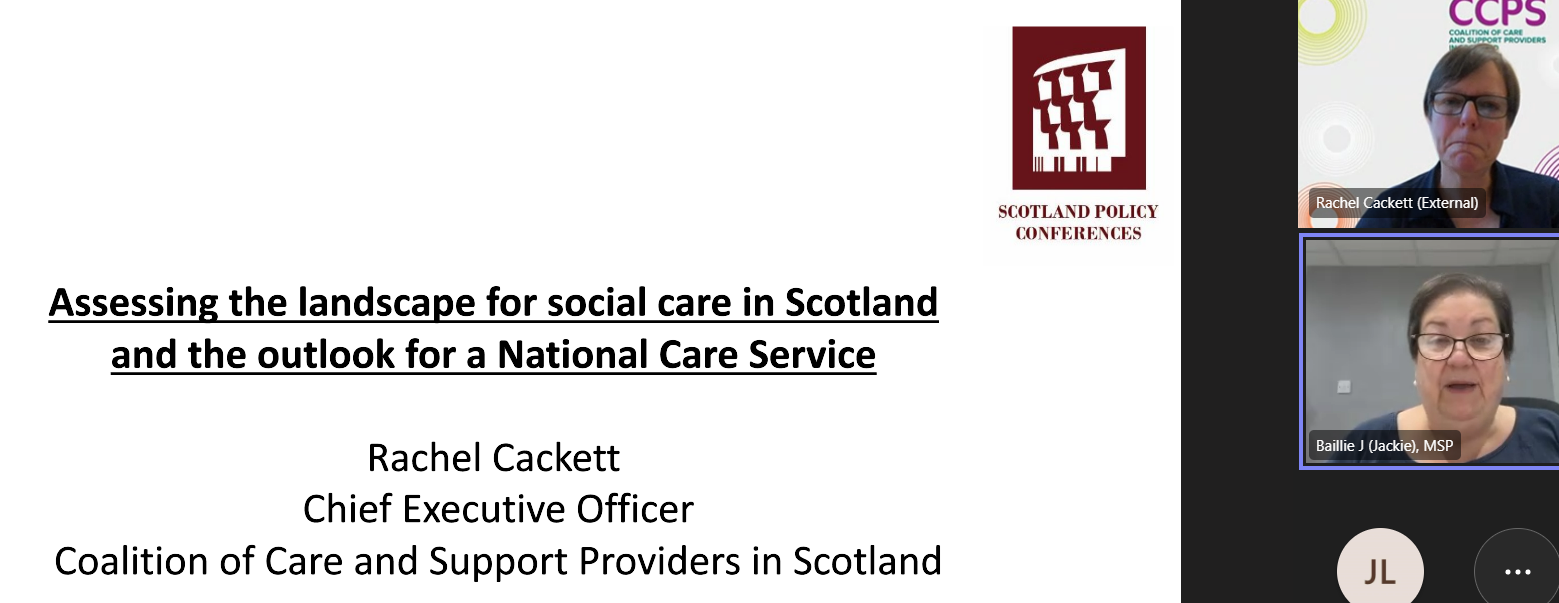
At a Scotland Policy Conference on social care, Rachel Cackett, Chief Executive of the Coalition of Care and Support Providers Scotland (CCPS), said the Bill must still look to create a publicly-funded, sustainable service that is “designed collaboratively, delivered locally and accessible equitable”.
Ms Cackett said this must be rooted in choice and control for those in need of and receiving care and support, carrying forward the intentions of Scotland’s Self-Directed Support (SDS) Act.
Although presenting an opportunity to learn from the challenges SDS faced in implementing shared decision-making, she raised concerns about the state of NCS co-design:
“We were all consulted and yet it has now fundamentally changed because of a deal done to which most of us were not party to.”
Last week, Social Care Minister Maree Todd revealed in a letter to parliament the decision to abandon previous plans to create care boards.
Meanwhile, an updated Financial Memorandum shows these proposed changes could see the NCS could cost millions less to deliver.
While Ms Cackett recognised that the language used by the Minister in writing to parliament has “moved to be more inclusive”, she questioned if the proposed altered Bill supports its original co-design aims.
Workforce worries
Conference attendees heard that listening to and valuing the social care workforce is key to the future of the NCS.
Director of the International Centre for Integrated Care, Professor Anne Hendry, said collaborative, cross-sectoral conversations with the workforce are a vital to delivering the NCS:
“New legislation won't make any difference unless we value and invest in our social care workforce, the statutory and the independent sector alongside our unpaid carers and community-level partners.”
CCPS’s Rachel Cackett echoed this sentiment and questioned how workers' pay and conditions will be improved to ensure the long-term sustainability of the service:
“Where’s the workforce? Fair work is meant to be central to a National Care Service, how do you ensure you’ve got the right set of providers to provide the right set of support and care and enable the choice of control embedded in the SDS Act?
“Who will hold responsibility for ensuring there can be choice and control for people who require care and support? Who is accountable for the sustainability of the overall system?”
A financial black hole
An expected £1bn shortfall in next year’s budget will also prove a challenge for government as it develops the NCS.
The Scottish Budget will be published on Tuesday – but Ms Cackett said the sector is in a very different place than it was even a few years ago and is still “reeling” from the impact of COVID:
“We know the government has a financial black hole. Add to that insufficient support and inflationary pressures and you end up with unstable providers.
“We see that impact social care waiting lists and increase pressure on wider services: not just on the NHS, housing, justice, education – our partners in this endeavour to help people thrive.
“We then start to see reduced choice, reduced control and reduced accessibility which are the cornerstones of what social care should be. We’ve also got this increasing demand coming to us.
“This is what we’re setting a National Care Service in – the context is ever-changing and certainly different from the one in which the Feeley report was produced.”
Accountability and delivery
Ms Cackett added that a major concern with the Bill now is trust. She questioned whether other parts of the Bill could be lost to “another political deal behind the scenes.”
Proposals to reform integration authorities, rather than create care boards, and for accountability to be shared between local authorities, the NHS and the Scottish government paint a different picture of the NCS.
Although this will avoid millions in set up costs, Ms Cackett asked attendees to consider how the Bill will hold when the “partners now assuming shared accountability seem to get on so badly”.
She also questioned how the National Care Board will advise ministers on social care investment to ensure services are delivered:
“Who manages the system risk when we know there is not enough money to deliver accessible, quality services?
“How can a National Board have a much more grown-up discussion about that gap between funds and availability and accessibility?
“Will these new proposals make a genuine difference to people’s lives?”
Read more: Children services need more than structural change; Action for social care workers “can't wait”; Holyrood scrutinises SDS 10 years on
Sign up to our bulletin for key health & social care updates straight to your inbox and you can follow healthandcare.scot on Google News. |