|
Call to action for third sector health creators |
Related newsScotland at the table with UN healthy air commission 50 years ‘just the beginning’ says Chief Scientist Public to have greater say in local health & care Doctors back fines for smoking near hospitals Scots honoured across health and care Respiratory care vision unveiled Scientists to help cut NHS medical device waste Edinburgh IJB faces judicial review over cuts Scotland’s new Chief Nurse appointed Urgent plea to safeguard advocacy amid local cuts New gene study offers arthritis treatment insights New Edinburgh hub set to transform global healthcare 
|
|
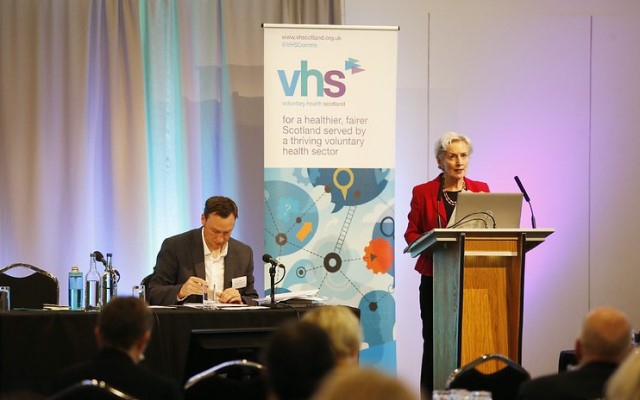
Angiolina Foster
© Voluntary Health Scotland |
||
|
||
|
Third sector organisations working across health and care have been told that a more formal structure to hold them accountable could embolden the sector and show that public money is being directed to health creation activities.
Angiolina Foster, Chair of Public Health Scotland, told attendees at Voluntary Health Scotland’s (VHS) annual conference that the third sector must challenge the perception that the work they do is anything less than crucial.
She said a belief that organisations in the third sector carry out “warm and fuzzy” work that is “nice to do” must be replaced with “authority” and “heft” that a more formal model of accountability could bring.
Such a structure, Ms Foster said, could show that the Scottish government is putting money into health improvement activities and fighting inequalities, rather than secondary care interventions alone.
Speaking at a conference keynote session, Ms Foster said:
“Evidence is critical. Evidence drives policy and policy drives investment.
“I think we have the ingredients and I think we have a groundswell of acknowledgement that we can't keep going as we have been, but also that we need to do something very, very different together.
“One of the things that would really put the wind in the sails of this kind of work would be if we had a formal accountability framework in Scotland, that held us all to account for health creation.
“Wouldn't it be fantastic if we had public discourse and parliamentary discourse clobbering us for not doing enough in the health creation space? I would love that in a weird way, because that would tell me that the targets and the drivers and the investment considerations were in that space [of primary prevention].”
Preventative health targets
Scotland’s Chief Medical Officer earlier this year told attendees at the NHS Scotland Event 2023 that he would like to see a “proportionate approach” to measure preventative health measures with “improvement at its heart”.
Sharing a stage with Angiolina Foster, Professor Sir Gregor Smith agreed on the need to recognise goals and targets for preventative work – but that this would need structural change and investment.
The VHS Annual Conference heard that the government is eager to build a stronger partnership with the third sector to take forward ill-health prevention activities.
Michael Matheson MSP, Cabinet Secretary for NHS Recovery, Health and Social Care, told attendees that he is “all ears” when it comes to suggestions around how the third sector and government can create a more meaningful relationship:
“I want to see the third sector being an important part of the health system.
“If you look at how the healthcare system currently operates, in terms of hierarchy of priorities, it goes from secondary care to primary care, to social care to patients. And actually, it should the complete reverse.
“I don’t think there’s a simple answer on how we can make that happen but it is going to require a partnership, not just with the NHS and local authorities, but with the third sector and private sector.
“We need to get much better at forging those relationships.”
He said he would explore the development of longer-term outcome-focused strategic partnerships with third sector organisations to allow for scaling up of good ideas while supporting better outcomes for patients.
Mr Matheson said that partnerships up to five years could be possible, as he acknowledged the problems that come with short-term funding or partnership arrangements.
Angiolina Foster told the third sector attendees that Public Health Scotland is similarly eager to build a more strategic partnership with the sector around population health and primary prevention:
“Come and talk to me and colleagues about how we can strengthen our partnerships and help make one another more effective in that health creation space.”
Read more: Economic change key to Scotland's health inequalities; Third sector services ‘stretched to the limit’;
Sign up to our bulletin for key health & social care updates straight to your inbox and you can follow healthandcare.scot on Google News. |
