|
Government ‘not on track’ for mental health |
Related newsPharmacy’s road to stigma-free drug dependency care ‘Whole-system shift’ needed on ADHD and autism support Long COVID putting Scots at risk of poverty Dementia campaign success to inform government actions Insight: Scotland’s ‘invisible’ patients and carers New taskforce to drive ADHD and autism improvements Call to fix date for ending care charges “Significant and lasting” change on poverty? Water Safety Scotland calls for caution amid heatwave MSPs’ ‘huge concerns’ over Scotland’s medicines system Insight: Care workers should not be commodities Insight: An unequal integration? 
|
|

Image Credit: © maryviolet
|
||
|
||
|
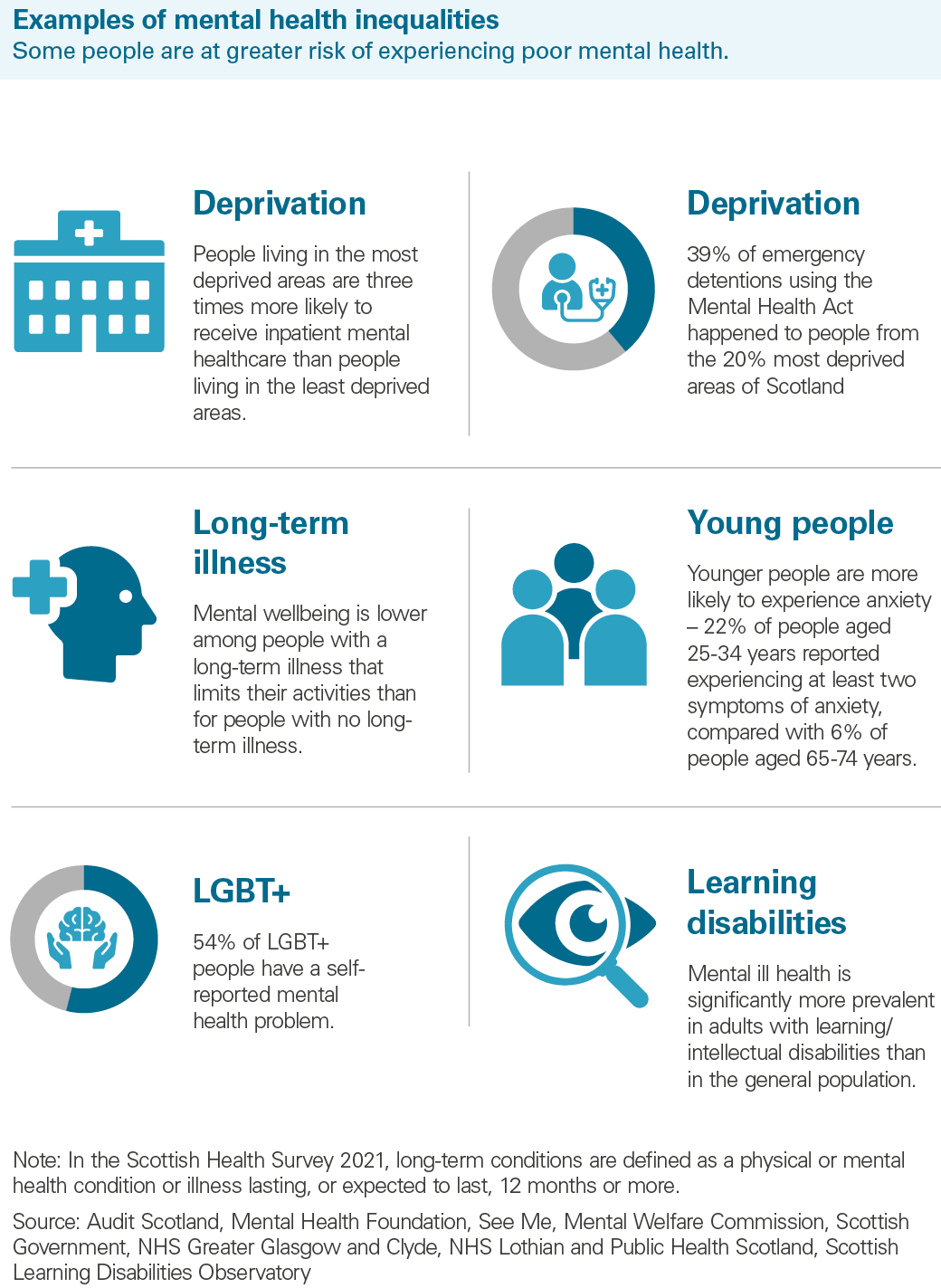
In a new report from Audit Scotland, the difficulties for adults trying to access mental health services in a ‘fragmented’ system and mental health inequalities across Scotland are laid bare as the body urges the government to improve the way it measures progress.
Audit Scotland and the Accounts Commission, which hold national and local governments to account, say the Scottish government must develop shared targets for services and collect more information to assess quality of care.
Its report says the government is currently not on track to meet its ‘essential’ commitments to improve access to services or boost the workforce – which it says continues to struggle with high vacancies and turnover.
The public spending watchdog says an overreliance on waiting times to measure mental health services performance is not enough, and bodies must work harder to understand how investment in services affects the lives of those that use them.
Mental health inequalities
The report has found that the mental health workforce is under pressure and ‘struggling to meet demand’ despite increased funding for services.
Vacancies for mental health nurses have “more than doubled” since 2017 and turnover rate remains at a high of 12%, while consultants in general psychiatry currently have the highest vacancies of all consultant roles in Scotland.
Access to mental health services is particularly difficult, says the report, for ethnic minority groups, people in poverty and those living in rural areas – despite many of these groups also being more likely to experience mental health problems.
Responding to the report, Dr Jane Morris, chair of RCPsych Scotland, said the Scottish government has “failed to provide reasonable consideration” for many adults with severe mental health, adding:
“There is a postcode lottery across Scotland, so it comes as no surprise that ethnic minorities and those living in rural or deprived areas are facing barriers to accessing services.
“What we face is a mental health emergency with demand only set to soar due to the ongoing cost-of-living crisis.”
The report says that while the government recognises the importance of addressing inequalities, the impact of efforts to do this is not always clear – lacking timescales for some of its key actions to tackle inequalities.
The watchdog says mental health services alone cannot address these inequalities, and calls for closer cross-sectoral working from housing to welfare and employment support.
Dr Morris said Scotland also needs a workforce that can meet the projected increase in patients seeking treatment.
Measuring impact
Audit Scotland says mental health outcomes are not being routinely measured across Scotland’s services and the government does not measure the quality of services.
Among its recommendations, Audit Scotland says the Scottish government should track whether services or interventions improve people’s mental health and wellbeing.
To track this, it says the government should deliver on plans for psychological therapies specifications and quality standards in adult mental health services – expected this autumn. Additionally, improving oversight of mental health support in primary care and the third sector will be key.
Stephen Boyle, Auditor General for Scotland, said:
“The Scottish government needs much more information to understand the difference its investment in mental health services is making, from specialist services to community-based support.
“That planning must include moving beyond using waiting times as the sole measure of whether services are improving the lives of those in need. And it needs to include a costed delivery plan for the care that people can expect in their communities.”
The Scottish government has committed to a 25% increase in funding and ensuring that 10% of the frontline NHS budget is for mental health by 2026.
Before accounting for inflation, the government’s Mental Health Directorate budget would need to reach £342m by 2026/27 to reach the target but the 2022/23 and 2023/24 budgets are lower than what is needed.
Despite government plans to further increase funding and give all GP practices community-based mental health and wellbeing services, Audit Scotland says these plans are also not on track.
Chair of RCPsych Scotland, Dr Morris, agrees the government must develop a costed delivery plan to accommodate the primary care mental health services across Scotland by 2026, adding:
“We recently wrote to Humza Yousaf asking him to honour the commitment made more than two years ago by his government, to ensure mental health services received the funding they deserve.
“However, despite promises we’ve not seen this come to fruition.
“These are services that people with serious mental health conditions so desperately need and deserve.”
Ronnie Hinds, Interim Chair of the Accounts Commission, said councils and IJBs play a “vital role” in improving the availability and quality of data for planning services and meeting necessary staffing levels, adding:
“They need urgently to develop shared goals and targets to improve how housing, welfare and other services work together in order to address and prevent the root causes of poor mental health.”
Read more: ‘Ground-breaking' mental health support to go national; Scots mental wellbeing declined since pandemic; Transatlantic mental health partnership strengthened
Sign up to our bulletin for key health & social care updates straight to your inbox and you can follow healthandcare.scot on Google News. |