|
“Significant and lasting” change on poverty? |
Related newsScotland’s chance to lead on disability benefit system Austerity policy harm to newborns laid bare A timeline of Scotland’s National Care Service Two-child limit scrap could improve children’s health Insight: the work of the benefits case manager 40 years of disability with attitude Government ‘not on track’ for mental health Call to fix date for ending care charges Water Safety Scotland calls for caution amid heatwave MSPs’ ‘huge concerns’ over Scotland’s medicines system Insight: Care workers should not be commodities Insight: An unequal integration? 
|
|
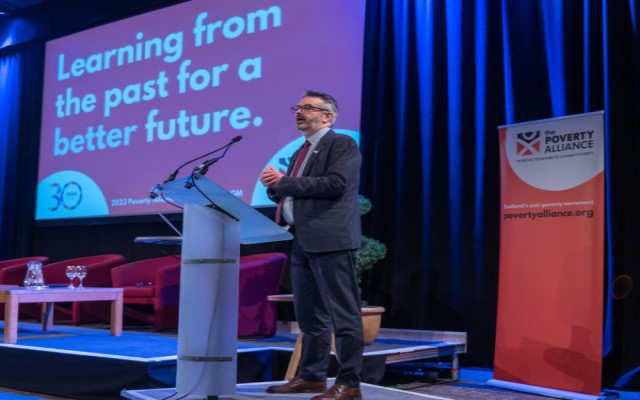
Peter Kelly, Director of the Poverty Alliance introducing the annual conference. © The Poverty Alliance
|
||
|
||
|
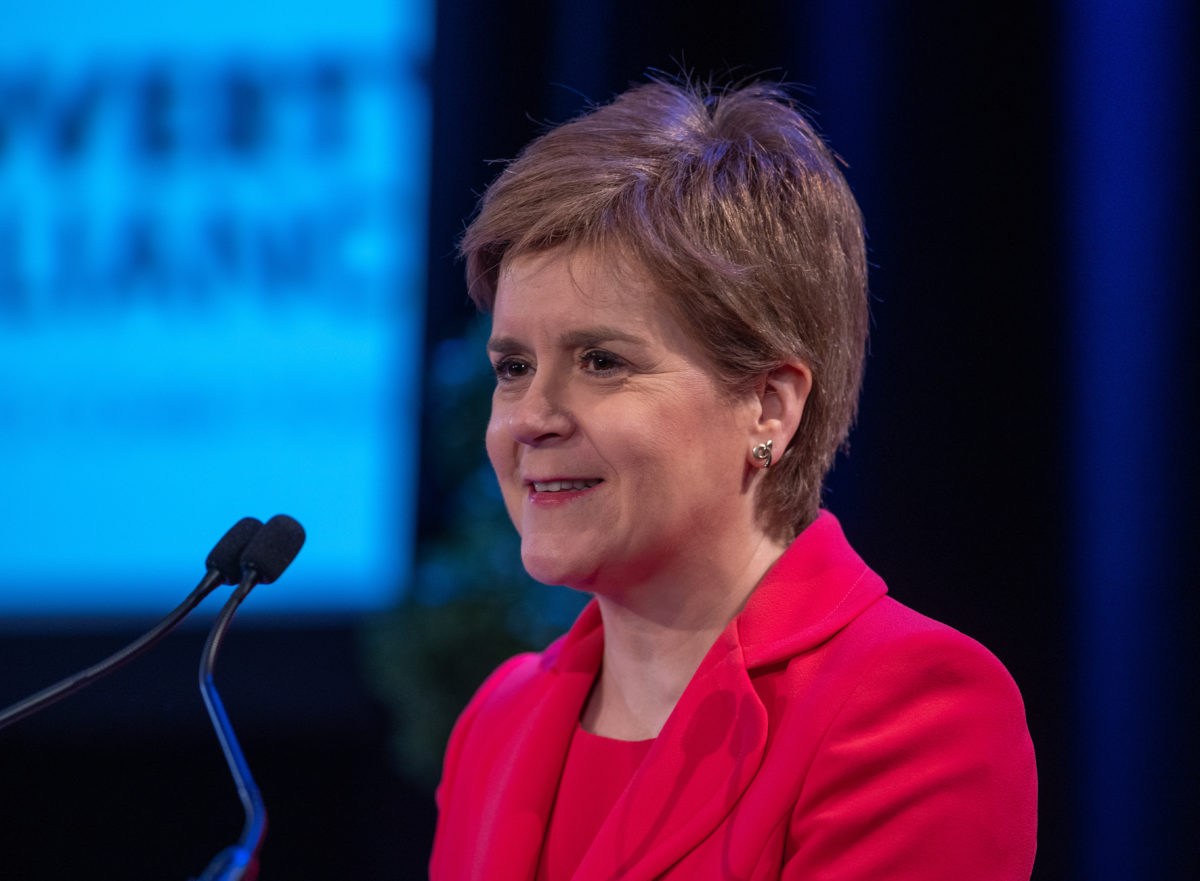
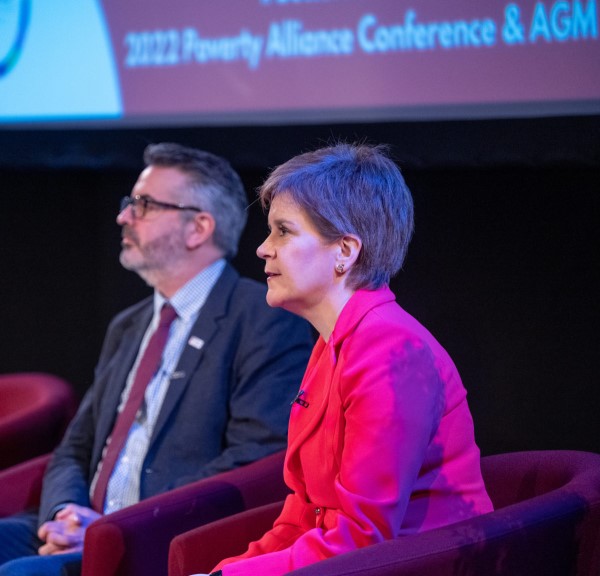
Scotland’s First Minister marked the 30th anniversary of the Poverty Alliance by both praising the charity’s work and expressing her ‘deep frustration’ that the organisation still has to exist.
The theme of the Poverty Alliance’s annual conference in Glasgow this year was ‘Learning from the Past, For a Better Future’, hearing from representatives across academia, charities and third sector workers.
Nicola Sturgeon said:
“For me, and I suspect - I strongly suspect this will be the case for all of you - it's an anniversary that prompts some mixed feelings. Positivity about the fantastic work of this organisation, which I'll come on to talk about; but a deep frustration, that an organisation like this - 30 years on - is still necessary.”
She added that social security and direct payments are “vital tools” in tackling poverty but Scotland’s national mission must be “much more all-embracing” than these, continuing:
“It has to cover all parts of the public sector and all parts of society. So housing policy, for example, is absolutely vital.
“One of the reasons we recently introduced emergency legislation to freeze rents temporarily and introduce a moratorium on evictions is because we know how vital housing is to people's health, wellbeing, and their life chances.”
Beyond what we have learned, the nation’s anti-poverty charity held workshop sessions on living wage, social security in Scotland disability and gender equality, community work tackling poverty and social services to discuss what is still needed.
Discussing the fight against poverty and challenges that remain, Annie McCormack, Chair of the charity Broke not Broken which runs a foodbank and a series of initiatives in Kinross said:
“We started seven years ago and the changes we’ve seen have been – unless the level of poverty in our area has risen alarmingly, or it’s just that we’ve uncovered this hidden, ignored poverty that already actually existed.
“But what we’ve seen as a change, certainly as recently as the last nine months is an awareness that poverty exists and it’s been pushed up the agenda. Whether that’s from more people facing it because it’s affecting ‘middle income’ people now, or the Poverty Alliance work – it’s definitely talked about it more”
Ms McCormack added that the way that people have found themselves in poverty has varied and one of her take-aways from the day’s workshops was not just looking at the causes of poverty, but also putting wealth under scrutiny. She said while people building relationships and working together with those in poverty has been a hugely positive change, one area where progress has not been made in the “inhumane” sanctions that are seen in some benefits.
Social security support
Earlier this year, Poverty Alliance’s Policy and Parliamentary Officer, Ashley McLean sat down with healthandcare.scot to discuss the intersection of health, wellbeing and poverty – highlighting the importance of monetary support for Scots in poverty.
Speaking at this year’s conference on benefits and social security to support people in Scotland, the First Minister recalled an early campaign by the Poverty Alliance calling for cold winter payments which have since been implemented. She said she believes the Poverty Alliance has improved Scotland’s inclusion of lived experience in policymaking:
“That's a point that my government has tried - not always perfectly, I readily concede – but has tried to take to heart and to make sure that we implement in how we go about making policy, and perhaps the best example of that is the establishment of the social security experience panels.
“And these new social security payments come with a new approach that we have sought to introduce - one that doesn't rely, in our social security system, on the cruelty of sanctions, but instead seeks to respect the dignity of people who rely on social security.”
Ms Sturgeon said that in February of 2023, the 13th Social Security Scotland benefit, for annual winter heating payments, will be rolled out – the eighth new benefit to become available for people in Scotland. This will reach 400,000 low-income households, beyond the heating payment already provided to support the families of almost 20,000 severely disabled children.
Yet this October, Inclusion Scotland urged the Scottish government to provide more targeted financial support for disabled people “to avert the tragedy of avoidable deaths” this winter.
When asked if the Scottish Child Payment – against a backdrop of the cost-of-living crisis and households facing debt in Scotland – is “going far enough”, Ms Sturgeon said:
“On the Scottish Child Payment – it is not just game changing, I think it’s life-changing. We are taking a very deliberate approach through all of the benefits in Social Security Scotland, we want to maximise uptake of these benefits.
“We introduced it at £10 a week and in eight months we’ve increased it by 150% to £25 a week – I would love to take it further; I would love to double it from that. This where I have to be really honest with you, the Scottish government within that fixed, eroding budget, we just don’t have means to do that.”
The First Minister explained that within the fixed budget, which is lower by billions than expected due to inflation, if the Scottish government were to increase Child Payment further, it would “have to take money away” from the health budget or education budget.
Polly Jones, Head of Scotland for the Trussell Trust which supports many of the food banks in Scotland, provided her perspective in the final discussion panel of the conference:
“Thinking back to 30 years ago, I’m struggling to see where we have made progress and positive changes. But actually, maybe it isn’t always the victories and where we’ve secured change – surely it’s also about the stuff we haven’t lost.
“We still have an NHS, we are still giving out free school meals and there are some things that we’ve managed to preserve because we’ve taken action to protect them.”
Read more: Social deprivation linked to frailty; Money matters for poverty and health in Scotland; Unpaid carers “spiralling” in cost-of-living crisis; Can Scotland make health fairer?
Sign up to our bulletin for key health & social care updates straight to your inbox and you can follow healthandcare.scot on Google News.
Tags: Child Health; Disability; Finances; Social security. |