|
Insight: We need a plan for cancelled surgery backlog |
Related newsNHS spending millions on private beds in covid deal Chief Medical Officer: ‘Critical connections’ priority NHS left with less than 24hr PPE supply Government reveals new private hospital contract costs Medics voice doubts over NHS catch-up pledge NHS CEO: Vaccination is health records opportunity 
|
|
|
||
|
||
|
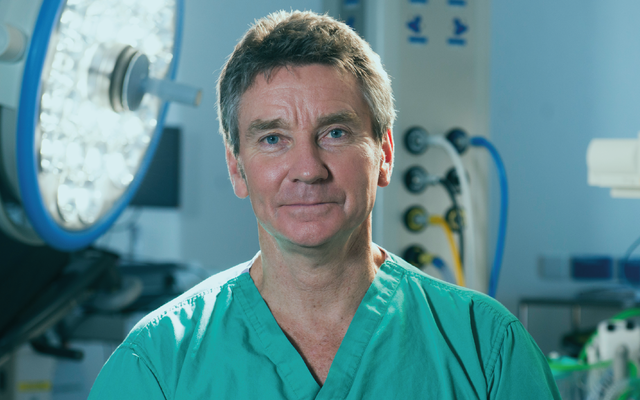
One of the UK’s leading surgeons has said the NHS now needs a plan to deal with the “huge” backlog of cancelled operations that have built up as the health service focuses on coronavirus.
Professor Michael Griffin, president of the Royal College of Surgeons of Edinburgh, says one option would be to convert Glasgow’s Louisa Jordan hospital into a centre that focuses entirely on routine procedures such as knee and hip replacements, hernias and cataracts.
The surgeon, who works in Newcastle, said it is essential that health boards in Scotland also set up ringfenced hubs that focus on the most urgent surgeries, such as cancers.
Professor Griffin stressed that rigorous testing and self-isolation of staff at these centres would be needed to protect patients from contracting covid-19.
It comes as English health secretary Matt Hancock announced last night that NHS services in England would begin restarting from today, beginning with the most urgent cases.
Last week one of Scotland’s top public health experts Professor Linda Bauld told healthandcare.scot that it’s now time to look at getting services up and running again in Scotland.
A survey from the Royal College last week found that almost nine in ten cancer surgeons had reduced the number of operations they were doing.
Professor Griffin said it is a question of assessing risk:
“What is the effect of delaying that cancer surgery? Well, it differs from one cancer to another but the fact is, if it’s delayed it’s not good.
“If it’s delayed a week or two or three it’s highly unlikely to make a difference to the overall prognosis from cancer.
“If it’s delayed a matter of months that is different and that will start to reflect on outcomes.”
Multidisciplinary teams across the UK are having to make difficult decisions about the best route forward for cancer patients, weighing up the chance that they may catch covid-19 if they go into hospital.
“They have to consider the risk-benefit of putting somebody through this major surgery at this difficult time, with Covid rich in the environment, or looking at alternative forms of treatment like chemotherapy and radiotherapy, which may not have the same chance of cure,” Professor Griffin said.
He added that “we cannot underestimate” the toll on mental health for cancer patients who have no idea when they will get their potentially life-saving treatment.
The surgeon, who leads the 26,000 worldwide-membership College, said the sheer volume of cancelled operations building up meant that catching up would “of course” be a problem and called for a plan to address the growing waiting list.
“That recovery phase is something we’ve really got to think about,” he said.
“Because it’s not just cancer, there’s a lot of urgent operations for non-cancer problems that need to be done.
“There are opportunities, the Louisa Jordan centre in Glasgow, that has been set up as a hospital, but it’s not seeing a huge number of patients at the moment.
“That could perhaps be converted into a potential hub for surgery – not necessarily cancer surgery – but for routine surgery, elective surgery, for hernias, for hip replacements, for cataracts, whatever, such that we can get through a large number of cases in a relatively short period of time.
"Otherwise there’s going to be a huge waiting list of routine elective surgery, which has been now cancelled for two months.”
Sign up to our bulletin sent twice a week so you don’t miss out on the latest health and social care news. |
