|
Medics voice doubts over NHS catch-up pledge |
Related newsRespiratory care vision unveiled Meaningful change promised on medical workforce Staff express concern over latest NHS reform plans New directions to NHS on staffing and deficits Scotland at the table with UN healthy air commission NHS is working to address “unacceptable” abuse 
|
|
|
||
|
||
|
Leading doctors have questioned the feasibility of a promise made by Nicola Sturgeon to boost NHS Scotland activity by 10% above pre-pandemic levels within a year.
It is one part of a series of commitments by the SNP to deal with the backlog of diagnostic tests, elective procedures and other routine NHS activity that has built up during the pandemic.
Underscoring the scale of the challenge, England’s Nuffield trust said it believes it will take years to undo the damage that covid-19 had caused to health services – and patient outcomes would suffer as a result.
Doctors’ leaders have told healthandcare.scot it is difficult to see how the pledge can be achieved when staff are already exhausted from dealing with covid-19 for more than a year.
“I have real concerns about unrealistic public expectations on what the NHS in Scotland can deliver,” Dr Lewis Morrison of the British Medical Association said.
“We do not have the capacity or workforce to deliver on this target, especially in the timescales being talked about.”
Professor Angela Thomas, Acting President of the Royal College of Physicians of Edinburgh, said being stuck on waiting lists was “distressing” for patients but added: “We are keen to stress that while catching up is important, the wellbeing of our hard-working healthcare staff must not be forgotten.”
The patient backlog
The scale of the ‘catch-up’ challenge is stark, with more than 100,000 patients on a waiting list for one of eight diagnostic tests when figures were last released. This group includes endoscopies and radiology tests that are used to test for suspected cancer.
Cancer Research UK has previously warned that diagnosis delays will mean “more cancers will be diagnosed at a late stage when they’re harder to treat”.
Meanwhile the number of planned operations collapsed at the start of the pandemic, from 27,000 in February 2020 to just 3,400 in April, while the number of patients seen within the 18-week referral to treatment target dropped to the lowest level since the measure was introduced in 2011.
While the situation has improved dramatically since the first wave, monthly operations are still at less than two-thirds of pre-pandemic levels due to necessary social distancing and enhanced cleaning schedules in between procedures.
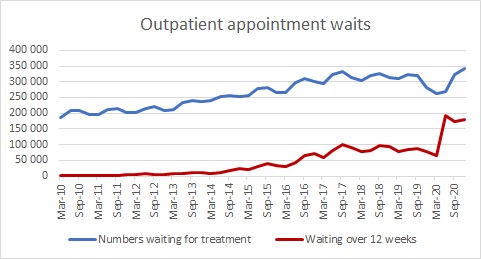
Elsewhere numbers waiting for outpatient appointments reached their highest-ever level in September 2020, with the proportion of those facing waits of 12 weeks or more surging.
SNP promises
Nicola Sturgeon promised an ‘NHS recovery plan’ in the first 100 days of an SNP government that would detail how the party in government would ‘support a 10% increase in inpatient, day patient and outpatient activity to address delays caused by the pandemic’.
More clues are provided in the party’s manifesto, which pledges “accelerated recruitment” of staff for new elective and diagnostic centres – with a promise to find “at least” 1,500 more frontline staff for these facilities by 2025.
Another £100m will go to two additional elective care centres in Cumbernauld and Ayrshire.
The Scottish government is already funding a national programme of elective care centres, though timescales have been pushed further back because of the pandemic.
Staff 'must not be forgotten'
Professor Angela Thomas, Acting President of the Royal College of Physicians of Edinburgh, says it’s vital “service redesign that’s already underway continues”, pointing to the increased focus on multidisciplinary team working that has emerged during the pandemic.
Prof Thomas added that a lack of bed capacity had emerged as a “serious issue” and needed to be “addressed urgently”.
But she says staff wellbeing “must not be forgotten”.
“In many instances, we have heard anecdotal reports of staff working unpaid overtime, and having their annual leave cancelled during the pandemic response.
“Like the rest of society, healthcare staff need a break – and this should be made a priority as part of the health service recovery. We are clear that well-rested healthcare staff are required to maintain quality patient outcomes.”
BMA Scotland’s Dr Lewis Morrison said a clear plan was needed to address “extensive” staff shortages in the Scottish NHS.
“To put simply, we need more staff. And the staff we do have need an opportunity to recover from what has been a very challenging year from them – we cannot ignore the health and wellbeing of NHS staff who are already under severe pressure due to covid-19 and suffering the physical and mental impact that this has had,” he told healthandcare.scot.
Dr Morrison, who works as a consultant geriatrician in East Lothian, is blunt about the feasibility of the SNP’s election pledge:
“We do not have the capacity or workforce to deliver on this target, especially in the timescales being talked about.
“I fully support the need to urgently address the healthcare needs of patients whose assessment or treatment may have been paused or delayed as a result of the pandemic, and doctors will of course continue to do their very best to do this. However, it needs to be supported by an increase in capacity and workforce.”
What was not mentioned in the manifesto, but could still be a straightforward way to boost NHS capacity above normal levels, is further use of the independent sector.
Private hospitals partnered with NHS Scotland during the first wave of the pandemic so that essential cancer treatment could go ahead.
The agreement, which cost up to £20m by the end of 2020, was re-started in January when cases rose again.
Read more: Holyrood research shows no integration funding shift; Manifesto to mandate: the SNP on health & social care; Election social care funding plans ‘fall short’
Sign up to our bulletin for key health & social care updates straight to your inbox. |