|
Social care careers drive to be launched |
Related news‘Rethink’ dementia support, says government Dementia care services need urgent reform Care home visits promote wellbeing Concerns at rise in care home dementia drugs Plea for dedicated government dementia unit IJB costs driving councils’ unsustainable funding gap 
|
|
|
||
|
||
|
A national campaign to promote working in adult social care as a “meaningful, valued and rewarding” career choice will be launched next year.
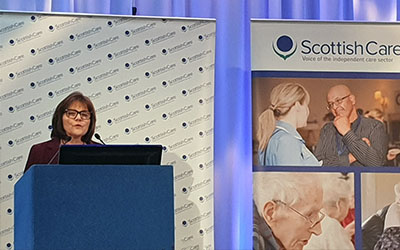
Health secretary Jeane Freeman outlined plans for the recruitment drive as she addressed Scottish Care’s national conference in Glasgow today.
In her speech she praised the work of care staff saying: “I don’t underestimate for one minute the critical role that every person who works in our care homes carries out, every hour of every day right across this country.”
However, Ms Freeman said recruitment challenges had been “undoubtedly” exacerbated by the uncertainty around Brexit, adding “we know we are losing vital colleagues and we are not seeing new ones come to replace them.”
“That matters and in my opinion diminishes the richness of what we are able to do and offer. At the same time demand for social care is rising and the complexity of that care is increasing.
“Much work has gone into the development of a national adult social care recruitment campaign, due to launch early next year.
“Scottish Care has been involved in the development of this work and the campaign is intended to promote social care as a meaningful, valued and rewarding career choice.”
The campaign will include a new care careers website produced by the Scottish Social Services Council, with case studies to inspire people into the profession and build their qualifications.
Ms Freeman said professional frameworks for practice in social care and for social workers are also being developed to support learning and development.
She added: “Ensuring the workforce is properly trained, supported and regulated is central to effective, safe and high-quality care.
“It is also central to showing how much we value the work that goes on in the care sector.”
The health secretary also spoke of the challenges around the increasing demands on social care and the need to provide “more personalised care”.
She pointed to the example of a programme developed in Sweden to focus on the needs of frail elderly individuals – by always asking the question of what a virtual person known as ‘Esther’ would want or need.
“It changes the conversation away from whose job is it, whose budget is it, whose processes are the right ones – to what do we need to do for Esther,” she said.
“It is a different way of thinking about what we are doing – it doesn’t mean that budgets and processes and jobs don’t matter, but it puts them where they belong, to support what we need to do for Esther.
“So, you will hear more of this from me in the months to come.”
Ms Freeman also spoke of the “balancing act” of health and social care integration, by trying to build up what is available in the community while decreasing reliance in the hospital sector.
She said there had to be more thinking to enable a “significant shift” to take place across Scotland.
“I see huge examples of progress, but my difficulties with those examples of progress is they are not spread.
“I keep on saying – could we please stop talking about sharing best practice and start implementing best practice.
“Stop caring about who invented it first – lift it, steal it, apply it and do it – because it works.
“I’m not bothered I didn’t think about Esther, I don’t care that it was Sweden’s bright idea – I am going to steal it as I think it is a cracking idea. And that is what learning is about.”
|
