|
Insight: Tackling loneliness in Scotland |
Related newsHealth and charity leaders join forces for NHS reform Scotland commits to change the dementia story TV advert promotes human right to benefits Over 20,000 Scots benefitting from befriending Insight: Seeking to get the picture Politicians told: “Carers cannot wait” 
|
|
|
||
|
||
|
A chance work placement encounter with an eight-year-old girl with learning disabilities changed one women’s career and life plans – and eventually led to her becoming the child's legal guardian.
Then in high school, Sarah Van Putten did work experience at an organisation looking after children with complex and profound learning disabilities.
During her two-week placement, she tells healthandcare.scot, she built up a relationship with one girl living there.
“I wanted to be able to see her again so I became her befriender and the relationship with her changed my career path. I originally wanted to be a teacher but I changed my mind and decided to go and do learning disability nursing.
“I still see her today – I continued initially as her befriender for a number of years and as she moved into adult services, I became her citizen advocate and a few years ago I became her legal guardian.
“I think she shaped a lot of the ways I have worked and my career, enabling me to experience life from the point of view of being a service user and being a carer.”
Some years later Ms Van Putten is still a befriender but also leading a charge to tackle growing levels of loneliness and social isolation.
As many as 282,000 older Scots reported feeling lonely some or most of the time as part of this year’s Scottish household survey.
Campaigners have recently called on the Scottish Government to act on a ‘public health crisis’ of loneliness.
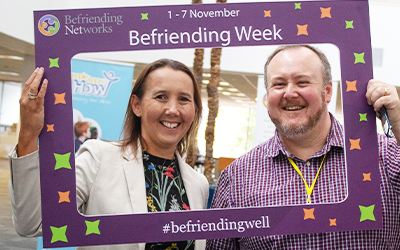
As chief executive of the Befriending Networks – the organisation behind the annual befriending week celebrations – and someone who has been a befriender since her teenage years, Ms Van Putten knows the importance of creating and maintaining social connections.
She became a learning disability nurse in the early 1990s and from there moved to work with people with learning disabilities before moving into charities working with children, families and young people.
Charity boss Van Putten says her sector has not been good in the past at shouting about the ‘mutuality of benefit’ that comes from befriending and being befriended but she is determined to change this.
“The heart of every befriending experience is about relationships”, she explains.
“It’s about the relationship between the volunteer and the people they befriend. That can be one-to-one where you go and see someone in their own home or go out with them.
“We also have telephone befriending, particularly for people who may not be able to go out from home, where a regular telephone call is arranged with a volunteer so they get to know each other, catch up and share what’s happening in their lives.
“Some of our projects today now offer more group befriending. Recruiting volunteers can be quite difficult and to manage volunteers well is resource intensive and often for befriending projects the number of people waiting for a befriender is much higher than the number of volunteers we have coming through the door.
“So group befriending has often initially started as a way of trying to manage waiting lists because you can bring some people together in a group and support them with less…but actually it’s taken off because the benefits people get from that group of people they meet and volunteers to get to know other people as well.”
It is often suggested that we now live, despite the advent of social media, more lonely and separate lives.
But building social connections through befriending is not necessarily an an attempt to rebuild something society has lost.
“Sometimes when you look back on something you don’t see what’s there, you see what you want to see,” Ms Van Putten continues.
“We like to think society was more connected in the past and that we are less connected now.
“I think the answer is we don’t know because we didn’t talk about loneliness in the past, and we didn’t ask people whether or not they were lonely, partly because there was a lot of stigma attached to that.
“Certainly, what we do know is that loneliness affects lots of people across the life course – it does not just affect older people. Recent statistics related to loneliness among young people are scarily high.
“Despite the fact we have social media and new technology there is evidence to suggest these don’t necessarily improve young people’s mental health and well-being and young people still talk about face-to-face contact and how that improves their mental health and well-being more than technology does.
Ms Van Putten goes to on to say technology is no silver bullet:
“There are definite positive benefits that technology can offer, but we have to be very, very careful that we don’t go down a route that is purely technology-driven.
“Whilst technology can help connect people it’s the face-to-face talking to people that still matters more and has a better impact than just technology alone.
“So if technology can help people connect and see each other face-to-face to meet up and to find places and things to do together that’s great, but technology cannot and will not replace direct human contact.”
|
