|
Dundee looks to lead the way on thrombectomy |
Related newsDoctors: ‘Shocking’ A&E figures require action Greener NHS research funding boost AI for lung cancer care to help tackle “hidden killer” Less than full-time – behind the NHS trend Drug harms on the rise in Scotland NHS saves £82m a year through outdoor spaces Delayed ‘game changing’ cancer scan service launches Insight: Pharmacists in palliative care Interim chair to stay on at health board World-first for Tayside in ‘eliminating’ hepatitis C Community covid response team stands down Virtual appointments here to stay 
|
|
|
||
|
||
|
Two leading professors have visited Dundee’s largest hospital to share insights around a new type of stroke treatment.
Stroke is the third most common cause of death in Scotland and the most common cause of severe physical disability amongst adults.
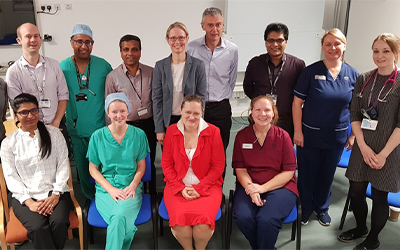
NHS Tayside and the University of Dundee hosted stroke thrombectomy interventional neuroradiologist Professor Iris Grunwald and neurologist Professor Silke Walter this week to meet staff and review the training and research potential of Ninewells medical school to become a recognised leading centre of excellence in thrombectomy.
A service proposal and business plan are currently being developed to establish Ninewells Hospital as a regional centre for the delivery of mechanical thrombectomy in the north of Scotland.
The timescales for this new development form part of an overarching business plan for the establishment of thrombectomy services across Scotland, to be considered by NHS Scotland within the next few months.
It is estimated that around 15,000 people in Scotland have a stroke each year, with hospital care for these patients accounting for 7% of all NHS beds and 5% of the entire NHS budget.
Thrombectomy is a procedure in which blood clots are removed mechanically rather than broken down by medicines but has not been available in Scotland before.
In July the Royal College of Physicians of Edinburgh called for the treatment to be made available after the latest Scottish stroke care improvement programme report showed health boards were routinely falling short of stroke care standards linked to reduced mortality and increased likelihood of speedy discharge home after a stroke.
As part of the proposals, Professor Grunwald has been training key staff in NHS Tayside using advanced simulation techniques, supported by Professor Walter.
Chair of clinical imaging and intervention Professor Graeme Houston said “It has been a great pleasure to host two leading professors in the field of stroke thrombectomy in NHS Tayside and University of Dundee.
The honorary consultant interventional radiologist said: “Professor Grunwald is an inspirational interventional neuroradiologist who has been working hard to train us in the skills necessary to safely deliver stroke thrombectomy, while Professor Walter has offered key insights into the importance of rapid treatment and assessment for stroke patients.
“Using advanced mechanical simulation, the training of interventional radiologists in Dundee is underway to undertake this key treatment for stroke patients.” |
